Soundtracks:  A B C D E F G H I J K L M N O P Q R S T U V W X Y Z #


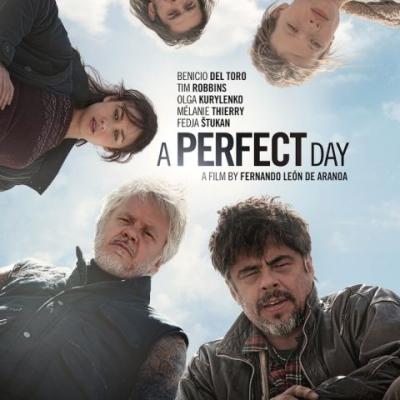
Perfect Day Album Cover

"Perfect Day" Soundtrack Lyrics

Movie • 2015

Track Listing


“A Perfect Day — Original Motion Picture Soundtrack (2015)” – Album Guide to Tracks and Key Scenes

A Perfect Day official trailer frame — aid workers in a muddy Balkan landscape
Fieldwork, black comedy, and needle-drops that cut through the dust — 2015

Overview

How do you score a joke told on a battlefield — so the joke lands, and the battlefield still hurts? A Perfect Day threads that paradox with dry, human-scaled score cues and sharp, sometimes biting needle-drops. Aid workers (Benicio del Toro, Tim Robbins, Olga Kurylenko, Mélanie Thierry) road-trip through the Balkans trying to solve a simple problem — and running into the war’s aftershocks at every turn. The music keeps their gallows humor buoyant without sanding off the damage.

The palette splits: an understated original score that moves like a steady pulse, then bold songs that slam the frame open — punk for frustration, classic chanson for bitter irony, a 90s-goth cover as a gut-punch. When the team hauls ropes, negotiates checkpoints, or just sits with locals, the soundtrack toggles between empathy and edge.

Phases map cleanly to the story’s rhythm — arrival (spare, observational cues) → adaptation (road-music textures, local songs on radios) → rebellion (loud, cathartic drops) → collapse and acceptance (a final, rain-washed elegy). According to the film’s credits and coverage, Spanish composer Arnau Bataller supplies the score while a curated set of licensed tracks paints the war’s cultural crosswinds.

How It Was Made

Composer & tone. Director Fernando León de Aranoa leans on Bataller for a minimal, humane score — acoustic forward, no melodrama. Quiet piano/strings cues bridge field scenes and the film’s black-comedy beats (as listed in the film’s music credits).

Needle-drop strategy. Punk and alt-rock cues voice the NGO crew’s frayed patience; classic songs (and a famous protest standard) counterpoint images of bureaucracy and aftermath. The placements favor source-like credibility — radios, venues, cars — so when a big track takes over, you feel the choice. (Per reviews and public song credits.)

Trailer frame — convoy crawling along a mountain road as a cue fades in
Small, lived-in score; loud, purposeful songs — the film needs both to balance empathy and edge.

Tracks & Scenes

“Na Drini ćuprija” — Kemal Malovčić
Where it plays: A truck blares folk-pop while the team tries to extract a corpse from a village well — locals working, music floating in from the cab.
Why it matters: Life continues, loudly, even in triage; the scene locates the story in the region, not above it. (as cataloged by fan scene guides)

“Sweet Dreams (Are Made of This)” — Marilyn Manson
Where it plays: A shocking discovery in a garage (Mambrú’s detour to a family home) turns the film’s mood to ice as the cover grinds in.
Why it matters: The needle-drop lands like a moral slap — style weaponized as grief. (critics called out this cue explicitly)

“Pinhead” — Ramones
Where it plays: Over a frustrated push down bad roads and worse red tape; the cut breaks tension with bratty momentum.
Why it matters: Punk as pressure-valve — a chant for when authority won’t listen.

“Venus in Furs” — The Velvet Underground
Where it plays: A night passage where headlights rake empty rooms and the team recalibrates plans.
Why it matters: A droning, destabilizing mood that underlines how surreal the work can feel.

“There Is No Time” — Lou Reed
Where it plays: Late-day urgency as the water-safety deadline looms; a hard-nosed voiceover ethos in song form.
Why it matters: On-the-nose title, right spirit — doing the job means moving now.

“Where Have All the Flowers Gone” — Marlene Dietrich
Where it plays: Final rain-soaked beat as faces turn up and the day exhales; the anti-war standard plays like a benediction.
Why it matters: History’s refrain answering a present-tense mess; elegy without sentimentality.

Additional heard tracks (select): X — “Your Phone’s Off the Hook, But You’re Not”; Santana — “Evil Ways”; Robin Loxley & Jay Hawke — “Ain’t No Way.”

Trailer montage — rope over a pulley, a well mouth, quick cuts timed to percussive hits
Diegetic radios for texture, bold drops for turning points — the placements carry narrative weight.

Notes & Trivia

  • Composer credit is Arnau Bataller; the film is his English-language collaboration with León de Aranoa.
  • No wide commercial score album — selected cues were shared by the composer via stream/upload; the songs live on their original releases.
  • The music choices deliberately mix local pop with U.S./UK catalog cuts to mirror the NGO team’s cultural jumble.
  • Lou Reed appears twice on the official credits (“There Is No Time”; the Velvet Underground’s “Venus in Furs”).
  • Dietrich’s “Where Have All the Flowers Gone” (German/English repertoire staple) closes the film with an anti-war echo.

Music–Story Links

When a village truck blares “Na Drini ćuprija” during the well sequence, the film insists on normalcy inside crisis — sound as local weather. Ramones crash in whenever bureaucracy chokes momentum, a comic shove that also reads as protest. And the Manson cover freezes a discovery so we can’t look away; later, Dietrich’s anti-war lament widens the lens from one “perfect” day to the long, imperfect aftermath.

Reception & Quotes

Reviewers split on tone but repeatedly noted how the soundtrack frames the film’s dark humor and political sting; one outlet singled out the “Sweet Dreams” cue as a deliberate jolt. The overall music design — small score, surgically chosen songs — helps the film walk its tightrope.

“Rock-star aid workers… a tonal mishmash that still lands humane truths.” The Guardian
“Minor-key odyssey with sharp needle-drops; a mid-film cue hits like a brick.” Variety / The Playlist
Trailer end beat — rain on windscreen, headlights, a cue settling into quiet
The rain-soaked coda lets a protest classic close the book — softly.

Interesting Facts

  • Score access: Bataller posted selections from the score online after release; no retail OST assembled.
  • Two Reeds: Lou Reed appears solo (“There Is No Time”) and via Velvet Underground (“Venus in Furs”).
  • Local color: Balkan folk-pop on in-story vehicles/rooms keeps scenes grounded in place.
  • Punk lever: “Pinhead” works as an energy reset after run-ins with officials.
  • End-song irony: Dietrich’s “Flowers” counters the title with history’s dirge — pointed, not sentimental.

Technical Info

  • Title: A Perfect Day — Original Motion Picture Soundtrack (film music & selected songs)
  • Year / Type: 2015 / Movie
  • Composer: Arnau Bataller
  • Music supervision: Production credits list licensed tracks by Ramones, Lou Reed/Velvet Underground, Marlene Dietrich, X, Santana, Robin Loxley & Jay Hawke, and others.
  • Album status: No official commercial score album; composer-hosted streams exist; songs on original artist releases.
  • Key placements (select): “Na Drini ćuprija” (truck radio at the well); “Sweet Dreams (Are Made of This)” (garage discovery); “Pinhead” (road/mission push); “Venus in Furs” (night passage); “There Is No Time” (late-film urgency); “Where Have All the Flowers Gone” (final rain scene).
  • Release context: Directors’ Fortnight (Cannes 2015); U.S. release via IFC Films in January 2016.

Questions & Answers

Who composed the score?
Spanish composer Arnau Bataller, whose understated cues bridge the film’s black-comedy tone and its field-report realism.
Is there an official soundtrack album?
No full commercial OST — select score tracks were posted by the composer; the licensed songs are available on their original releases.
Which song plays over the final rain scene?
Marlene Dietrich’s “Where Have All the Flowers Gone,” a pointed anti-war standard.
What’s the controversial mid-film cue?
Marilyn Manson’s “Sweet Dreams (Are Made of This),” used over a disturbing discovery to deliberately jar the audience.
Does the film use local music?
Yes — for example, “Na Drini ćuprija” is heard diegetically from a truck during the well sequence.

Canonical Entities & Relations

SubjectRelationObject
Fernando León de AranoadirectedA Perfect Day (2015)
Arnau Batallercomposed score forA Perfect Day (2015)
IFC Filmsdistributed (US)A Perfect Day (2015)
Ramonesperformed“Pinhead”
Marilyn Mansonperformed“Sweet Dreams (Are Made of This)”
The Velvet Undergroundperformed“Venus in Furs”
Lou Reedperformed“There Is No Time”
Marlene Dietrichperformed“Where Have All the Flowers Gone”
Xperformed“Your Phone’s Off the Hook, But You’re Not”
Santanaperformed“Evil Ways”

Sources: Variety Cannes review; Wikipedia (film & credits); composer’s site/streams; IFC Films trailer & materials; soundtrack credit pages and scene-by-scene fan guides; The Playlist review noting the “Sweet Dreams” scene.

The main story line of movie tells about several employees of international organization, which task is to help at provision of the local population with clean water, who try to overcome various obstacles that local Balkan population and military create for them. Self-sacrificing workers are depicted by such actors as Olga Kurylenko (Ukrainian-origin French actress who started her prominent career in 2008 in Quantum of Solace, one of James Bond's series), Benicio del Toro and Tim Robbins. Latter’s major part was in The Shawshank Redemption, Frank Darabont's work based on Stephen King's novel, very popular in the world and which was nominated for 7 Oscars, but barely recouped at the box office. The musical accompaniment chosen very active – entirely rock (The Ramones or Velvet Underground, as examples), which should literally delight fans of this music direction. Where Have All the Flowers Gone – one of rare songs on English by Marlene Dietrich, that has the same charm as the singer of German origin had herself, who was a big bright star of her time. East Infection brought a oomph of folklore performance, giving interesting gypsy folk rock, which diluted the collection with its enthusiasm and the Western Carpathian allure. Halali Mi Majko is solely knocked out of the general picture, representing Arabic folk that most likely may be attributed to the global genre of pop. This film is a debut of English-language work of the director Fernando León de Aranoa, with limited release in the world – it was premiered in Spain in the late summer of 2015. Reviews for this movie on Rotten Tomatoes indicate that the film is overextended and filled with clichés. But the acting is the solely element that pulls this motion picture out of a dangerous precipice of failure.

November, 18th 2025

Movie profile on IMDb, Rotten Tomatoes
A-Z Lyrics Universe

Lyrics / song texts are property and copyright of their owners and provided for educational purposes only.