Soundtracks:  A B C D E F G H I J K L M N O P Q R S T U V W X Y Z #


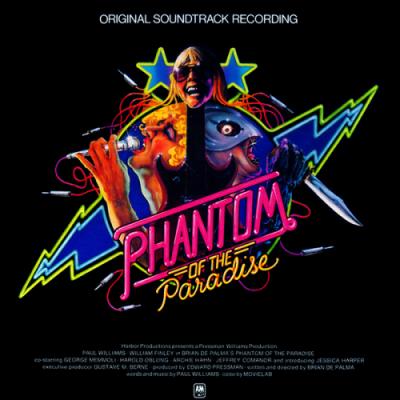
Phantom Of The Paradise Album Cover

"Phantom Of The Paradise" Soundtrack Lyrics

Movie • 1974

Track Listing


“Phantom of the Paradise (Original Soundtrack Recording)” – Album Guide to Tracks and Key Scenes

Phantom of the Paradise 1974 trailer still: neon marquee of The Paradise and masked Phantom preparing a sabotage
Phantom of the Paradise — glam-goth rock musical, 1974

Overview

What happens when a Faust cantata gets fed through a record press — and a contract written in blood? Phantom of the Paradise answers with glam swagger, doo-wop satire, and torch-song ache, all wired to explode inside a cursed concert hall.

Brian De Palma’s rock-opera fable makes music the weapon and the wound. Songwriter Winslow Leach is robbed by hit-maker Swan; out of betrayal comes the Phantom and a score that keeps changing masks — 50s teen-tragedy pastiche, surf send-up, glam thunder, piano hymn, cabaret kiss-off. The soundtrack is both joke and judgement: it parodies pop styles while caring deeply about the one true melody at its core.

What makes it distinct is Paul Williams’s chameleon pen — one voice writing all the voices — plus a story that lets songs move the plot like booby-trapped props. Phases: nostalgia pop (image-making); surf/garage (branding machine); glam & hard rock (spectacle/violence); balladry (Phoenix’s hope); cabaret finale (moral punchline). According to Wikipedia’s credits and the A&M album notes, Williams composed every number, with additional scoring credited to George Tipton.

How It Was Made

Composer/lyricist & performer: Paul Williams wrote words and music for the film; he also plays Swan and sings the Phantom’s numbers on the album. The fictional house bands — The Juicy Fruits → The Beach Bums → The Undead — are portrayed by Archie Hahn, Jeffrey Comanor and Peter (Harold) Elbling cycling styles as Swan’s “product.” The official LP (A&M Records) runs 10 tracks; the end-credits kicker is “The Hell of It.”

Editorial/music design: De Palma stages each number to comment on the industry’s shape-shifts: the same tune re-costumed across genres, Phoenix’s pure line presented without irony, and Beef’s glam pageant set up to be literally weaponized. (As per IMDb song credits and Discogs track notes.)

Behind-the-scenes mood via trailer frames: Swan’s Death Records office, the TONTO-scale synth wall, and stagehands rigging lightning
How it was made — one songwriter, many masks; songs staged as weapons

Tracks & Scenes

“Goodbye, Eddie, Goodbye” — The Juicy Fruits
Where it plays: The film’s opener — a 50s teen-tragedy stage act at The Paradise. Doo-wop harmonies, tragic lyrics, screaming fans.
Why it matters: Establishes Swan’s nostalgia machine and the film’s satire target from beat one. (Album & credits confirm title and performers.)

“Faust” — Winslow (piano)
Where it plays: At Death Records, Winslow auditions his cantata; Phoenix later echoes a reprise in a private run-through. Sparse piano, aching melody.
Why it matters: The “real” heart of the film — a melody so good the system must steal it.

“Upholstery” — The Beach Bums
Where it plays: A surf-rock rebrand of Winslow’s theme onstage. Foam waves, matching stripes, toothy grins — the whole sham.
Why it matters: Shows the assembly-line: same song, different jacket; profit over authorship.

“Special to Me (Phoenix Audition Song)” — Phoenix (Jessica Harper)
Where it plays: In Swan’s audition room and later onstage, Phoenix wins the room with light pop phrasing and immaculate pitch.
Why it matters: The film pauses to honor an honest voice — De Palma keeps the camera still; the audience hushes.

“The Phantom’s Theme (Beauty and the Beast)” — The Phantom
Where it plays: Post-accident, in his lair, Winslow’s melody returns with synthesized weight; a love song from behind a mask.
Why it matters: Turns tragedy inward — same tune, now a vow.

“Somebody Super Like You (Beef Construction Song)” — The Undead
Where it plays: A glam build-a-star montage as stagehands literally assemble Beef’s persona — studs, boots, sparkle.
Why it matters: Lays bare Swan’s factory: identity is costume, nailed together to order.

“Life at Last” — Beef
Where it plays: Opening night of Faust: Beef struts through a tomb set before the Phantom drops a rigged lightning bolt and electrocutes him mid-note.
Why it matters: Crowd reads murder as showmanship — the film’s blackest joke.

“Old Souls” — Phoenix
Where it plays: After chaos, Phoenix sings under soft spots; the rowdy house quiets for the only time in the film.
Why it matters: The album’s emotional summit; the melody becomes promise, not product.

“The Hell of It” — Swan (end credits)
Where it plays: Curtain call as bodies are hauled away; a jaunty, nasty cabaret send-off.
Why it matters: Final verdict on the industry and its appetites — catchy, cruel, unforgettable.

Also heard (film/album cross-notes): “Faust” reprises (Winslow/Phoenix/Phantom); “Somebody Super Like You” → “Life at Last” sequence; the three house bands (Juicy Fruits/Beach Bums/Undead) are the same trio re-skinned onstage.

Trailer collage: Juicy Fruits doo-wop spoof; Phoenix in spotlight; glam stage rig before Beef’s fatal lightning strike
Tracks & scenes — parody, purity, spectacle, shock

Notes & Trivia

  • The official A&M LP features 10 tracks; two brief film reprises aren’t on the album.
  • George A. (Tipton) receives “additional scoring” credit alongside Williams’s songs.
  • Beef’s onstage electrocution is played as entertainment by the crowd — a pointed satire beat.
  • Death Records replaced an original “Swan Song” label after a real-world conflict; some set signage still shows through.
  • Winnipeg embraced the movie: local sales sent the soundtrack Gold in Canada; the film ran there for months.

Music–Story Links

When Swan cycles the Juicy Fruits into Beach Bums into Undead, the same tune proves the point: style is packaging; power controls authorship. Phoenix’s “Old Souls” arrests the room because it rejects disguise — belief over branding. Beef’s entrance shows how spectacle eats sincerity; the switch to Phoenix after his death weaponizes the crowd’s appetite. And the cheery bile of “The Hell of It” makes the moral explicit: the machine smiles while it feeds, then sells you the grin.

Reception & Quotes

Initially a cult item, the film’s music has aged into praise for its wit and heart — a concept album about exploitation that still bangs. As Pitchfork notes, Williams lampoons styles while carrying a real love letter to melody.

“A multifaceted lampoon of pop machinery — catchy, caustic, and weirdly tender.” — modern retrospectives
“Harper’s ‘Old Souls’ hushes the madhouse.” — classic-film coverage
“De Palma turns murder into a musical number — and the audience applauds.” — cultural essays
Trailer close-up: Phoenix under a single spotlight; audience suddenly still as 'Old Souls' blooms
Reception — a cult soundtrack with staying power

Interesting Facts

  • Album basics: A&M Records, 10 tracks, ~35 minutes; widely streaming now.
  • Three bands, same guys: Juicy Fruits → Beach Bums → Undead are one trio re-costumed, a running gag about trend-chasing.
  • Credits quirks: Williams sings the Phantom on the album; Raymond Louis Kennedy dubs Beef’s singing in-film.
  • Finale irony: End credits pair a jaunty tune with fresh corpses being carted away.
  • Legacy: A noted influence on Daft Punk; screenings and anniversary shows continue to sell out.

Technical Info

  • Title: Phantom of the Paradise — Original Soundtrack Recording
  • Year: 1974 (film & album)
  • Type: Feature film (rock musical, comedy-horror) — songs with additional score
  • Music & lyrics: Paul Williams (additional scoring: George Tipton)
  • Principal vocal features: Jessica Harper (“Old Souls,” “Special to Me”); Gerrit Graham/Raymond L. Kennedy (Beef: “Life at Last”); The Juicy Fruits/Beach Bums/Undead; Paul Williams (Phantom’s songs)
  • Selected placements: “Goodbye, Eddie, Goodbye”; “Faust” (+ reprises); “Upholstery”; “Special to Me”; “Somebody Super Like You”; “Life at Last”; “Old Souls”; “The Hell of It”
  • Label/album status: A&M Records — 10 tracks; digital reissues on major platforms
  • Availability: Streaming (album on Apple Music/Spotify); physical LP/CD reissues circulate

Questions & Answers

Who wrote the songs?
Paul Williams wrote words and music for all featured numbers; George Tipton contributed additional score material.
Is Phoenix’s “Old Souls” on the album?
Yes — Jessica Harper’s vocal appears on the official A&M soundtrack.
Who actually sings Beef’s numbers?
Onscreen performance by Gerrit Graham; the singing voice was dubbed by Raymond Louis Kennedy.
Why do the house bands keep changing styles?
It’s the film’s joke about marketing: the same song is repackaged to chase trends.
What plays over the end credits?
Paul Williams’s “The Hell of It” — a jaunty cabaret kiss-off.

Canonical Entities & Relations

SubjectVerbObject
Brian De PalmadirectedPhantom of the Paradise (1974)
Paul WilliamswroteAll songs for Phantom of the Paradise
George A. Tiptonprovidedadditional scoring
William Finleystarred asWinslow Leach / The Phantom
Jessica Harperstarred asPhoenix
Gerrit Grahamstarred asBeef
A&M RecordsreleasedOriginal Soundtrack Recording (1974)
20th Century FoxdistributedFilm theatrically

Sources: Wikipedia; IMDb Soundtracks; Apple Music album page; Spotify album page; Discogs release/master; Pitchfork feature; Classic Film & TV Cafe; essays on the Beef sequence & Death Records lore.

November, 18th 2025

Phantom of the Paradise is a 1974 American musical rock opera horror comedy film written and directed by Brian De Palma, and scored by and starring Paul Williams. Get more info: Internet Movie Database, Wikipedia
A-Z Lyrics Universe

Lyrics / song texts are property and copyright of their owners and provided for educational purposes only.