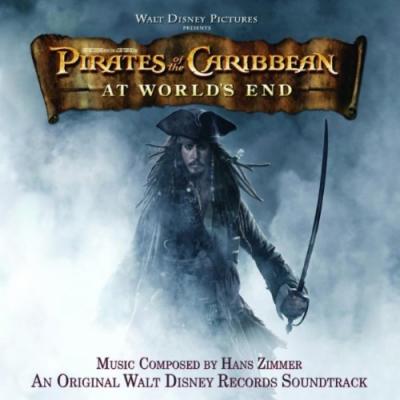
"Pirates Of The Caribbean: At World's End" Soundtrack Lyrics
Movie • 2007
Track Listing
Hans Zimmer
Hans Zimmer
“Pirates of the Caribbean: At World’s End (Original Motion Picture Soundtrack)” – Album Guide to Tracks and Key Scenes
Overview
What kind of pirate epic opens with a child’s hanging song and ends with an elegy for love under storm clouds? Arrival — adaptation — rebellion — collapse: At World’s End charts that arc with a score that’s bigger, brassier, and more orchestral than its predecessors, yet newly haunted by myth and fate.
The album — 13 cues, ~56 minutes — puts Hans Zimmer’s widescreen storytelling front and center: the shanty-hymn “Hoist the Colours,” the exotic-noir of “Singapore,” the delirious locker fantasia of “Multiple Jacks,” the kinetic puzzle-box of “Up Is Down,” the rousing choral rally “What Shall We Die For?”, and the suite-like finale “Drink Up Me Hearties.” It’s the trilogy’s thematic pay-off: ideas from the first two films recomposed into a larger tapestry.
Sonically, it trades the synth-forward bite of the 2003 score for muscular orchestra and choir. Fiddle, erhu, and low woodwinds color the edges; organ and men’s chorus give the sea a voice. Genres phase by story: shanty & lament (martyrdom) → Eastern-tinged intrigue (alliances) → surreal scherzo (limbo) → swashbuckling chorale (war council) → choral-orchestral cataclysm (maelstrom) → bittersweet anthem (legacy).
How It Was Made
Recorded across LA and London stages, the score credits Zimmer as composer/producer with a bench of additional writers shaping set-pieces and variations. The album arrived via Walt Disney Records in late May 2007 tied to the film’s release, and it debuts more fully symphonic writing for the series — choir in the rally, organ thunder for Davy Jones, and a love theme broadened into a “theme for the whole movie” (as per interviews and album notes).
“Hoist the Colours” functions as diegetic lore and franchise thesis; its lyrics were crafted within the film’s writing team, then woven through the score. Elsewhere, the production embraces playful textures (jaw harp, accordion) and virtuosic orchestral engines for the maelstrom battle.

Tracks & Scenes
“Hoist the Colours” — Choir
Where it plays: Opening executions in Port Royal. A boy begins alone; voices gather as the gallows creak. Diegetic-turned-score.
Why it matters: A pirate hymn and prologue of oppression — sets the film’s stakes and moral weather.
“Singapore”
Where it plays: Candlelit baths, hidden weapons, and the first skirmish in Sao Feng’s lair. Erhu and plucked strings slither through percussion.
Why it matters: Introduces power players and the East India motif in a single, exotic suite.
“At Wit’s End”
Where it plays: Toward the world’s edge — charts falling off maps. Horn carries a widescreen main theme; organ and strings loom.
Why it matters: The movie’s grand Romantic statement, later folded into battles and farewells.
“Multiple Jacks”
Where it plays: Davy Jones’ Locker — Jack argues with himself, hallucination on hallucination. Off-kilter electronics and jaw harp nudge the absurd.
Why it matters: Comic-surreal palate cleanser that still threads character DNA.
“Up Is Down”
Where it plays: The crew flip the Black Pearl to escape the Locker. A 12/8 fiddle ostinato churns as bodies heave to the beat.
Why it matters: Action as dance — the score’s most gleeful brain-teaser.
“I See Dead People in Boats”
Where it plays: The ferry of souls scene; Elizabeth glimpses her father. Oboe sings the A-theme; strings ache quietly.
Why it matters: Grief without melodrama — a necessary stillness before war.
“The Brethren Court”
Where it plays: Pirate lords convene; Captain Teague’s arrival bends the room. Jack’s motif appears in crooked mirrors; shanty fragments surface.
Why it matters: Politics set to parchment and pipe smoke — lore gets melody.
“Parlay”
Where it plays: Standoff on the sandbar: Barbossa, Jack, Elizabeth vs. Beckett and Jones. Distorted guitar and string ostinato trade barbs.
Why it matters: Western-styled standoff energy in a seafaring tale — a stylish wink.
“Calypso”
Where it plays: Ritual aboard the Black Pearl; Tia Dalma becomes storm and sea. Chant and drums rise into choral surge.
Why it matters: Myth cracks open — score turns elemental.
“What Shall We Die For?” — Choir & Orchestra
Where it plays: Elizabeth’s speech before the maelstrom. The shanty transforms into an anthem as the fleet answers.
Why it matters: The film’s moral roar; pirates find a cause larger than plunder.
“I Don’t Think Now Is the Best Time”
Where it plays: The maelstrom sequence: wedding amid cannon fire, Jack vs. Jones, the Endeavour’s fate.
Why it matters: Ten minutes of interlocking motifs — the trilogy’s action peak.
“One Day”
Where it plays: Aftermath and farewell — Will and Elizabeth’s beach parting, the burden of duty.
Why it matters: The love theme’s most tender, aching version.
“Drink Up Me Hearties”
Where it plays: Jack’s final gambit, horizon regained; into end credits suite with reprise nods.
Why it matters: Curtain-call of themes; adventure persists.
Notes & Trivia
- The album released in May 2007 on Walt Disney Records and runs ~55:50 across 13 tracks.
- “Hoist the Colours” opens the film diegetically; a longer end-credits suite arrangement exists outside the main album.
- Compared to 2003’s score, this one leans far more orchestral and choral, with organ set-pieces for Davy Jones.
- Retail tie-ins at the time included region-specific promos (poster giveaways, ringtone codes).
- The album entered the U.S. Billboard 200 inside the top 20 during release week.
Music–Story Links
When the boy begins “Hoist the Colours,” the movie reframes piracy as resistance; later, Elizabeth’s anthem reframes it as solidarity. Singapore’s slink becomes corporate menace when Beckett’s motif tightens the harmony. In the Locker, the score breaks its own rules — bent timbres for a bent reality — then snaps back into order for the council and the parlay. By the maelstrom, every theme collides: love over war, fate over ambition, freedom over empire.
Reception & Quotes
Critics diverged, fans swooned. Many welcomed the broader orchestral/choral palette and the clean integration of old motives with new; a few missed the lighter, jig-like swashbuckling of Golden Age models.
“A level of thematic complexity that rivals most other franchises.” as one soundtrack review summarized
“An intelligent merging of ideas from all three films, with a wider orchestral palette.” another critic noted
“Zimmer throws out the rulebook and writes myth.” album capsules often imply
Interesting Facts
- Opening theology: The shanty doubles as lore — a compressed history of Calypso and the Brethren Court.
- Verbinski’s guitar: The parlay cue slyly channels a spaghetti-western stare-down vibe — a stylistic Easter egg.
- Locker logic: “Multiple Jacks” uses warped timbres (jaw harp, detuned motifs) to signal fractured reality.
- Dance of physics: “Up Is Down” makes a physics puzzle feel like a jig — in strict 12/8.
- After-credits sting: The film’s coda (ten years later) lands softly; the album’s “Drink Up Me Hearties” folds in farewells without spoiling it.
Technical Info
- Title: Pirates of the Caribbean: At World’s End (Original Motion Picture Soundtrack)
- Year: 2007
- Type: Film score album
- Composer/Producer: Hans Zimmer
- Label: Walt Disney Records
- Length/Tracks: ~55:50; 13 cues
- Key placements (album cues): “Hoist the Colours,” “Singapore,” “At Wit’s End,” “Multiple Jacks,” “Up Is Down,” “I See Dead People in Boats,” “The Brethren Court,” “Parlay,” “Calypso,” “What Shall We Die For?,” “I Don’t Think Now Is the Best Time,” “One Day,” “Drink Up Me Hearties.”
- Studios: Sessions split across major LA and London scoring stages
- Chart note: Debuted top-20 on the U.S. Billboard 200
Questions & Answers
- What’s the opening song the boy sings?
- “Hoist the Colours,” a pirate hymn that becomes the film’s rallying motif.
- Is this score more orchestral than the first film?
- Yes — it leans into full orchestra and choir, with organ highlights for Davy Jones.
- Which cue scores the ship-flipping escape?
- “Up Is Down,” driven by a 12/8 fiddle ostinato.
- What plays under Elizabeth’s maelstrom speech?
- “What Shall We Die For?” — a choral-orchestral transformation of the shanty.
- Where do I hear the end-credits suite of themes?
- “Drink Up Me Hearties” on the album; longer “Hoist the Colours” suite variants exist on later compilations.
Canonical Entities & Relations
| Subject | Relation | Object |
|---|---|---|
| Hans Zimmer | composed & produced | Pirates of the Caribbean: At World’s End (score) |
| Walt Disney Records | released | At World’s End soundtrack (2007) |
| Gore Verbinski | directed | Pirates of the Caribbean: At World’s End |
| “Hoist the Colours” | functions as | diegetic shanty & thematic backbone |
| Elizabeth Swann | leads rally to | “What Shall We Die For?” |
| Cutler Beckett motif | underscores | East India Trading Company |
| “Drink Up Me Hearties” | closes | film & album via end-credits suite |
Sources: album pages/retail listings; soundtrack credits & track notes; industry coverage of sessions and chart bow; production interviews.
November, 19th 2025
A-Z Lyrics Universe
Cynthia Erivo Popular
Ariana Grande Horsepower
Post Malone Ain't No Love in Oklahoma
Luke Combs Good Riddance (Time of Your Life)
Green Day Bye Bye Bye
*NSYNC You're the One That I Wan
John Travolta & Olivia Newton-John I Always Wanted a Brother
Braelyn Rankins, Theo Somolu, Kelvin Harrison Jr. and Aaron Pierre The Power of Love
Frankie Goes to Hollywood Beyond
Auli’i Cravalho feat. Rachel House MORE ›