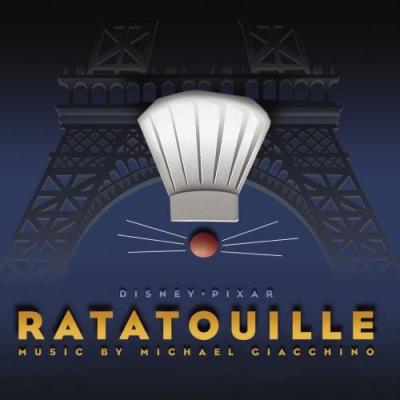
"Ratatouille" Soundtrack Lyrics
Cartoon • 2007
Track Listing
Camille
“Ratatouille (Original Motion Picture Soundtrack)” – Album Guide to Tracks and Key Scenes
Overview
What does ambition sound like when it wears a chef’s toque? Ratatouille answers with a fragrant blend of accordion, strings, and sly jazz — music that can sprint, simmer, and sigh. Michael Giacchino’s score isn’t “postcard French”; it’s story-first, threading Remy’s hunger (for food, for belonging) through a waltzing, tangoing, darting palette. The album adds one perfect chanson, “Le Festin” (sung by Camille), which bookends the tale like a recipe handed down.
The record plays like a day in the kitchen: knife-quick scherzos, lyrical reductions, and a final burst of joy that sends you out humming. Motifs do the real cooking — Remy’s dream theme, the Remy–Linguini buddy motif, and a fleeter, more mechanical figure for the kitchen itself. According to the label notes, Walt Disney Records issued the soundtrack on June 26, 2007, with Giacchino producing and arranging.
Genres & themes in phases: arrival — playful musette colors and light strings (curiosity); adaptation — quickstep cues for training and teamwork (craft); rebellion — percussive, racing ostinati for high-stakes service and Skinner’s chases (risk); closure — warm chanson and radiant end credits (home).
How It Was Made
Composer & palette. Giacchino leaned into Parisian timbres — accordion, guitarrón-like bass weight, gypsy-jazz guitar, small brass — but avoided clichés. “Le Festin” grew out of the score’s main theme; Camille’s French vocal keeps the film’s heart localized even in international prints. Sessions were cut in 2006–2007 at Sony Pictures Studios, with the composer producing.
Song strategy. Only one song matters here: “Le Festin,” a classic-feeling waltz about hunger and hope. Everything else is score, and the sequencing favors narrative flow: house-gig chaos, Paris wonder, kitchen ballet, then the memory-trigger that softens a critic.
Tracks & Scenes
“Le Festin” — Camille
Where it plays: Opens as a gentle prologue color and returns over end credits; on-screen, the melody also peeks during Paris-set discovery moments. Non-diegetic chanson; end-credit feature.
Why it matters: Remy’s thesis in three minutes — a lullaby for courage that frames the film’s appetite and empathy.
“Welcome to Gusteau’s” — Michael Giacchino
Where it plays: Remy reaches the fabled restaurant’s rooftop and peers into a world he’s only imagined. A short but buoyant cue that lifts with the kitchen lights. Non-diegetic.
Why it matters: The door-opening shimmer — curiosity becomes purpose.
“This Is Me” — Michael Giacchino
Where it plays: Early character statement as Remy narrates his split life (colony vs. cookbook). The harmony toggles between scamper and sigh. Non-diegetic.
Why it matters: Sketches the two Remys the movie must reconcile.
“Granny Get Your Gun” / “100 Rat Dash” — Michael Giacchino
Where it plays: The country-cottage chaos opener: a shotgun-wielding grandmother, a ceiling crash, a rushing river. Non-diegetic action scherzos cut to slapstick precision.
Why it matters: Announces the film’s elastic timing — cartoon energy with orchestral wit.
“A Real Gourmet Kitchen” — Michael Giacchino
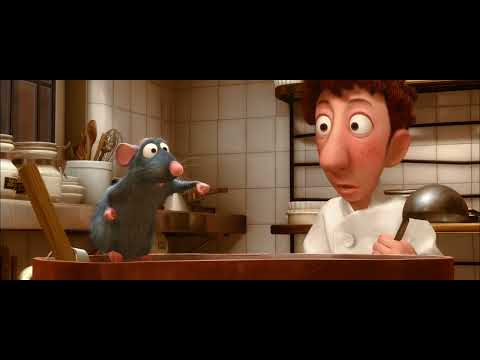
Where it plays: Remy first navigates the brigade — smoke, steam, steel, and a ballet of bodies. Non-diegetic; the motif becomes the kitchen’s breath.
Why it matters: Place-as-music; the cue turns process into poetry.
“Colette Shows Him Le Ropes” — Michael Giacchino
Where it plays: Linguini’s training montage — razor-quick cuts, muscle memory forming under Colette’s watch. Non-diegetic, syncopated for montage.
Why it matters: Buddy-motif+motor rhythms — teamwork in a saucepan.
“Wall Rat” — Michael Giacchino
Where it plays: Hidden-Remy choreography under the toque — ladder climbs, near-misses, saves. Non-diegetic with tiny percussive jokes.
Why it matters: Comic stealth cue that still feels gourmet.
“Heist to See You” — Michael Giacchino
Where it plays: Late-film sneaking and ingredient runs as Skinner tightens the net. Non-diegetic caper energy.
Why it matters: The score’s sprightliest caper — mischief with high stakes.
“Bonne Appétit!” / “End Creditouilles” — Michael Giacchino
Where it plays: After the critic’s revelation and the team’s new beginning, the suite wraps character themes into a celebratory finale; “Le Festin” then returns to send us home. Non-diegetic; end titles.
Why it matters: Payoff in melody — earned warmth after all the heat.
Notes & Trivia
- The album’s lone song, “Le Festin,” was written by Giacchino and performed in French by Camille; it bookends the film.
- The soundtrack released June 26, 2007 on Walt Disney Records; recording took place at Sony Pictures Studios in 2006–2007.
- Giacchino mixes musette, gypsy-jazz, and tango touches into orchestral writing — an intentional dodge of “tourist” pastiche.
- The score won the Grammy for Best Score Soundtrack Album and earned an Academy Award nomination.
Music–Story Links
When Remy first looks down into Gusteau’s kitchen, the harmony lifts — curiosity turns kinetic. As Linguini and Colette click, their staccato training cue relaxes into longer phrases: craft becomes grace. “Le Festin” doesn’t just decorate the credits; it reframes the plot as a memory — you feel how every risk tasted on the way to belonging. And when Anton Ego’s past ignites, the music drops its swagger and simply holds — a straight line back to a boy at a table.
Reception & Quotes
Critics praised the score’s wit and heart — a “Paris that breathes” without leaning on accordion caricature. Reviewers also singled out how tightly cues were cut to picture; the kitchen really does move like music.
“Zimmer’s protégé turns in a feast — charming, nimble, and surprisingly moving.” — score press
“Accordions as aroma, not punchline.” — review line
Interesting Facts
- Theme craft: Remy gets two interlocking motifs (colony vs. dream); a third “buddy” theme binds him to Linguini.
- Camille’s cut: “Le Festin” grew directly out of the main orchestral theme rather than being a bolt-on single.
- Kitchen meter: Giacchino writes quick mixed meters to match chop–stir–plate rhythms — action music without villains.
- Global prints: The song remains in French in nearly all language versions, preserving its flavor.
- Vinyl & regionals: Multiple regional/“international” album versions reshuffle a few cue titles; core program remains intact.
Technical Info
- Title: Ratatouille (Original Motion Picture Soundtrack)
- Year / Type: 2007 — Film score + one original song
- Composer & Producer: Michael Giacchino
- Primary song: “Le Festin” — written by Michael Giacchino; performed by Camille
- Studios / Sessions: Sony Pictures Studios, 2006–2007
- Label / Release: Walt Disney Records — June 26, 2007
- Representative cues: “Welcome to Gusteau’s”; “This Is Me”; “Granny Get Your Gun”; “100 Rat Dash”; “A Real Gourmet Kitchen”; “Colette Shows Him Le Ropes”; “Heist to See You”; “End Creditouilles”
- Film snapshot: Dir. Brad Bird; Pixar/Disney; Runtime 111 minutes
- Availability: Streaming (Apple Music/Spotify); CD & region-specific editions
Questions & Answers
- Who wrote and sings “Le Festin”?
- Michael Giacchino wrote it; French artist Camille sings it — in French, even in most international dubs.
- Is the soundtrack mostly songs?
- No — it’s a true film score album. “Le Festin” is the only featured song; the rest are Giacchino’s cues.
- What musical styles color the score?
- Musette/accordion, gypsy-jazz guitar, a touch of tango, and full orchestra — blended for story, not stereotype.
- Where does “Le Festin” appear in the film?
- As a framing presence and again over the end credits; its melody threads through discovery moments in Paris.
- Did the score win awards?
- Yes — it won the Grammy for Best Score Soundtrack Album and received an Oscar nomination for Original Score.
Canonical Entities & Relations
| Subject | Verb | Object |
|---|---|---|
| Michael Giacchino | composed | Ratatouille score |
| Michael Giacchino | wrote | “Le Festin” |
| Camille | performed | “Le Festin” |
| Walt Disney Records | released | Ratatouille (Original Motion Picture Soundtrack) |
| Sony Pictures Studios | hosted | recording sessions (2006–2007) |
| Brad Bird | directed | Ratatouille (film) |
Sources: Disney/Pixar and Walt Disney Records notes; album listings and credits; interviews with Michael Giacchino; score reviews and track indexes.
November, 19th 2025
A-Z Lyrics Universe
Cynthia Erivo Popular
Ariana Grande Horsepower
Post Malone Ain't No Love in Oklahoma
Luke Combs Good Riddance (Time of Your Life)
Green Day Bye Bye Bye
*NSYNC You're the One That I Wan
John Travolta & Olivia Newton-John I Always Wanted a Brother
Braelyn Rankins, Theo Somolu, Kelvin Harrison Jr. and Aaron Pierre The Power of Love
Frankie Goes to Hollywood Beyond
Auli’i Cravalho feat. Rachel House MORE ›