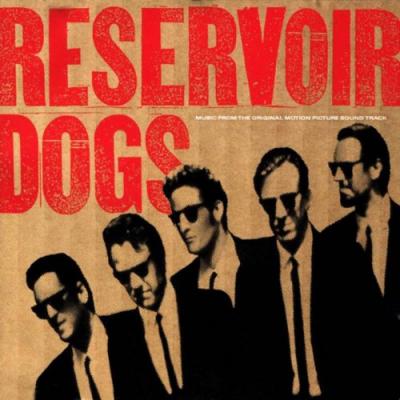
"Reservoir Dogs" Soundtrack Lyrics
Movie • 1992
Track Listing
Wright, Steven
George Baker Select
Wright, Steven
Blue Swede
Wright, Steven
Tex, Joe
Bedlam
Tarantino, Quentin
Rogers, Sandy
Wright, Steven
Stealers Wheel
Bedlam
Keitel, Harvey
Wright, Steven
Nilsson, Harry
Wright, Steven
"Reservoir Dogs (Original Motion Picture Soundtrack)" – Album Guide to Tracks and Key Scenes

Overview
What happens when a heist movie hums along to bubblegum seventies pop? Arrival — adaptation — rebellion — collapse: Reservoir Dogs turns a weekend of panic into a “radio show” you can’t turn off. The soundtrack’s bright, unblushing tunes rub against violence and betrayal until sparks fly — irony as a blade.
The album — compact, dialogue-laced, and punchy — established the Tarantino playbook: crate-dug singles, a fictional DJ threading the world together, and needle-drops that reframe scenes rather than decorate them. Steven Wright’s deadpan K-Billy patter makes it feel like the whole film is happening inside a Saturday-radio marathon. Then the songs do their damage: George Baker Selection swagger for the coolest walk of shame; Stealers Wheel turning a warehouse into a dance floor from hell; Harry Nilsson tucking the bodies into credits with a grin.
It’s a time-capsule that still cuts. The record is short, the ideas are huge, and the way it maps cheer to dread changed how directors think about source music. As Rolling Stone noted in a 2024 canon list, this little half-hour set rewired the culture’s ears.
Genres & themes in phases. Phase 1 (arrival): AM-pop and soft-funk — false comfort. Phase 2 (adaptation): barroom soul — bravado as coping. Phase 3 (rebellion): bubblegum and boogie — merry menace. Phase 4 (collapse/acceptance): lullaby classic — credits as punchline.
How It Was Made
Radio inside the movie. Tarantino frames the story with a fake station — “K-Billy’s Super Sounds of the Seventies Weekend” — voiced by stand-up legend Steven Wright. The DJ’s bumpers and ad-spots stitch scenes together, and the album preserves those interludes between songs.
Clearances & curation. Music supervisor Karyn Rachtman wrangled the catalog — crucially landing Stealers Wheel’s “Stuck in the Middle with You,” which Tarantino considered non-negotiable for the warehouse sequence. The commercial album (MCA Records) intercuts those hits with dialogue drops and two fresh recordings by Bedlam.
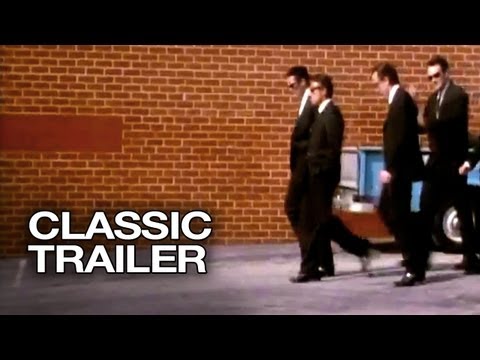
Tracks & Scenes
“Little Green Bag” — George Baker Selection
Where it plays: The iconic slo-mo exit from the diner and opening credits. Black suits, cigarette smoke, one perfect bass line.
Why it matters: Swag before disaster — the walk that launched a thousand Halloween costumes.
“Hooked on a Feeling” — Blue Swede
Where it plays: On K-Billy in the car with Mr. Pink, Mr. White, Mr. Orange, and Nice Guy Eddie. Windows up; “ooga-chaka” bouncing around the upholstery (diegetic radio).
Why it matters: Goofy chant as denial — they’re whistling past a crime scene.
“I Gotcha” — Joe Tex
Where it plays: Nice Guy Eddie barrels toward the warehouse while, elsewhere, a cop takes a beating.
Why it matters: Funk strut over moral rot — the split-screen of conscience that defines the film.
“Stuck in the Middle with You” — Stealers Wheel
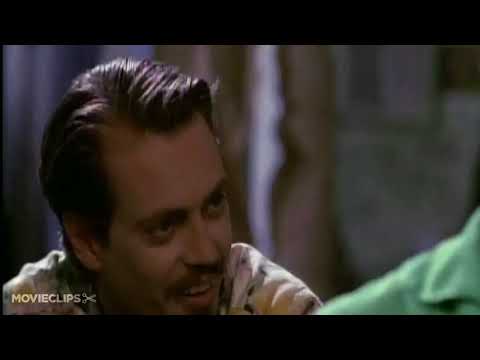
Where it plays: Mr. Blonde flips on K-Billy and dances into the ear-cutting — sunbeam pop in a concrete hell (diegetic radio, then needle-lift).
Why it matters: The definitive cheerful-song/awful-act pairing; the scene that made moviegoers hear this track differently forever.
“Magic Carpet Ride” — Bedlam (new recording)
Where it plays: Mr. Orange performs the “commode story” in a club — the practice run turned stand-up routine.
Why it matters: A shaggy classic recut for a shaggy alibi; performance blurs into memory.
“Harvest Moon” — Bedlam
Where it plays: Freddy/Mr. Orange in a restaurant, chatting with his handler; the undercover persona hardens.
Why it matters: A deceptively mellow bridge between the film’s two lives.
“Fool for Love” — Sandy Rogers
Where it plays: In Mr. Orange’s apartment — a quiet, wounded needle-drop in a story that rarely sits still.
Why it matters: Lets the film breathe; you feel the human cost creeping back in.
“Coconut” — Harry Nilsson
Where it plays: End credits — a silly, sunny send-off after the gunshots.
Why it matters: Gallows lullaby; the joke is that there’s still a joke.

Notes & Trivia
- The album is heavy on dialogue — K-Billy bumpers, ad copy, and scene snippets — so it plays like the movie’s radio broadcast.
- Only Bedlam recorded new tracks for the film; the rest are catalog singles.
- Steven Wright’s DJ voice is canon now; his “Super Sounds” bumpers even appear as track IDs on some releases.
- The soundtrack was issued by MCA Records in October 1992; several international editions share the same sequence.
- That ear-cutting dance? Tarantino insisted on that Stealers Wheel song; clearing it unlocked the scene.
Music–Story Links
Radio as narrator. K-Billy ties characters who aren’t sharing space; when a song starts in one car and finishes in another scene, the city feels like one cruel channel.
Cheer vs. dread. “Hooked on a Feeling” and “I Gotcha” lay a sugar glaze over fear and cruelty; “Stuck in the Middle…” makes the tension unbearable by refusing to match the mood.
Performance as plot. “Magic Carpet Ride” frames the “commode story” like a set — we’re watching the myth being rehearsed in real time.
Exit music as punchline. “Coconut” doesn’t resolve anything; it dares you to hum along anyway.
Reception & Quotes
The film split early audiences on violence but united them on the soundtrack’s swagger. According to album credits and interviews, the music-as-radio conceit — plus a few perfectly perverse song choices — set a template Tarantino kept riffing on for decades.
“A happy soundtrack for a very unhappy day.” Soundtrack roundups
“K-Billy isn’t wallpaper — it’s the narrator.” Critic’s note
Interesting Facts
- Rachtman’s clearance for “Stuck in the Middle with You” was the domino — the scene was built around it.
- Some releases credit both a film music supervisor and an MCA Records music supervisor (label-side oversight).
- Listening front-to-back mirrors the film’s rhythm: swagger → stress → rupture → shrug.
- That diner chatter about Madonna’s “Like a Virgin”? It appears as its own dialogue track on the album.
- The soundtrack later picked up multiple platinum/gold certifications across territories.
Technical Info
- Title: Reservoir Dogs — Original Motion Picture Soundtrack
- Year: 1992 (album release October 13, 1992)
- Type: Various-artists compilation with dialogue interludes
- Label: MCA Records
- Music Supervision: Karyn Rachtman (film); label-side supervision credit on some editions
- DJ/Voice: Steven Wright as K-Billy
- Representative placements: George Baker Selection — “Little Green Bag” (opening walk); Blue Swede — “Hooked on a Feeling” (car/K-Billy); Joe Tex — “I Gotcha” (Eddie driving); Stealers Wheel — “Stuck in the Middle with You” (warehouse); Bedlam — “Magic Carpet Ride,” “Harvest Moon” (club/restaurant); Sandy Rogers — “Fool for Love” (apartment); Harry Nilsson — “Coconut” (end credits)
- Availability: Widely streaming; multiple MCA/Geffen pressings on CD/vinyl; includes dialogue tracks.
Questions & Answers
- Who’s the radio DJ we hear between songs?
- Comedian Steven Wright voices K-Billy; his deadpan bumpers are preserved on the album.
- Did the movie commission new music?
- Yes — Bedlam cut fresh versions of “Magic Carpet Ride” and “Harvest Moon”; the rest are catalog singles.
- What plays during the ear-cutting scene?
- Stealers Wheel’s “Stuck in the Middle with You,” blasted from K-Billy while Mr. Blonde dances.
- What’s the opening and closing song pairing?
- “Little Green Bag” for the slo-mo credits; “Coconut” over the end titles.
- Who cleared the big songs?
- Music supervisor Karyn Rachtman — her work on the clearances shaped the album and the scene design.
Canonical Entities & Relations
| Subject | Relation | Object |
|---|---|---|
| Quentin Tarantino | wrote & directed | Reservoir Dogs (1992) |
| MCA Records | released | Reservoir Dogs — Original Motion Picture Soundtrack |
| Karyn Rachtman | music supervised | Reservoir Dogs (film) |
| Steven Wright | voiced | K-Billy DJ (film & album bumpers) |
| George Baker Selection | performed | “Little Green Bag” (opening) |
| Blue Swede | performed | “Hooked on a Feeling” (car/K-Billy) |
| Joe Tex | performed | “I Gotcha” (Eddie driving) |
| Stealers Wheel | performed | “Stuck in the Middle with You” (warehouse) |
| Bedlam | recorded for film | “Magic Carpet Ride”; “Harvest Moon” |
| Sandy Rogers | performed | “Fool for Love” (apartment) |
| Harry Nilsson | performed | “Coconut” (end credits) |
Sources: Wikipedia (album & film pages: release date/label/DJ concept); Discogs (credits, supervision, pressing notes); The Quentin Tarantino Archives (scene-by-scene placements); major press retrospectives on the ear-cutting scene and the opening credits; official trailer and song pages.
Per Wikipedia and Discogs, MCA issued the dialogue-laced soundtrack on Oct 13, 1992 with Steven Wright’s K-Billy links; according to The Quentin Tarantino Archives, placements include “Little Green Bag” (opening), “Hooked on a Feeling” (car), “I Gotcha” (Eddie drive), “Stuck in the Middle with You” (warehouse), Bedlam’s cuts (“Magic Carpet Ride,” “Harvest Moon”), “Fool for Love” (apartment), and “Coconut” (credits); as coverage and interviews recount, Karyn Rachtman cleared the crucial Stealers Wheel cue; as later roundups noted, the soundtrack’s influence remains outsized.
Can you tell now that this movie was shot only for 1.2 million dollars? Neither could we, until read it in Wikipedia. Despite the fact of official gross in the box office at only USD 2.8 millions, this data is definitely incorrect, as this was re-published, re-ran in the cinemas for several times and from the box office usually excluded such data as grossing from DVD, Blu-Ray and VHS sells, which had to be huge – in tens of times more than cinema’s box office. One of the most popular songs in the film is Hooked on a Feeling by Blue Swede, which also was in the Guardians of the Galaxy. Harry Nilsson did not only unusual lyrics, but also an interesting tranquil clip, where guerillas play on a guitar and men dance dressed-up like cheerleading girls. Freaky and interesting at the same time. The same as this movie, which captivates with fantastic acting, fascinates with tremendous violence and releases with the deaths of main characters. Do you like something in the middle between pop, rock and country? Then you should definitely listen to Harvest Moon by Bedlam – we have even added this song to our favorites. They have so kind lyrics that it is even questionable why they were selected for such furious film where everybody dies. Maybe, this is a hallmark of Quentin Tarantino, who shot this film in the early years of his tread, 1992. He uses in his brainchildren only the best music, as he did with his The Hateful Eight of 2015. It is not the only peculiarity of this person – he likes to work frequently with several people and for being in his movies, they receive tons of awards of all ranges, like Christoph Waltz did (he played in Inglorious Bastards and Django Unchained). We hope to hear from Quentin Tarantino soon again, as his movies are delightful, all without exception.November, 19th 2025
A-Z Lyrics Universe
Cynthia Erivo Popular
Ariana Grande Horsepower
Post Malone Ain't No Love in Oklahoma
Luke Combs Good Riddance (Time of Your Life)
Green Day Bye Bye Bye
*NSYNC You're the One That I Wan
John Travolta & Olivia Newton-John I Always Wanted a Brother
Braelyn Rankins, Theo Somolu, Kelvin Harrison Jr. and Aaron Pierre The Power of Love
Frankie Goes to Hollywood Beyond
Auli’i Cravalho feat. Rachel House MORE ›