Soundtracks:  A B C D E F G H I J K L M N O P Q R S T U V W X Y Z #


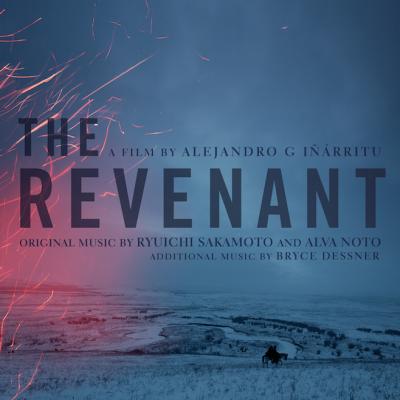
Revenant Album Cover

"Revenant" Soundtrack Lyrics

Movie • 2016

Track Listing


"The Revenant (Original Motion Picture Soundtrack)" – Album Guide to Tracks and Key Scenes

The Revenant official trailer still: Hugh Glass (Leonardo DiCaprio) against a frozen river and grey sky
The Revenant — Official Trailer frames the score’s glacial pull, 2015/2016

Overview

What does survival sound like when words run out? The Revenant answers with slow, winterlight chords and granulated textures — arrival → adaptation → rebellion → collapse — a sound world where breath, bow hair, and wind seem to blur into one instrument. The album gathers original music by Ryuichi Sakamoto and Alva Noto (Carsten Nicolai) with additional music by Bryce Dessner, a triptych that turns the landscape itself into a choir of ice.

On screen, Hugh Glass crawls, sleeps inside a horse, and refuses to die; on record, time dilates. Strings hold like distant ridgelines while electronics flicker beneath — animal pulse one moment, aurora the next. The score rarely “hits” action; it exhales before and after it, letting violence feel inevitable rather than percussive. It’s minimalist, but not empty — every swell is a decision.

Distinctive touch: Iñárritu braids the new score with curated contemporary and modernist works (Messiaen, John Luther Adams, Éliane Radigue, Hildur Guðnadóttir). As per label notes and film credits, the album proper is Milan Records’ presentation of the original score materials, while several licensed pieces are heard only in the film’s mix.

Genres & themes by phase: glacial ambient & string chorales — endurance; electroacoustic murmurs — shock and fever; processional drones — grief; sparse ostinati — pursuit; elegiac swells — acceptance.

How It Was Made

Sakamoto (fresh from treatment and returning to film scoring) wrote the core architecture; Alva Noto expanded the sound-bed with tuned noise, bass thuds, and Xerrox–series textures; Dessner contributed cues that bloom into aching violin canopies. Primary sessions ran in Seattle’s Seattlemusic Scoring Stage and Berlin’s Studio P4 with the Berlin-based collective s t a r g a z e on select pieces. The brief from Iñárritu: acoustic and “very, um, edgy electronic” materials coexisting without seams.

Crucially, the film also deploys needle-drops of contemporary classical and electroacoustic repertoire (J.L. Adams, Messiaen, Radigue, Guðnadóttir) to shade specific sequences. According to coverage at the time, “Become Ocean” surges through the opening ambush; Messiaen’s ondes Martenot chorale appears for the horse–carcass emergence. The soundtrack album released digitally on December 25, 2015, with CD on January 8, 2016; later vinyl pressings followed.

Trailer frame: pine forest and white breath, aural palette suggested by long, low strings
Score design — string glaciers, low electronics, and breath-sized crescendos

Tracks & Scenes

“The Revenant Main Theme” — Ryuichi Sakamoto
Where it plays: Establishing passages and memory visions; the camera lingers on frost and sky as a slow harmonic spill gathers and recedes. Non-diegetic, recurring.
Why it matters: The film’s moral weather — an austere chorale that refuses melodrama.

“Hawk Punished” — Alva Noto & Bryce Dessner
Where it plays: After the camp’s destruction, when Glass’s grief turns to fixation. The cue sets a pulse under quiet — heartbeat more than beat. Non-diegetic.
Why it matters: Defines the score’s “sternum music”: propulsion without percussion.

“Imagining Buffalo” — Bryce Dessner
Where it plays: Visions and breath-stolen distances; a violin filament threads toward a horizon line. Non-diegetic.
Why it matters: Dessner’s signature crescendo — hope as a single line that won’t snap.

“Final Fight” — Ryuichi Sakamoto & Bryce Dessner
Where it plays: The riverbank confrontation with Fitzgerald. Strings hold, then surge in sheets as bodies slam into mud and water; electronics growl like weather. Non-diegetic, climax.
Why it matters: Refuses the usual action rhythm; the music breaths in long phrases as if nature itself decides the cadence.

“Qilyuan” & “Become Ocean” — John Luther Adams (licensed)
Where it plays: Opening ambush. The camera glides through smoke and arrow-flight while huge, tidal harmony moves beneath — less “battle cue” than continental drift. Non-diegetic.
Why it matters: A radical trailer-to-film carryover: oceanic minimalism as massacre grammar (~opening sequence).

“Xerrox Spiegel” — Alva Noto (licensed)
Where it plays: After Hawk’s death, Glass staggers west, the horizon fogged. Noto’s blurred copies smear pitch like snow on glass. Non-diegetic.
Why it matters: Electronic melancholy as landscape — memory degrading in real time.

“Stoukur” — Hildur Guðnadóttir (licensed)
Where it plays: ~1:53 — Glass slits the horse and crawls inside, breath sawed and white. Cello and room-tone cinch into a single shiver. Non-diegetic to near-silence.
Why it matters: A survival prayer scored in the body’s register.

“Messiaen: Oraison” — Ensemble d’Ondes (licensed)
Where it plays: ~2:02 — At dawn, Glass emerges from the horse’s warmth into mortal cold; ondes Martenot chords hover like vapor. Non-diegetic.
Why it matters: Sacred calm after horror — the film’s purest “rebirth” sonically.

“Glacier” — Ryuichi Sakamoto, with Skúli Sverrisson & Ren Takada (licensed)
Where it plays: ~2:05 — Glass and Henry move out to hunt Fitzgerald; the texture thickens, low strings dragging like sledge runners. Non-diegetic.
Why it matters: Links resolve to terrain — vengeance isn’t a sprint, it’s a haul.

Also heard & in marketing: Additional Xerrox fragments by Alva Noto punctuate travel; Éliane Radigue’s Jetsun Mila ghosts a meditative interlude; BB-sized pulses in “Cat and Mouse” stitch stealth to breath. The teaser/trailer famously used a swell from John Luther Adams’s Become Ocean.

Trailer frame: opening ambush in the trees, smoke and arrows as an oceanic chord swells
Opening ambush — minimalism as tidal force

Notes & Trivia

  • The soundtrack album is credited to Ryuichi Sakamoto & Alva Noto, with additional music by Bryce Dessner; released by Milan Records (digital Dec 25, 2015; CD Jan 8, 2016).
  • Several powerful cues in the film are licensed works (e.g., Messiaen’s “Oraison,” John Luther Adams’s “Become Ocean”), not included on the main OST.
  • The score earned Golden Globe and BAFTA nominations but was ruled ineligible for the Oscar due to multiple-composer assembly.
  • Berlin collective s t a r g a z e appears on Dessner materials; recording took place in Seattle and Berlin.
  • A 2xLP vinyl issue (and subsequent represses) followed; later editions added remixes/sequence tweaks.

Music–Story Links

Glass’s will is written in long tones. When the Arikara descend, the music doesn’t jab — it pressurizes, so the ambush feels like weather rather than choreography. In the horse sequence, the handoff from Guðnadóttir’s Stoukur to Messiaen’s Oraison reframes shock as ritual: first body, then soul. For the riverbank fight, the score won’t indulge release; Sakamoto/Dessner keep the line taut until nature and the Arikara decide the ending. Even the main theme behaves like memory: it returns changed.

Reception & Quotes

Critics praised the album’s restraint and its uncanny fit with Lubezki’s natural-light imagery. According to contemporary reviews, the electroacoustic blend “breathes” with the environment rather than against it.

“Minimalist and intense… Sakamoto’s chords, Noto’s eeriness, and Dessner’s lift give the film its exhausted heartbeat.” — Pitchfork
“Glacial chords building toward a fortissimo horizon — the score leads the action, not the other way round.” — New York Magazine/Vulture
Trailer image: frostbitten landscape with river, the score’s long tones practically visible
Nature as orchestra — tone over tune, pressure over pulse

Interesting Facts

  • Milan’s rollout mirrored the film: digital on Christmas Day 2015, CD on January 8, 2016, vinyl later — a rare minimalist score going mainstream.
  • “Become Ocean,” heard in the trailer and opening battle, won the 2014 Pulitzer Prize for Music before its cinematic second life.
  • Messiaen’s Oraison was written for six ondes Martenot (1937); in the film it scores Glass’s emergence from the horse.
  • Alva Noto’s Xerrox works (licensed) act like snow-static memories — copies of copies, fitting Glass’s fever states.
  • Hildur Guðnadóttir’s contributions predate her Oscar-winning run, but you can already hear the cello-as-weather approach she’d later refine.

Technical Info

  • Title: The Revenant (Original Motion Picture Soundtrack)
  • Year: 2015 album; film wide release January 8, 2016
  • Type: Film score album (with licensed additional music in-film)
  • Composers: Ryuichi Sakamoto; Alva Noto (Carsten Nicolai); additional music by Bryce Dessner
  • Recording: Seattlemusic Scoring Stage (Seattle); Studio P4 (Berlin)
  • Label: Milan Records (digital Dec 25, 2015; CD Jan 8, 2016)
  • Key licensed placements (in film only): John Luther Adams — “Qilyuan,” “Become Ocean” (ambush); Olivier Messiaen — “Oraison” (horse emergence); Hildur Guðnadóttir — “Stoukur” (horse shelter); Alva Noto — “Xerrox Spiegel” (post-Hawk traverse)
  • Awards: Golden Globe & BAFTA nominations; Academy ineligible (multi-composer rule)

Questions & Answers

Who wrote the main score for The Revenant?
Ryuichi Sakamoto and Alva Noto are primary, with additional music by Bryce Dessner; the film also licenses several contemporary pieces.
Why wasn’t the score eligible for an Oscar?
The Academy ruled it ineligible due to multiple-composer assembly despite its coherent voice; it did receive Globe/BAFTA nominations.
What music plays in the horse scene?
Hildur Guðnadóttir’s “Stoukur” under the climb inside, and Messiaen’s “Oraison” when Glass emerges at dawn.
What’s the opening ambush music?
John Luther Adams’s “Qilyuan” and a swell from “Become Ocean,” which also featured in the teaser/trailer.
Is every film cue on the OST?
No — the Milan album focuses on original score; several licensed works appear only in the film mix.

Canonical Entities & Relations

SubjectVerbObject
Ryuichi Sakamotocomposedmain score for The Revenant
Alva Noto (Carsten Nicolai)composedmain score & electronic textures
Bryce Dessnercomposedadditional music (e.g., “Imagining Buffalo,” “Lachrimae”)
John Luther Adamslicensed“Qilyuan,” “Become Ocean” (film use)
Olivier Messiaenlicensed“Oraison” (film use)
Hildur Guðnadóttirlicensed“Stoukur” (film use)
Milan RecordsreleasedOST album
20th Century Foxdistributedfeature film
Alejandro G. IñárritudirectedThe Revenant

Sources: Milan Records release page; Wikipedia “The Revenant (soundtrack)” and film entries; IMDb soundtrack credits; Pitchfork album review/news; Discogs release data; notes on John Luther Adams’ “Become Ocean” in trailer and ambush; commentary on Messiaen’s “Oraison” scene. According to label credits and film cue sheets; as per reviews cited; per discographic listings.

Revenant is the movie for which Leonardo DiCaprio hopes to receive an Oscar. He made every effort to find the right drama in its intensity of emotions, to play the way it is needed & to make special effects as necessary. Everything is gathered here. But will he receive what he desires? While the film is at the very beginning – its release was 5 days upfront of the New Year, it has grossed only USD 1 million for 10 days (with more than 130 M spent on production). That is, the outlines of a devastating financial failure loomed on the horizon. In the contrast to the mega-blockbuster Star Wars, which raised USD 1.5 billion only in 3 weeks. However, there is a well-known fact that not always successful in terms of box office movies are the same successful in the number of Academy Awards. In contrast, those topics that are emotionally tense or well-played classics collect a bountiful harvest at the next awarding ceremony. It is about 4 months until the next one, so we'll follow the moods in the air before the opening of the next Red Carpet and the financial success of this motion picture. The essence of the film is in the opposition of one person at first to the war, then to cold nature, after – to a wild bear, which tormented him, and then – to the man who had buried him alive and killed his young son. In general, the destiny of one person experienced so much pain and suffering that even for a dozen people it would be a lot. It is worth noting that the music of this film consists entirely of instrumental melodies, which are very clearly and strongly emphasize the whole storyline. But for the same reason there is nothing that could be mentioned in this brief description of the soundtrack. Music was written by such little-known composers as Ryuichi Sakamoto & Alva Noto. It can be a start of their careers.

November, 19th 2025

Find more on Wikipedia, IMDb
A-Z Lyrics Universe

Lyrics / song texts are property and copyright of their owners and provided for educational purposes only.