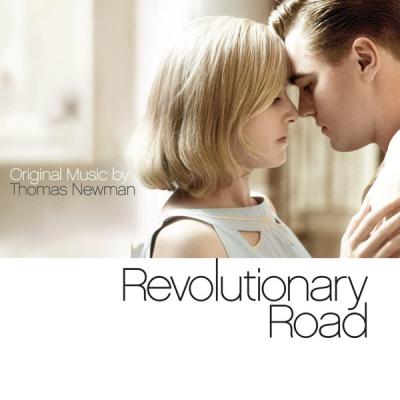
"Revolutionary Road" Soundtrack Lyrics
Movie • 2008
Track Listing
Performed by The Orioles
The Ink Spots
"Revolutionary Road (Original Music of the Motion Picture)" – Album Guide to Tracks and Key Scenes
Overview
What if a marriage soundtrack refuses to resolve? Revolutionary Road (2008) answers with Thomas Newman’s hovering chords and glassy pulses — arrival → adaptation → rebellion → collapse — a soundworld of half-finished cadences that mirror Frank and April Wheeler’s unkept promises. The album balances Newman’s score with three era-perfect vocal sides that slip in like memories from a radio left on in the kitchen.
Newman’s writing — piano motifs, string halos, soft metallic percussion — keeps leaning forward and pulling back. The effect is suburban vertigo: beauty without release. Meanwhile, doo-wop and pre-rock ballads (“Count Every Star,” “Crying in the Chapel,” “The Gypsy”) bookmark courtship and the fantasy of escape the Wheelers sell themselves. The result is a record that feels like a neighborhood’s weather report: barometric pressure rising, never breaking.
Distinctive touch: the album is as curated as it is composed. Music supervisor Randall Poster threads three vintage cuts amid the score; the sequencing lets them play like flashbacks rather than needle-drop fireworks. According to the label’s notes, the release is produced by Thomas Newman and Bill Bernstein and issued by Nonesuch — a chamber-scaled presentation that still aches widescreen.
Genres & themes by phase: minimalist orchestral & ambient percussion — domestic tension; doo-wop & close-harmony pop — idealized romance; mid-century ballroom tones — conformity; elegiac piano chorales — reckoning.
How It Was Made
Composer Thomas Newman wrote and conducted the score; J.A.C. Redford handled orchestrations. Sessions were tracked at the Newman Scoring Stage (Twentieth Century Fox), with additional recording/mix work at The Village; Tommy Vicari engineered and mixed. The ensemble includes Newman’s regular colorists (George Doering, Steve Tavaglione, Rick Cox, Michael Fisher), whose hammered dulcimer, E-bow textures, and “wire piano” noises create the score’s signature shimmer.
Music supervision & curation: Randall Poster placed three period tracks on the album: The Ravens’ “Count Every Star,” The Orioles’ “Crying in the Chapel,” and The Ink Spots’ “The Gypsy.” The soundtrack was released by Nonesuch Records on December 23, 2008 (CD/digital), aligning with the film’s awards run.
Tracks & Scenes
“Route 12” — Thomas Newman
Where it plays: Early passages and returns; piano picks out an interval while muted strings haze the edges as suburban roads unspool. It often functions as the story’s pulse before arguments snap the quiet. Non-diegetic, recurring.
Why it matters: Establishes the non-resolving grammar — wanting as motif.
“The Bright Young Man” — Thomas Newman
Where it plays: Frank’s office world and commuter drift; a spare keyboard idea tugged forward by soft percussion. Non-diegetic.
Why it matters: Puts a polite sheen on restlessness — the cubicle as a kind of reverb chamber.
“April” — Thomas Newman
Where it plays: Mid-to-late film introspection sequences: silence after a blow-up, private decisions forming. The cue breathes over nine minutes, blooming and thinning with flute glints. Non-diegetic, longform.
Why it matters: Newman’s endurance piece — interior weather tracked in slow motion.
“Night Woods” — Thomas Newman
Where it plays: A nocturnal walk/drive under streetlamps; strings hover as footsteps feel too loud. Non-diegetic.
Why it matters: Joins suspense to grief without ever raising its voice.
“Count Every Star” — The Ravens
Where it plays: Heard during a Wheelers romance interlude — close dancing, soft lamps, the idea of being special together briefly convincing them both. Source (on-air/phonograph) that melts into scene score.
Why it matters: Dreamy doo-wop as self-deception; lyrics about cosmic tallying mirror Frank and April’s habit of reckoning feelings like math.
“Crying in the Chapel” — The Orioles
Where it plays: A quiet domestic beat when the house pretends to be a sanctuary; the radio hush pushes back against the unspoken. Source cue.
Why it matters: Sacred language for an unsacred peace — the song blesses a room that won’t stay blessed.
“The Gypsy” — The Ink Spots
Where it plays: Flashback/meet-cute: a cramped Village party, cigarette haze, two strangers find each other on the floor and float. The cut returns in memory as the couple re-mythologizes their beginning. Source cue at the party; memory echo later.
Why it matters: Their origin story on wax — wanderers who promised a road out.
“Revolutionary Road (End Title)” — Thomas Newman
Where it plays: End credits; a final, unresolved swell that leaves the argument vibrating in the air. Non-diegetic.
Why it matters: Refuses neatness; stays true to the film’s moral discomfort.
Notes & Trivia
- Nonesuch issued the album; the booklet credits Newman as composer/conductor and Poster as music supervisor, with Sam Mendes among executive album producers.
- Recording locales include the Newman Scoring Stage (20th Century Fox) with additional work at The Village; mastering by Bernie Grundman.
- Soloists add unusual timbres (hammer dulcimer, E-bow guitar, “wire piano”) that make the suburban setting feel slightly out of tune with itself.
- The album mixes 12 cues from Newman with three period tracks (Ravens, Orioles, Ink Spots) — a tight, 45-minute listen.
- The score’s unresolved intervals (fourths/fifths) mirror the Wheelers’ irresolvable stalemate, as several critics noted.
Music–Story Links
When Frank daydreams toward escape, “The Bright Young Man” applies a glossy patina that betrays the lie; the percussion nudges while the harmony won’t comfort. “Count Every Star” and “The Gypsy” re-enchant the couple’s myth of specialness, so the next scene can puncture it. In private aftermaths, “April” stretches time — you feel decisions thicken rather than arrive. And that end-title refuses catharsis: the chords keep asking a question neither character answers.
Reception & Quotes
Reviewers singled out the score’s quiet authority; many placed it among 2008’s standout dramatic works, with praise for its unresolved, anxious beauty. As per Nonesuch’s summary and contemporary reviews, the mix of chamber intimacy and period sides fits Mendes’ domestic tragedy like frost on glass.
“Emotionally complex piano contemplation… chords that never resolve, like the tension in the Wheeler household.” — Vanity Fair
“Quintessential Newman — smart, moving and cool.” — The Irish Times (quoted on the album page)
“Not his finest, but very good — and quietly influential across the decade.” — Movie-Wave
Interesting Facts
- Three-song rule: only three non-score tracks appear on the album — The Ravens, The Orioles, The Ink Spots — each tied to romance, ritual, or memory.
- The longest cue, “April,” runs ~9½ minutes — a rarity for Newman, and a miniature symphonic argument.
- Catalog details: Nonesuch 517387-2 (CD); barcode 075597983753; digital issue mirrored the CD sequencing.
- The score features several Newman trademarks — ticking figures, dulcimer shimmer, breathy reeds — but uses them with unusual austerity.
- A studio “For Your Consideration” promo of the score circulated separately during awards season.
Technical Info
- Title: Revolutionary Road (Original Music of the Motion Picture)
- Year: 2008 (film wide release December 2008–January 2009)
- Type: Film score album with three period vocal tracks
- Composer/Conductor: Thomas Newman
- Orchestrations: J.A.C. Redford
- Music Supervisor: Randall Poster
- Key cues: “Route 12,” “The Bright Young Man,” “Night Woods,” “April,” “Revolutionary Road (End Title)”
- Period songs (album): “Count Every Star” (The Ravens); “Crying in the Chapel” (The Orioles); “The Gypsy” (The Ink Spots)
- Label & catalog: Nonesuch Records — 517387-2; release date December 23, 2008
- Recording: Newman Scoring Stage (20th Century Fox); additional work at The Village; mastered by Bernie Grundman
- Availability: Streaming on major platforms; CD in print/second-hand; digital via Nonesuch
Questions & Answers
- Is the album mostly score or songs?
- Mostly Thomas Newman’s score; three vintage vocal tracks (Ravens/Ink Spots/Orioles) are woven in for period color.
- What song plays when Frank and April first meet?
- The Ink Spots’ “The Gypsy,” at a Village party — a tender source cue that later echoes as memory.
- Why does the music feel unresolved?
- Newman leans on suspended intervals and hovering textures; the harmony rarely “lands,” echoing the Wheelers’ stalemate.
- Who handled music supervision?
- Randall Poster — the album credits call out his role alongside Newman’s composing/producing.
- Where was the score recorded?
- At the Newman Scoring Stage (20th Century Fox), with additional recording/mix at The Village.
Canonical Entities & Relations
| Subject | Verb | Object |
|---|---|---|
| Thomas Newman | composed & conducted | Revolutionary Road original score |
| Sam Mendes | directed | Revolutionary Road (2008) |
| Nonesuch Records | released | soundtrack album (catalog 517387-2) |
| Randall Poster | supervised | source music & licensing |
| The Ravens | performed | “Count Every Star” |
| The Orioles | performed | “Crying in the Chapel” |
| The Ink Spots | performed | “The Gypsy” |
| J.A.C. Redford | orchestrated | score |
Sources: Nonesuch Records album page/credits; AllMusic album entry; SoundtrackCollector & Discogs catalog data; Apple Music listing; GQ seasonal feature noting the Ink Spots placement; Movie-Wave review; official trailers. As per label credits and release listings; according to cited reviews and features.
November, 19th 2025
A-Z Lyrics Universe
Cynthia Erivo Popular
Ariana Grande Horsepower
Post Malone Ain't No Love in Oklahoma
Luke Combs Good Riddance (Time of Your Life)
Green Day Bye Bye Bye
*NSYNC You're the One That I Wan
John Travolta & Olivia Newton-John I Always Wanted a Brother
Braelyn Rankins, Theo Somolu, Kelvin Harrison Jr. and Aaron Pierre The Power of Love
Frankie Goes to Hollywood Beyond
Auli’i Cravalho feat. Rachel House MORE ›