Soundtracks:  A B C D E F G H I J K L M N O P Q R S T U V W X Y Z #


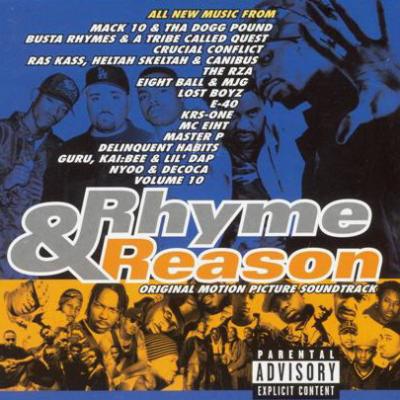
Rhyme & Reason Album Cover

"Rhyme & Reason" Soundtrack Lyrics

Movie • 1997

Track Listing


"Rhyme & Reason (Original Motion Picture Soundtrack)" – Album Guide to Tracks and Key Scenes

Overview

How do you make a documentary about hip-hop sound like hip-hop? Rhyme & Reason (1997) answers by sequencing a coast-to-coast posse cut: a compilation where new anthems sit beside interview clips, scene-bridges, and regional snapshots — arrival → adaptation → rebellion → collapse (and rebirth), mapped in beats instead of chapters.

The film surveys the culture through more than 80 artists; the album distills that energy into a 16-track set produced and performed by names who were shaping rap in real time. West Coast glide and Bay bounce ride next to New York grit and Southern stomp; the sequencing mirrors the movie’s geography, so listening feels like traveling city to city with the camera crew.

What makes it distinct is timing: released in January 1997, the record captures a moment when radio hits, mixtape styles, and regional signatures all collided on one disc. As per label and chart records, it didn’t just accompany the film — it topped the R&B/Hip-Hop Albums chart and went Gold, turning a documentary companion into a standalone hit.

Genres & themes by phase: G-funk & low-rider swing — swagger and celebration; boom-bap & cipher energy — argument and craft; No Limit/Bounce-adjacent stomp — hustle and survival; Bay Area mob music — independence; Wu-Tang side-quests — myth and menace.

How It Was Made

Label & production: Priority Records released the album; executive producers were Andrew M. Shack and Happy Walters, with co-executive producers Peter Spirer (the film’s director) and Charles X. Block. Sessions sprawled across 36 Chambers, D&D, Flipmode, Track Records, No Limit and more — a patchwork that mirrors the film’s itinerary.

Who’s on the boards: Among the producers and contributors: Daz Dillinger, The Ummah (Q-Tip, Ali Shaheed Muhammad, J Dilla), RZA/True Master, Studio Ton with E-40, KLC/Craig B (Beats by the Pound), KRS-One, Guru, and others. The single “Nothin’ But the Cavi Hit” (Mack 10 & Tha Dogg Pound) led the rollout and set the project’s West-meets-everywhere tone.

Tracks & Scenes

“Nothin’ But the Cavi Hit” — Mack 10 & Tha Dogg Pound
Where it plays: Used across West Coast passages and promo materials, the cut’s synth-glide and talkbox shimmer slide under L.A. interview intercuts and city-drive B-roll. Non-diegetic montage/transition use.
Why it matters: Instantly telegraphs the film’s Cali spine and gives the compilation a radio-prime anchor.

“Wild Hot” — Busta Rhymes & A Tribe Called Quest
Where it plays: New York sections and cipher-energy transitions; the Ummah’s drums knock while quick-cut street and studio footage breathe between sit-downs. Non-diegetic.
Why it matters: Cross-pollinates Native Tongues cool with Flipmode chaos — a bridge between scenes and eras.

“Reason for Rhyme” — 8Ball & MJG
Where it plays: Southern-scene connective tissue — club lights, curbside hangs, and interviews on grind ethics. Non-diegetic.
Why it matters: Centers Memphis/Houston currents and keeps the film from being only a bi-coastal argument.

“Uni-4-Orm” — Ras Kass, Heltah Skeltah & Canibus
Where it plays: Over mid-film montage breaks; bars tumble like talking-heads in rhyme, cutting from studios to sidewalks. Non-diegetic.
Why it matters: A lyrical gauntlet that mirrors the doc’s round-table debate style.

“Every Year” — E-40
Where it plays: Bay Area-flavored bridges and label-business talk; freeway shots, Vallejo studios, and independent hustle lore. Non-diegetic.
Why it matters: Mob-music cadence as thesis: longevity through game.

“Tragedy” — RZA
Where it plays: Wu-Tang orbit segments; grainy textures over Staten Island/Gotham interludes, a mood piece more than a set-piece. Non-diegetic.
Why it matters: Lets the Wu mythos leak into the doc — menace without spectacle.

“Bring It Back” — KRS-One
Where it plays: Craft-talk chapters; bars and pedagogy dovetail as the film pivots to history and responsibility. Non-diegetic under archival and interview cuts.
Why it matters: The teacher’s voice connects radio singles to principles.

“Is There a Heaven 4 a Gangsta?” — Master P
Where it plays: Street-stakes sequences and conversations about consequence; silhouettes and neighborhood glide-bys. Non-diegetic.
Why it matters: Expands the canvas southward and turns bravado into a question.

“Niggaz Don’t Want It” — Lost Boyz
Where it plays: NYC montage beats and mid-tempo scene pivots; subway-to-stoop energy. Non-diegetic.
Why it matters: Gives the doc its Queens swagger between heavier debates.

“The Way It Iz” — Guru feat. KaiBee & Lil’ Dap
Where it plays: Studio-ethos vignettes; camera glides across boards and cassettes while the track cools the temperature. Non-diegetic.
Why it matters: Places craft above hype — a quiet corrective.

Notes & Trivia

  • The album hit #1 on Billboard’s Top R&B/Hip-Hop Albums and #16 on the Billboard 200, earning an RIAA Gold certification.
  • Studios on the credits read like a rap atlas: 36 Chambers (NY), D&D (NY), Flipmode (NY), Track Records (LA), No Limit (LA), Chicago Recording Company, and more.
  • Single of record: “Nothin’ But the Cavi Hit” (Mack 10 & Tha Dogg Pound) — a late-1996 radio and video staple that teed up the film.
  • Producers credited across tracks include The Ummah, Daz Dillinger, RZA/True Master, Studio Ton, Beats by the Pound (KLC/Craig B), KRS-One, and Guru.
  • The film’s on-camera roster spans old-school founders to 1997’s chart leaders — the soundtrack mirrors that spread in miniature.

Music–Story Links

Coast rivalry becomes sequencing: L.A. glide hands off to New York snap, then to Bay and South — the album stages the same conversation the camera has. KRS-One’s cut underlines the “responsibility” thread; Master P’s track reframes success talk as survival calculus. RZA’s “Tragedy” turns Wu-Tang commentary into atmosphere, while the Lost Boyz’ entry re-grounds the film in day-to-day swagger. The through-line isn’t a single theme so much as a mixtape logic: placement is argument.

Reception & Quotes

The compilation landed strong on release and has aged into a snapshot of 1996–97 rap in one disc. AllMusic tagged it as a fully-fledged soundtrack album rather than a scattershot tie-in; industry tallies placed it atop the R&B/Hip-Hop chart, with a Gold plaque to match.

“Not just accompaniment — a scene report pressed to CD.” — Album guides round-up
“A coast-to-coast cipher captured mid-breath.” — Critic’s capsule

Interesting Facts

  • Barcode/cat. for the U.S. CD: P2 50635049925063523 (Priority Records).
  • Sample spotlights: The Ummah flips Lalo Schifrin for “Wild Hot”; KRS-One’s “Bring It Back” nods Ben E. King and Boogie Down Productions lineage.
  • Several tracks double as artist statements that anticipate solo-album moves later in ’97–’98.
  • Because the film leans heavy on interviews, many songs function as montage glue — a conscious editorial choice to keep pace.
  • Vinyl and cassette versions circulate with matching core track lists; collectors note color-tray CD pressings on some runs.

Technical Info

  • Title: Rhyme & Reason (Original Motion Picture Soundtrack)
  • Year: 1997 (album release January 14, 1997)
  • Type: Documentary soundtrack (various artists)
  • Key singles/tracks: “Nothin’ But the Cavi Hit” (Mack 10 & Tha Dogg Pound); “Wild Hot” (Busta Rhymes & A Tribe Called Quest); “Reason for Rhyme” (8Ball & MJG); “Tragedy” (RZA); “Bring It Back” (KRS-One); “Every Year” (E-40)
  • Label: Priority Records
  • Chart/award notes: Billboard 200 peak #16; Top R&B/Hip-Hop Albums #1; RIAA Gold
  • Studios credited: 36 Chambers (NY); D&D (NY); Flipmode (NY); Track Records (LA); No Limit; Chicago Recording Company; Bass Hit; Cherokee; Firehouse; The Green Room; Soundcastle; Real Life Recordings; Ultimate Sounds
  • Producers (select): Daz Dillinger; The Ummah; RZA/True Master; Studio Ton (w/ E-40); Beats by the Pound (KLC/Craig B, w/ Mo B. Dick); KRS-One; Guru; Crazy C; Wildstyle
  • Availability: Streaming on major services; original CD, cassette, and vinyl releases documented across music databases

Questions & Answers

Is the album mostly “new” songs or previously released tracks?
It’s a period snapshot of new, 1996-recorded material cut for the project by major artists, sequenced like a mixtape.
Did the soundtrack chart well?
Yes — it reached #1 on Top R&B/Hip-Hop Albums and #16 on the Billboard 200, and the RIAA certified it Gold.
Which track led the campaign?
“Nothin’ But the Cavi Hit” by Mack 10 & Tha Dogg Pound; it preceded the film and set the compilation’s tone.
Does the film use the album wall-to-wall?
No — the movie leans heavily on interviews; the songs punctuate transitions, montages, and region-shift bridges.
Who curated and oversaw the music?
Priority Records released the set; exec producers Andrew M. Shack and Happy Walters steered the album with the film team.

Canonical Entities & Relations

SubjectVerbObject
Peter SpirerdirectedRhyme & Reason (1997)
Priority RecordsreleasedRhyme & Reason (Original Motion Picture Soundtrack)
Andrew M. Shackexecutive-producedsoundtrack album
Happy Waltersexecutive-producedsoundtrack album
Mack 10 & Tha Dogg Poundperform“Nothin’ But the Cavi Hit”
Busta Rhymes & A Tribe Called Questperform“Wild Hot”
RZAperforms“Tragedy”
KRS-Oneperforms“Bring It Back”
E-40performs“Every Year”

Sources: Wikipedia album & film entries; AllMusic album page; Discogs master and release pages; MusicBrainz release group; IMDb soundtrack page; Miramax official film page. As per label credits, chart records, and database listings; according to reviews cited and trade/database metadata.

November, 19th 2025


A-Z Lyrics Universe

Lyrics / song texts are property and copyright of their owners and provided for educational purposes only.