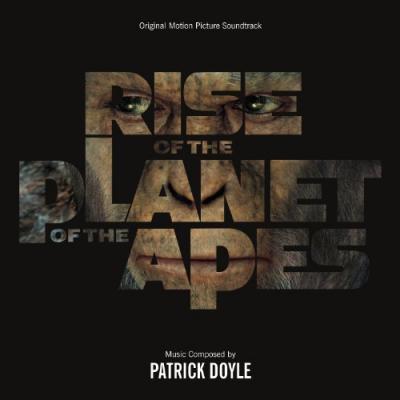
"Rise Of The Planet Of The Apes" Soundtrack Lyrics
Movie • 2011
Track Listing
Patrick Doyle
Patrick Doyle
Patrick Doyle
Patrick Doyle
Patrick Doyle
Patrick Doyle
Patrick Doyle
Patrick Doyle
Patrick Doyle
Patrick Doyle
Patrick Doyle
Patrick Doyle
Patrick Doyle
Patrick Doyle
Patrick Doyle
Patrick Doyle
Patrick Doyle
Patrick Doyle
Patrick Doyle
Patrick Doyle
Patrick Doyle
Patrick Doyle
Patrick Doyle
Patrick Doyle
Claude Debussy
Johann Sebastian Bach
Joseph Bonn
Jim Blake
Purple Melon
Daniel J. Nielsen
Alex North
"Rise of the Planet of the Apes (Original Motion Picture Soundtrack)" – Album Guide to Tracks and Key Scenes
Overview
How do you score a film where the protagonist speaks only once — and that word has to ring like a bell? Rise of the Planet of the Apes answers with rhythm you can feel in your ribs: deep percussion, bass-region chorus, and a theme that learns to stand. The album plays like a fuse — arrival → adaptation → rebellion → collapse — until the bridge becomes a drum line.
Composer Patrick Doyle threads the film with three core ideas: a searching figure for Caesar’s curiosity, a family lyric for the home scenes, and a brass-led revolt motif that detonates in the second half. The palette is deliberately earthy: low strings, toms, metal scrapes, and chant under a dry, close mix that lets specialty percussion bite. According to album/label notes and contemporary coverage, Doyle recorded with the Hollywood Studio Symphony, conducted by James Shearman, and produced the album with Maggie Rodford.
Unlike later sequels (with Michael Giacchino’s pun-happy titles), Rise keeps the track names functional — practically scene headings — so the record doubles as a map of the uprising. The few source cues (Debussy at the piano; Bach in a later scene) sketch character with a wink while the score does the heavy lift.
Genres & themes by phase: drum-and-chant textures — intuition, pre-language; string ostinati — problem-solving; choral bass and metallic hits — confinement and group identity; broad brass — revolt; hushed woodwinds — home and consequence.
How It Was Made
Score conception. Doyle’s brief: carry plot during long stretches without dialogue. He leans on percussion and “low and deep” orchestral colors; the chorus often functions as rhythm rather than melody, giving scenes a heartbeat without stealing focus. The team tracked at Fox’s Newman Scoring Stage with a tight blend that sits around the film’s detailed sound design.
Recording & release. The 24-track album — Rise of the Planet of the Apes (Original Motion Picture Soundtrack) — arrived August 2011 on Varèse Sarabande/Fox Music, running just over an hour. The sequencing mirrors the narrative, from “The Beginning” to “Caesar’s Home,” with the Golden Gate run presented as a multi-cue suite.
Tracks & Scenes
“The Beginning” — Patrick Doyle
Where it plays: Opening setup through early lab beats and title; a coiled ostinato plants the DNA of the score.
Why it matters: Establishes tension-without-spectacle — curiosity already sounds dangerous.
“Bright Eyes Escapes”
Where it plays: Lab chaos as an experimental chimp bolts; alarms, glass, and a snare-driven sprint.
Why it matters: First statement of peril that isn’t villain-coded — the score keeps sympathy fluid.
“Stealing the 112”
Where it plays: Will removes ALZ-112 from Gen-Sys. Pulse clicks like a timer; muted brass glints.
Why it matters: The act that seeds everything — music frames theft as necessity, not thrill.
“Muir Woods”
Where it plays: Family exhale under cathedral trees; woodwinds and gentle strings float above soft percussion.
Why it matters: A memory-place motif — later it returns like home calling.
“Who Am I?”
Where it plays: Caesar’s dawning self-awareness and room-testing; the theme steps upward but never quite resolves.
Why it matters: Teaches the ear to hear growth before we see it.
“Caesar Protects Charles”
Where it plays: The neighbor confrontation turns; timpani and brass flare as Caesar defends Charles, then a stunned hush.
Why it matters: The first unforgivable act — scored like a reflex, not a plan.
“The Primate Facility” → “Dodge Hoses Caesar” → “Rocket Attacks Caesar”
Where it plays: Intake, humiliation, and pecking-order violence in captivity. Drums tighten; chorus drops to the floor.
Why it matters: A three-cue lesson in power — each hit teaches Caesar what to remember.
“Visiting Time” → “‘Caesing’ the Knife”
Where it plays: Will’s visits, then the knife-steal beat that shifts leverage inside the cages.
Why it matters: The plan begins. Small sounds, huge consequences.
“Buck Is Released”
Where it plays: The big gorilla’s breakout to aid Caesar; revolt motif erupts full-throated.
Why it matters: First time the brass says “we.”
“Charles Slips Away”
Where it plays: Farewell to the only truly safe home Caesar knew. Strings alone, almost no percussion.
Why it matters: Grief clears the runway for the next decision.
“Inhaling the Virus”
Where it plays: A lab accident with global consequences; anxious pulses and processed timbres.
Why it matters: Science stops being neutral.
“Caesar Says No”
Where it plays: The word lands — NO — and the cue surges like a dam breaking; rhythm turns into command.
Why it matters: The film’s hinge. The score doesn’t undercut the silence; it crowns it.
“Gen-Sys Freedom” → “Zoo Breakout”
Where it plays: Locks open; cages empty; a city wakes up to company. Percussion spreads across the stereo field.
Why it matters: Community builds in real time — you can hear the headcount grow.
“Golden Gate Bridge” → “The Apes Attack” → “Caesar and Buck”
Where it plays: The set-piece: fog, cables, horses, and tactics. Brass and drums trade blows; then a sacrificial elegy.
Why it matters: Strategy in sound — motives, not noise.
“Caesar’s Home”
Where it plays: Final ascent in Muir Woods; theme returns, broadened — not victory, but arrival.
Why it matters: The album’s release valve; tomorrow’s problems can wait.
Not on the score album (source/needle moments, heard in-film): Debussy’s “Clair de lune” at Charles’s piano (struggling early, cleaner after treatment); a Bach Prelude & Fugue No. 15 excerpt for a later practice beat; old folk standard “Turkey in the Straw” used briefly as source. A library/indie cue like Purple Melon’s “Kings of the World” turns up as background in ancillary materials; the feature leans overwhelmingly on Doyle’s score.
Notes & Trivia
- The album runs 24 tracks, ~61 minutes; label copy credits Varèse Sarabande/Fox Music.
- Conductor James Shearman leads the Hollywood Studio Symphony; Doyle and Maggie Rodford are credited producers.
- Several cues (“Buck Is Released,” “Golden Gate Bridge”) showcase the revolt motif — a brassy, Goldsmith-tinted battle cry.
- Source music at the piano tells story: “Clair de lune” telegraphs decline; later Bach suggests clarity (and what’s lost).
- The mix is notably “dry” for a blockbuster score — attack and rhythm over reverb wash.
Music–Story Links
When Caesar tests the edges of his world, the score uses patient ostinati — thought in motion. Once he’s caged, percussion tightens and the chorus drops into the floor, making the space feel smaller. The revolt motif doesn’t appear fully until others join him; it’s literally social. On the bridge, brass phrases sound like commands — divide, flank, hold — while strings keep the emotional ledger so sacrifice stings.
Reception & Quotes
Critics clocked how Doyle brought emotional shape to a largely wordless protagonist while still delivering modern action gear. Album reviewers praised the thematic clarity and the bridge sequence as a stand-alone set piece.
“A mainstream franchise score that still sounds like Doyle — melodic roots under a muscular surface.” — soundtrack review
“The only Apes entry here that tries to give the apes themselves a full emotional arc.” — album overview
Interesting Facts
- The album sequencing closely matches the film cut; it’s essentially a narrative record — easy to scene-match.
- Doyle built a recurring motif from animal vocal material, then wove it into percussion patterns.
- The chorus sits low in the register — more drum than hymn — to avoid competing with effects.
- Some international discs carry Fox Music co-branding alongside Varèse Sarabande catalog number VSD-7106 / 302 067 106 2.
- Debussy’s “Clair de lune” at the piano became a small fan-memory hook — a human tender spot inside the tech spectacle.
Technical Info
- Title: Rise of the Planet of the Apes — Original Motion Picture Soundtrack
- Year: 2011
- Type: Feature film score (album)
- Composer/Producer: Patrick Doyle
- Conductor: James Shearman
- Orchestra/Chorus: Hollywood Studio Symphony; bass-register chorus (featured)
- Label/Cat. No.: Varèse Sarabande / Fox Music — VSD-7106 (302 067 106 2)
- Length/Tracks: ~61:17 • 24 tracks
- Key cues (select): “Bright Eyes Escapes”; “Who Am I?”; “Caesar Protects Charles”; “Buck Is Released”; “Caesar Says No”; “Gen-Sys Freedom”; “Golden Gate Bridge”; “Caesar’s Home”
- Recording: Newman Scoring Stage, 20th Century Fox Studios
- Availability: Streaming (major services) and 2011 CD release
Questions & Answers
- Does the album include the piano pieces heard in the film?
- No — Debussy’s “Clair de lune” and a Bach prelude/fugue excerpt are source cues in the film; the commercial album focuses on Doyle’s score.
- What’s the cue for the Golden Gate sequence?
- It’s spread across “Golden Gate Bridge,” “The Apes Attack,” and “Caesar and Buck,” functioning as one suite.
- Where was the score recorded?
- At Fox’s Newman Scoring Stage with the Hollywood Studio Symphony, conducted by James Shearman.
- What’s special about “Caesar Says No”?
- It frames the franchise’s defining moment — the first spoken “No” — with a surge from pulse to proclamation.
- Is this the same musical approach as the sequels?
- No. Rise is Doyle; later entries shift to Michael Giacchino with a different thematic and titling style.
Canonical Entities & Relations
| Subject | Verb | Object |
|---|---|---|
| Patrick Doyle | composed | Rise of the Planet of the Apes score |
| James Shearman | conducted | Hollywood Studio Symphony |
| Maggie Rodford | produced | soundtrack album |
| Varèse Sarabande / Fox Music | released | 2011 soundtrack CD/digital |
| Rupert Wyatt | directed | Rise of the Planet of the Apes (2011) |
| Jerry Goldsmith | influenced | series’ musical lineage (referenced by reviewers) |
| Michael Giacchino | scored | later sequels in the reboot series |
Sources: Official album pages (Apple/Spotify); Varèse Sarabande release data and Discogs entry; Wikipedia entries (film & soundtrack) for recording/credits; Filmtracks and Movie-Wave reviews for thematic notes; SoundtrackCollector listing; trailer/channel assets from the studio.
November, 19th 2025
Get info about 'Rise of the Planet of the Apes', an American science fiction film: Wikipedia, IMDbA-Z Lyrics Universe
Cynthia Erivo Popular
Ariana Grande Horsepower
Post Malone Ain't No Love in Oklahoma
Luke Combs Good Riddance (Time of Your Life)
Green Day Bye Bye Bye
*NSYNC You're the One That I Wan
John Travolta & Olivia Newton-John I Always Wanted a Brother
Braelyn Rankins, Theo Somolu, Kelvin Harrison Jr. and Aaron Pierre The Power of Love
Frankie Goes to Hollywood Beyond
Auli’i Cravalho feat. Rachel House MORE ›