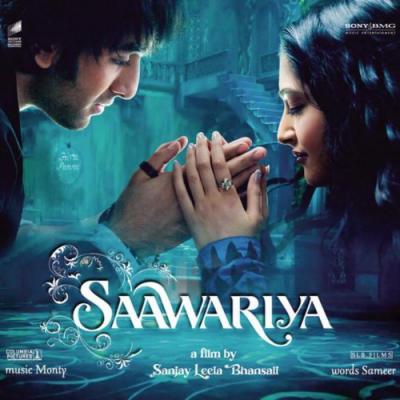
"Saawariya" Soundtrack Lyrics
Movie • 2007
Track Listing
Shail Hada
Shaan
Kunal Ganjawala, Shreya Ghoshal
Shreya Ghoshal
Parthiv Gohil
Parthiv Gohil, Shail Hada, Richa Sharma
Shreya Ghoshal
Kunal Ganjawala, Shreya Ghoshal
Kunal Ganjawala
Alka Yagnik
Shail Hada
“Saawariya (Original Motion Picture Soundtrack)” – Album Guide to Tracks and Key Scenes
Overview
Can a soundtrack feel like moonlight poured over a stage set? Saawariya answers with a glowing yes: every cue is dipped in blue, every melody floats like mist in an imaginary city. The album’s spine is romance—arrival → infatuation → doubt → devotion—expressed through classic filmi forms and Sanjay Leela Bhansali’s theatrical world-building.
Monty Sharma’s compositions (with a pivotal guest tune by Bhansali himself) lean on lilting waltzes, sufi-pop swells, and soft-rock contours. Vocals do the heavy lifting: Shaan’s boyish wonder, Shreya Ghoshal’s silvery shyness, Kunal Ganjawala’s ardor, Parthiv Gohil’s sufi shimmer, and Shail Hada’s heralding title motif. The film may divide audiences, but the music stands apart—glossy, melodic, unabashedly sincere.
The soundtrack doesn’t just decorate scenes; it is the scene. Songs are staged as diegetic performances in bars, on bridges, under lanterns, in letters; then they spill into non-diegetic reprise, braiding score and story. According to the film’s release notes and award tallies, the album became one of the year’s talking points even as the movie struggled commercially.
Genres & themes by phase. Dream-waltz and torch ballad — innocence & first sight. Sufi-trance and mid-tempo pop — yearning & ritual. Ghazal-lite and lullaby — doubt & memory. Festive filmi dance — decision & destiny.
How It Was Made
Composer Monty Sharma crafts the primary score and songs; lyric duties are led by Sameer Anjaan with key contributions from Sandeep Nath and Nusrat Badr. One centerpiece, “Thode Badmaash,” is composed by Sanjay Leela Bhansali, a signature he’d expand in later films. The album released under Sony’s India arm in September 2007 ahead of the film’s November bow, and quickly drew strong coverage for its vocals and arrangements.
Instrumentation favors shimmering strings, harmonium, mandolin flourishes, and brushed drums; arrangements pivot from intimate (a single voice and heartbeat rhythm) to stage-filling (full chorus, dhol, and brass). Editorially, numbers are designed as tableaux—each song blocks character movement with choreographic intent (e.g., lantern-lit processions, barroom platforms, a moon-washed canal). As per trade reporting, the album sold robustly in India for 2007’s crowded slate.
Tracks & Scenes
“Saawariya” — Shail Hada
Where it plays: Raj’s signature, performed on the RK Bar stage with Gulabji in frame. The camera circles him through fountains of neon and mist; later, on Eid night, he returns to sing it as a plea to Sakina. Mid-to-late film; diegetic, then quoted in score.
Why it matters: A calling card and thesis: love as performance, optimism as melody. It frames Raj as troubadour-guide to Bhansali’s toy-town.
“Jab Se Tere Naina” — Shaan
Where it plays: Early in the film as Ranbir’s wide-eyed romantic takes flight; the choreography toggles from cheeky boy-next-door to free-falling crush, the infamous towel-drop moment sealing his arrival. Early film; diegetic performance stylized into montage.
Why it matters: Pure infatuation. The rhythm skips like heartbeat; the hook becomes Raj’s inner monologue.
“Masha-Allah” — Kunal Ganjawala & Shreya Ghoshal
Where it plays: The first nocturnal encounter of Raj and Sakina on the bridge and a flower-strewn boat. Moonlight spills blue; her veil slips; he breathes, “Masha-Allah,” as they drift under an arch. Early-middle film; diegetic singing that dissolves into a soaring non-diegetic refrain.
Why it matters: Names the enchantment. It’s the movie’s spell-casting: awe before identity, devotion before detail.
“Thode Badmaash” — Shreya Ghoshal (music by Sanjay Leela Bhansali)
Where it plays: A letter-writing, blush-and-smile sequence for Sakina. She tests the waters of affection, scolding and teasing in the same breath; quick cuts of narrow lanes, paper boats, and shy glances. Mid film; non-diegetic with diegetic echoes of humming.
Why it matters: Character point-of-view. The melody is delicate but decisive: desire finding words.
“Yun Shabnami” — Parthiv Gohil
Where it plays: A lantern-lit procession beneath the clock tower; powder-blue night and silver confetti. Choreography builds from sways to spins as the neighborhood becomes chorus. Mid-late film; staged diegetically with crowd participation.
Why it matters: Communal rapture. The sufi-pop lilt frames Raj’s idealism against the town’s rituals.
“Chhabeela” — Alka Yagnik
Where it plays: Gulabji’s quarter turns carnival—courtesans in sequins, balcony drums, and neon rain. She steals the spotlight with a wink straight into camera. Early-mid film; diegetic club performance.
Why it matters: World-building and power dynamics. Gulabji owns the room; the song sketches her as protector and provocateur.
“Jaan-E-Jaan” — Kunal Ganjawala & Shreya Ghoshal
Where it plays: Lovers separated by arcades and shadows. Cutaways to clock hands and a letter folded twice; a suspended final note hangs over a midnight street. Late film; non-diegetic montage that previews the choice to come.
Why it matters: The ache before an answer. Harmony suggests two futures pulling at the same heart.
“Daras Bina Nahin Chain” — Richa Sharma, Shail Hada, Parthiv Gohil
Where it plays: A semi-devotional interlude at the water’s edge; candles float, the chorus rises, and Raj watches Sakina pray for a promise. Mid film; diegetic ritual with orchestral underscoring.
Why it matters: Places faith on the table—love as vow, not vibe.
“Pari” — Kunal Ganjawala
Where it plays: Raj narrates Sakina’s otherworldliness amid billowing curtains and streetlamps; quick inserts of her anklet and veil become leitmotifs. Middle film; non-diegetic, then source music peeks from a passing bandstand.
Why it matters: A character sketch in three refrains. The arrangement paints her as both near and unreachable.
Notes & Trivia
- “Thode Badmaash” is the outlier: composed by director Bhansali, not Monty Sharma.
- Shail Hada’s title track doubles as a motif; he later became a frequent Bhansali vocal collaborator.
- The soundtrack snagged major playback and debut nominations across Indian awards; Shaan won for “Jab Se Tere Naina.”
- The imaginary town set (clock tower, canal, RK Bar) was designed to stage songs like theatre numbers.
- Despite the film’s box-office stumble, the album sold strongly for 2007 and stayed a catalog staple.
Music–Story Links
- When Raj first sings “Saawariya” on stage, performance equals confession; later, the reprise becomes a last-ditch proposal.
- “Jab Se Tere Naina” signals the crush as destiny—rhythm racing ahead of reason.
- “Masha-Allah” baptizes the bridge as sacred space; each return to it echoes that benediction.
- “Yun Shabnami” turns private longing public; the town’s chorus pressurizes Raj’s hope.
- “Jaan-E-Jaan” foreshadows the finale: two melodies, two paths, one inevitable goodbye.
Reception & Quotes
Contemporary reviews praised the melodies, new voices, and orchestral sheen even as they debated consistency. The film itself polarized; the music traveled. According to a year-end roundup, the title song, “Jab Se Tere Naina,” and “Masha-Allah” anchored radio rotations long after release.
“In entirety, the soundtrack is a superior product… well done, Monty!” Rediff (music review)
“Shail Hada’s title tune lilts; ‘Masha-Allah’ enchants.” Milliblog (album notes)
“Shaan’s ‘Jab Se Tere Naina’ — Best Male Playback.” Filmfare / IIFA listings
Interesting Facts
- Label & date: Sony BMG (India), album out mid-September 2007 ahead of the November release.
- Award math: Shaan’s “Jab Se Tere Naina” swept multiple ceremonies; Shreya’s “Thode Badmaash” drew nominations.
- One-city set: The backlot build lets every song “own” a location (bridge, bar, clock tower, canal).
- Reprise logic: The title theme returns as emotional punctuation rather than filler.
- Catalog life: The album remains widely available (Apple Music, Spotify) in its 11-track configuration.
- Credits mix: Sameer leads lyrics, with Sandeep Nath (“Yun Shabnami”) and Nusrat Badr (“Thode Badmaash”) adding distinct flavors.
- Box-office vs. jukebox: Film underperformed; the OST landed among the year’s stronger sellers.
Technical Info
- Title: Saawariya (Original Motion Picture Soundtrack)
- Year: 2007 (album 19 September 2007; film 9 November 2007)
- Type: Feature film soundtrack (Hindi)
- Composer: Monty Sharma (except “Thode Badmaash” by Sanjay Leela Bhansali)
- Lyricists: Sameer Anjaan; Sandeep Nath (“Yun Shabnami”); Nusrat Badr (“Thode Badmaash”)
- Key vocals: Shail Hada, Shaan, Shreya Ghoshal, Kunal Ganjawala, Parthiv Gohil, Alka Yagnik, Richa Sharma
- Label: Sony BMG / Sony Music Entertainment India
- Album length: ~48 minutes (11 tracks, standard edition)
- Sales/notes: ~1,000,000 units in India; one of 2007’s notable sellers despite the film’s box-office fate.
- Availability: Streaming (Apple Music, Spotify); original CD in circulation via Sony India.
Questions & Answers
- Which song won the big award from this album?
- Shaan’s “Jab Se Tere Naina” took Best Male Playback at Filmfare and IIFA.
- Why does “Thode Badmaash” sound different?
- It’s composed by Sanjay Leela Bhansali—more ghazal-leaning and intimate than the Monty Sharma cues.
- Is the title track just an intro?
- No. It returns at a story pivot (Eid night), functioning as Raj’s plea and the film’s emotional refrain.
- What’s the visual signature of these songs?
- Indigo palettes, constructed sets, and theatre-style blocking—music staged as living tableaux.
- Where can I hear the canonical album?
- The 11-track Sony release is on major platforms; most copies mirror the theatrical song order.
Canonical Entities & Relations
| Subject | Relation | Object |
|---|---|---|
| Monty Sharma | composed | Saawariya soundtrack (primary songs/score) |
| Sanjay Leela Bhansali | composed | “Thode Badmaash” (single track) |
| Sameer Anjaan | wrote lyrics for | Title song, “Jab Se Tere Naina,” and others |
| Sandeep Nath | wrote lyrics for | “Yun Shabnami” |
| Nusrat Badr | wrote lyrics for | “Thode Badmaash” |
| Shail Hada | sang | “Saawariya” (title song) & reprise |
| Shaan | sang | “Jab Se Tere Naina” (award-winning) |
| Shreya Ghoshal | sang | “Thode Badmaash,” “Masha-Allah,” “Jaan-E-Jaan” |
| Kunal Ganjawala | sang | “Masha-Allah,” “Jaan-E-Jaan,” “Pari” |
| Parthiv Gohil | sang | “Yun Shabnami” |
| Alka Yagnik | sang | “Chhabeela” |
| Sony Music Entertainment India | released | Saawariya (Original Motion Picture Soundtrack) |
| Columbia Pictures / SPE Films India | co-produced | Saawariya (film) |
| RK Bar (set) | hosts | Title performance and Eid reprise |
Sources: Wikipedia (film & soundtrack entries); Apple Music album page; IMDb Soundtracks; Rediff music review; Milliblog review; Box Office India figures; Times of India coverage; YouTube trailer channel/album jukebox.
November, 26th 2025
A-Z Lyrics Universe
Cynthia Erivo Popular
Ariana Grande Horsepower
Post Malone Ain't No Love in Oklahoma
Luke Combs Good Riddance (Time of Your Life)
Green Day Bye Bye Bye
*NSYNC You're the One That I Wan
John Travolta & Olivia Newton-John I Always Wanted a Brother
Braelyn Rankins, Theo Somolu, Kelvin Harrison Jr. and Aaron Pierre The Power of Love
Frankie Goes to Hollywood Beyond
Auli’i Cravalho feat. Rachel House MORE ›