Soundtracks:  A B C D E F G H I J K L M N O P Q R S T U V W X Y Z #


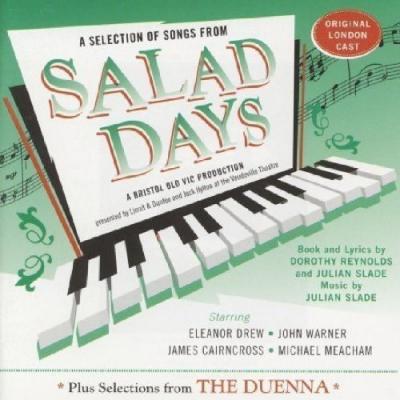
Salad Days Album Cover

"Salad Days" Soundtrack Lyrics

Musical • 1954

Track Listing


“Salad Days (Original London Cast Recording)” – Album Guide to Tracks and Key Scenes

Trailer still from a modern UK tour of Salad Days — a park bench, a push-along piano and dancers bursting into motion
Magic piano, summer-in-the-park optimism — the musical’s signature mood, then and now.

Overview

How do you bottle youth, luck and a little nonsense? Salad Days (1954) answers with a sunshine score where a magic piano makes everyone who hears it dance. The story tracks two fresh graduates, Timothy and Jane, through arrival → secret marriage → odd job → saucer-assisted finale; the album keeps pace with melodies that feel like park breezes and teashop chatter.

Julian Slade’s tunes are quick-footed and hilariously singable; Dorothy Reynolds’s lyrics wink without ever sneering. The sound world is light-foot orchestrations, nimble patter, and choruses that bloom the moment the onstage piano “Minnie” starts playing. As per cast-album notes, the London cast (Eleanor Drew, John Warner, et al.) cut a compact recording that preserves the show’s daisy-chain of numbers and comic set pieces.

Distinctive flavor? Earnest silliness. A UFO drops in for helpful advice, mothers complain that they “don’t understand our children,” and an employment agency keeps sending Timothy to increasingly silly posts. It’s buoyant, British, and built to make a room grin.

Genres & themes by phase. Music-hall sparkle — youthful bravado. Pastoral romance — “park-bench forever” optimism. Patters & reprises — society fuss vs. free spirits. Waltz-to-march finales — nonsense becomes destiny.

How It Was Made

Commissioned as a summer musical by the Bristol Old Vic, the show opened there in June 1954 before transferring to the Vaudeville Theatre, where it ran an astounding 2,283 performances — at the time a record-breaker for the West End. Slade (music) and Reynolds (book/lyrics) wrote with the resident company in mind; Reynolds also performed in supporting roles. The Original London Cast recording was issued that same year, with later reissues keeping the sequence familiar to fans (and newcomers who met the show via revivals).

Salad Days trailer still — chorus clustered around the park piano as dancers ripple outward
A piano nicknamed “Minnie,” a crowd, then—chaos: the show’s comic engine.

Tracks & Scenes

“The Things That Are Done by a Don” — Company
Where it plays: Graduation bustle and don-ish fuss as mortarboards settle and futures loom. Onstage chorus builds to a collegiate curtain-raiser.
Why it matters: Sketches the polite world our couple will gently rebel against.

“We Said We Wouldn’t Look Back” — Timothy & Jane
Where it plays: Early Act I: park bench, shared promise, secret marriage in the air. The melody floats like summer heat above soft pizzicato.
Why it matters: Defines the pair’s creed — forward momentum over proper planning.

“I Sit in the Sun” — Jane
Where it plays: A reflective breather: Jane weighs love, work, and weather, feet tucked beneath her on the grass. Gentle solo with woodwind filigree.
Why it matters: Gives the froth a heart; time pauses so character can bloom.

“Oh, Look at Me!” — Timothy & Jane
Where it plays: A giddy self-introduction duet as the pair try on adulthood. Quick patter exchanges punctuated by choral asides from passers-by.
Why it matters: Musical selfie; sets up the show’s love of reprise-based character beats.

“It’s Easy to Sing” — Timothy, Jane & Nigel
Where it plays: Employment-agency chaos; Nigel (the hilariously unhelpful friend) “assists” with a tune that insists everything’s simple.
Why it matters: Irony machine: nothing is easy, but the tune is.

“We’re Looking for a Piano” — Company
Where it plays: The hunt for Minnie begins: park paths, baffled bobbies, and an ever-growing crowd.
Why it matters: The show’s premise distilled — find piano, find joy (and trouble).

“Out of Breath” — Company
Where it plays: Ensemble whirlwind as Minnie sets off mass dancing; policemen, nannies and bystanders whirl into a breathless canon.
Why it matters: Proof of magic: one vamp and the world starts moving.

“The Saucer Song” — Timothy, Jane & Uncle Zed
Where it plays: Act II eccentricity delight: Uncle Zed lands in a saucer to offer interplanetary wisdom (as one does).
Why it matters: The musical’s cheerful absurdism at full tilt.

“The Time of My Life” — Jane
Where it plays: Later-act solo as stakes rise and Jane faces life without Minnie’s crutch.
Why it matters: Honest sentiment anchors the whimsy.

“We Don’t Understand Our Children” — The Mothers
Where it plays: Two posh mums lament modern youth in delicious counterpoint, tea cups clinking.
Why it matters: Generation gap, lovingly roasted.

“Sand in My Eyes” — (club cameo/novelty)
Where it plays: A comic turn that often stops the show in revivals, usually staged as a lounge interlude or seaside spoof.
Why it matters: Variety-slot wink reminding us this is a revue at heart.

Salad Days trailer frame — a UFO gag lights the stage while the ensemble gapes upward
Yes, a flying saucer drops by. No, you’re not dreaming — you’re in 1954’s happiest fantasy.

Music–Story Links

  • “We Said We Wouldn’t Look Back” turns a park-bench decision into a mission statement, reprising whenever courage is needed.
  • “Out of Breath” isn’t just a title — it’s the cause-and-effect of Minnie’s spell: crowds dance, plot quickens.
  • “It’s Easy to Sing” undercuts every sensible plan with blithe optimism; the joke deepens as jobs fail upward.
  • “The Saucer Song” reframes absurdity as rescue — the cosmos itself endorses young love.

Reception & Quotes

In 1954–60, Salad Days became a phenomenon, running 2,283 performances at the Vaudeville Theatre and, for a time, holding the West End longevity crown (before Oliver! and the U.S. juggernaut My Fair Lady surpassed it). The Original London Cast album distilled that charm into a tidy souvenir that’s kept the show freshly castable for decades.

“Commissioned for the Bristol Old Vic… moved to the Vaudeville and played an unprecedented 2,283 performances.” Masterworks Broadway
“A pure joy, uplifting and quirky… a magic piano and a flying saucer.” contemporary revival review
“Songs include ‘We Said We Wouldn’t Look Back,’ ‘Oh, Look at Me!,’ ‘We’re Looking for a Piano.’” licensing synopsis

Notes & Trivia

  • The title comes from Antony and Cleopatra: “My salad days…”
  • The original Bristol company transferred almost intact to London; Reynolds performed onstage and co-wrote the piece.
  • “Minnie” is the offstage star — a mobile piano whose vamp makes everyone dance.
  • There’s a saucer cameo; Uncle Zed pilots, naturally.
  • Multiple cast albums exist: 1954 Original London Cast; a stereo revival recording in 1976; later studio-cast editions.

Interesting Facts

  • Longest-run milestone: The 2,283-performance haul set a West End benchmark in the 1950s.
  • Tiny company, many roles: The original London run used 12 actors (plus a pianist) to play dozens of parts.
  • Career-launch pad: Early Bristol/London companies featured future British stage and screen stalwarts.
  • UFO continuity: Revivals still keep the flying-saucer gag — audiences expect it.
  • Recording family: The 1954 cast LP was followed by a stereo revival disc; digital reissues keep the show findable.

Technical Info

  • Title: Salad Days — Original London Cast Recording
  • Year: 1954 (musical premiere and cast album)
  • Type: Stage musical (Original Cast recording; later revival/studio recordings)
  • Music: Julian Slade
  • Book & Lyrics: Dorothy Reynolds & Julian Slade
  • Key numbers (selection): “The Things That Are Done by a Don,” “We Said We Wouldn’t Look Back,” “I Sit in the Sun,” “Oh, Look at Me!,” “It’s Easy to Sing,” “We’re Looking for a Piano,” “Out of Breath,” “The Saucer Song,” “We Don’t Understand Our Children,” “The Time of My Life.”
  • Original labels: Oriole (UK cast LP); later reissues via Masterworks/That’s Entertainment/EMI (various editions).
  • Run: Vaudeville Theatre, West End — 2,283 performances.
  • Plot essentials: Newlyweds guard a magic piano in a London park; chaos, jobs, mothers, and a UFO ensue.

Questions & Answers

Is the cast album a full plot document?
It’s a highlights-style Original London Cast recording — enough to track the story, not a complete libretto-in-song.
Why does everyone dance when the piano plays?
Because it’s Minnie, a “bewitched” piano — the musical’s central gag and catalyst.
Did Salad Days really hold a West End record?
Yes; its 2,283-performance run set a then-record for London musical longevity in the 1950s.
Are there modern recordings?
A stereo revival album (1976) and later studio-cast editions complement the 1954 OLC; digital reissues are available.
What’s with the flying saucer?
Uncle Zed arrives in one — a cheerful piece of 1950s sci-fi whimsy that helps resolve the plot.
Trailer still — finale tableau with Minnie center-stage and confetti, chorus mid-cadence
Finale glow: when optimism, a vamp, and a park bench feel like destiny.

Canonical Entities & Relations

SubjectRelationObject
Julian SladecomposedSalad Days (1954)
Dorothy Reynoldswrote (book & lyrics)Salad Days
Eleanor Dreworiginated roleJane (Original London Cast)
John Warneroriginated roleTimothy (Original London Cast)
Bristol Old Vic → Vaudeville Theatrepremiere → transferJune 1954 → August 1954 (2,283 performances)
Oriole RecordsreleasedOriginal London Cast recording (1954)
Concord TheatricalslicensesPerforming rights & materials

Sources: Masterworks Broadway (OLC notes); Concord Theatricals synopsis; Wikipedia (historical run, song roster, recordings); Ovrtur / CastAlbums (recording number titles); Discogs (1954 OLC release details); revival reviews noting the flying saucer and comic numbers; tour trailers (for figures).

November, 26th 2025


A-Z Lyrics Universe

Lyrics / song texts are property and copyright of their owners and provided for educational purposes only.