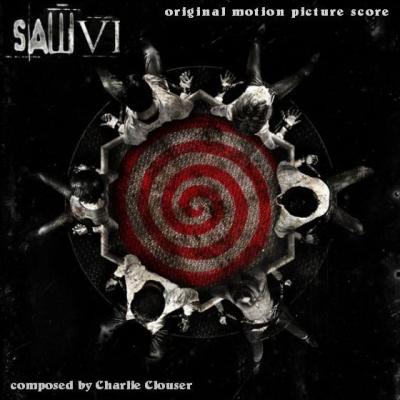
"Saw VI" Soundtrack Lyrics
Movie • 2009
Track Listing
Hatebreed
Lacuna Coil
It Dies Today
Mushroomhead
Chimaira
Danko Jones
Suicide Silence
Memphis May Fire
Outbreak
Shadows Fall
Type O Negative
Converge
Kittie
Nitzer Ebb
Every Time I Die
My My Misfire
The Flood
James Brothers
"Saw VI (Original Motion Picture Soundtrack / Score)" – Album Guide to Tracks and Key Scenes
Overview
What does a morality play sound like when it’s welded from steel and deadlines? Saw VI answers with a split spine: a label-driven, metal/EBM compilation on one side and Charlie Clouser’s cold-precision score on the other. Arrival → adaptation → rebellion → collapse — and then that last, merciless click.
The film pivots to a health-insurance gauntlet, so the music’s language hardens: industrial pulses and compressor-slam percussion under William Easton’s trials; serrated guitars and hardcore bursts around promos and transitions. The songs album reads like a 2009 heavy sampler (Hatebreed, Lacuna Coil, Converge, Kittie, Nitzer Ebb, Every Time I Die), while the screen itself is steered by Clouser’s motif logic culminating in “Zepp Six.”
As listening experiences, they diverge. The Soundtrack thrives as gym-grade adrenaline with a few franchise winks; the Score is the narrative’s metronome — metal-on-bone textures, clockwork builds, and the franchise theme tightening like a vise.
Genres & phases: EBM/industrial for surveillance and calculation; metalcore/thrash/post-hardcore for panic and pursuit; minimalist thriller scoring for revelations and endgame geometry.
How It Was Made
The commercial songs compilation streeted October 20, 2009 on Trustkill Records, collecting 18 core tracks (with digital editions listing 21) from Hatebreed, Lacuna Coil, Mushroomhead, Chimaira, Suicide Silence, Shadows Fall, Converge, Kittie, Nitzer Ebb and more. Trustkill’s liner notes credit Twisted Pictures and the franchise’s music team for curation, with bonus cuts appearing on digital storefronts.
Clouser composed the original score for the film; the endgame suite (“Zepp Six”) extends the series’ famous theme. While fans have circulated “complete sessions,” the score wasn’t broadly issued as a standalone retail album in 2009; official releases and suites surfaced across later franchise anthologies and platform uploads. According to contemporary soundtrack roundups and label pages, most needle-drops functioned as “inspired by” material rather than foregrounded dialogue beds.
Tracks & Scenes
“Zepp Six (Finale Suite)” — Charlie Clouser
Where it plays: Endgame stretch — William’s final test crosscut with Jill’s setup for Hoffman and the reverse bear trap escape attempt; continues into the credits in some versions as a suite.
Why it matters: The franchise theme returns with added mass — brass surges, mechanical pulses, and a grim, inevitable cadence.
“More Than a Sin” — The James Brothers
Where it plays: Heard over the theatrical end credits, serving as the lone prominent song placement after the finale’s score resolves.
Why it matters: A rare in-film needle-drop for this installment; the lyric hook underlines the chapter’s judgment vibe.
“In Ashes They Shall Reap” — Hatebreed
Where it plays: Featured on the album and in campaign tie-ins; used as non-diegetic energy around marketing and transition beats rather than dialogue beds.
Why it matters: Sets the compilation’s teeth — momentum and punishment in three minutes flat.
“Dark Horse” — Converge
Where it plays: Album standout; heard in franchise-adjacent cuts and promo slugs, not a foreground scene.
Why it matters: Hardcore whiplash that matches the film’s brutal, one-on-one trap design.
“Never Known” — Nitzer Ebb
Where it plays: EBM chassis that sits comfortably under surveillance and cross-cut montage energy; album cut.
Why it matters: The cleanest blade on the disc — clinical propulsion that mirrors the story’s spreadsheet logic.
“Cut Throat” — Kittie
Where it plays: Album feature commonly slotted to trailers/featurettes and home-media extras; not a dialogue-foregrounded scene.
Why it matters: Razor-edged chorus work that fits Hoffman-era ruthlessness.
“Ghost in the Mirror” — Memphis May Fire
Where it plays: Songs-disc placement often associated with home-media music-video extras; not a central scene bed.
Why it matters: A melodic counter-move inside an otherwise punishing compilation.
Notes & Trivia
- The Trustkill album lists 18 core tracks; digital storefronts show 21 with bonus songs.
- Artists range from hardcore and metalcore to EBM: Hatebreed, Converge, Every Time I Die, Kittie, Nitzer Ebb, Type O Negative, Mushroomhead, and more.
- End credits: the theatrical cut features “More Than a Sin” after Clouser’s finale suite.
- Director Kevin Greutert (longtime series editor) steps in here; the musical continuity remains via Clouser’s returning motifs.
- Home-media editions bundled artist music videos alongside film extras.
Music–Story Links
When Hoffman maneuvers behind the scenes, the music gets clinical: dry EBM pulses and sparse percussion make the room feel colder than the traps. As William faces individualized tests, Clouser’s motifs become a metronome — tick, scrape, surge — translating ethics into time signatures.
By the finale, guitars step aside and the score’s architecture takes over. “Zepp Six” threads prior themes through a harsher brass profile; it doesn’t comment — it sentences.
Reception & Quotes
Heavy-music outlets welcomed the return to an aggressive various-artists disc, while score watchers praised the finale’s construction. The general consensus: compilation for the gym; score for the autopsy.
“A fitting marriage — hard rock and metal as the sonic suitors of horror.” as summarized from AllMusic’s review
“Clouser’s endgame suite remains the franchise’s compass.” according to specialty score coverage
Interesting Facts
- Release pattern: Soundtrack streeted October 20, 2009; the film opened October 23, 2009.
- Label color: Trustkill’s digital edition advertises two bonus tracks and a PDF booklet.
- One clear in-film song: “More Than a Sin” is the notable theatrical credits needle-drop; most other album tracks are “inspired by.”
- Suite vs. single: Different cuts feature slightly different end-credits music assemblies (suite emphasis vs. added song).
- EBM thread: Nitzer Ebb’s inclusion keeps a lineage with earlier entries’ industrial DNA.
Technical Info
- Title: Saw VI — Original Motion Picture Soundtrack (various artists) / Original Motion Picture Score (Charlie Clouser)
- Year: 2009
- Composer: Charlie Clouser
- Label (songs): Trustkill Records (physical/digital)
- Release date (songs): October 20, 2009
- Notable artists (songs): Hatebreed; Lacuna Coil; Converge; Kittie; Every Time I Die; Nitzer Ebb; Mushroomhead; Chimaira; Suicide Silence; Shadows Fall
- Signature cue (score): “Zepp Six” (finale variant of the series theme)
- End-credits identifier: “More Than a Sin” (theatrical) following Clouser’s finale suite
- Availability: Songs — CD/digital/streaming (editions vary); Score — official suites and later compilations/platform uploads
Questions & Answers
- Is the songs album the same as the film’s score?
- No. The Trustkill compilation is a various-artists set; Clouser’s score underpins the movie’s scenes and finale.
- Which track closes the movie?
- The endgame is carried by Clouser’s “Zepp Six.” In the theatrical credits, “More Than a Sin” by The James Brothers follows.
- How many tracks are on the soundtrack?
- 18 core tracks; some digital editions list 21 with bonus cuts.
- Do most album songs play audibly in the film?
- No — most function as “inspired by” pieces tied to marketing, transitions, or home-media extras.
- Who directed this chapter, and did that change the musical approach?
- Kevin Greutert directed; Clouser returned, keeping the series’ thematic continuity while the compilation amped the heavy-music angle.
Canonical Entities & Relations
| Subject | Relation | Object |
|---|---|---|
| Kevin Greutert | directed | Saw VI (2009 film) |
| Charlie Clouser | composed score for | Saw VI (2009 film) |
| Trustkill Records | released | Saw VI (Original Motion Picture Soundtrack) |
| Hatebreed | performed | “In Ashes They Shall Reap” (songs album) |
| Lacuna Coil | performed | “The Last Goodbye” (songs album) |
| Converge | performed | “Dark Horse” (songs album) |
| Kittie | performed | “Cut Throat” (songs album) |
| Nitzer Ebb | performed | “Never Known” (songs album) |
| The James Brothers | performed | “More Than a Sin” (theatrical end-credits song) |
Sources: Trustkill Records album page; Apple/Spotify soundtrack listings; Wikipedia film entry (soundtrack section); Metalunderground lineup news; fan/industry cue breakdowns; IMDb soundtrack notes.
November, 26th 2025
A-Z Lyrics Universe
Cynthia Erivo Popular
Ariana Grande Horsepower
Post Malone Ain't No Love in Oklahoma
Luke Combs Good Riddance (Time of Your Life)
Green Day Bye Bye Bye
*NSYNC You're the One That I Wan
John Travolta & Olivia Newton-John I Always Wanted a Brother
Braelyn Rankins, Theo Somolu, Kelvin Harrison Jr. and Aaron Pierre The Power of Love
Frankie Goes to Hollywood Beyond
Auli’i Cravalho feat. Rachel House MORE ›