
"Scorpion King" Soundtrack Lyrics
Movie • 2002
Track Listing
Godsmack
P.O.D.
Drowning Pool
System Of A Down
Creed
Nickelback
Hoobastank
Flaw
Rob Zombie feat. Ozzy Osbourne
12 Stones
Mushroomhead
Lifer
Sevendust
Injected
Breaking Point
Coal Chamber
"The Scorpion King: Music from and Inspired by the Motion Picture" – Album Guide to Tracks and Key Scenes
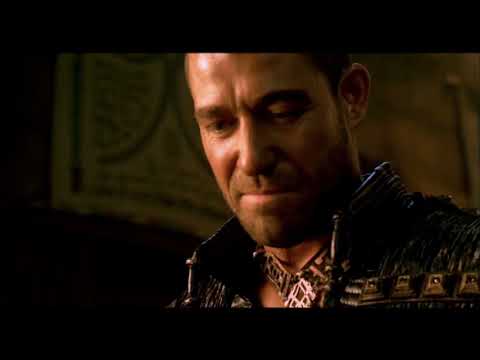
Overview
What happens when a sword-and-sand adventure borrows 2002’s loudest guitars? The Scorpion King answers with a two-tier soundtrack: a “music from & inspired by” compilation that courts rock radio, and a muscular orchestral score that does the narrative lifting — arrival → adaptation → rebellion → collapse.
The songs album launches with Godsmack’s “I Stand Alone,” a custom-written single that doubled as the film’s sonic calling card. Around it: P.O.D., System of a Down, Creed, Nickelback, Hoobastank, Rob Zombie with Ozzy Osbourne, and more — most tracks built to market the movie as much as to sit under dialogue.
Meanwhile, composer John Debney supplies a desert-flavored action score — full orchestra, choir, and color from duduk/ney/taiko — that steers ambushes, escapes, and the final siege. The split is deliberate: album for shelf appeal; score for story mechanics.
Genres & phases: nu-metal/alt-rock for bravado and promos; groove-metal for end-credits catharsis; big-screen symphonic writing with Middle-Eastern timbres for pursuit, prophecy, and battle.
How It Was Made
Albums & dates. The compilation The Scorpion King: Music from and Inspired by the Motion Picture streeted in spring 2002 on a Universal family imprint. The separately issued score album — The Scorpion King (Original Motion Picture Score) — collects 14 Debney cues (~40 minutes).
Score brief. Director Chuck Russell tapped Debney for a “gargantuan, desert-flavored” action palette — orchestra and choir with non-Western colors — to inherit the adventure mantle from the Mummy films while carving out Mathayus’s own motif set.
Lead single. Godsmack’s “I Stand Alone” was commissioned for the project and serviced to radio ahead of release; it later reappeared on the band’s 2003 album Faceless and became a long-running rock-radio staple.

Tracks & Scenes
“I Stand Alone” — Godsmack
Where it plays: Powers the end credits and campaigns hard in trailers/TV spots. Onscreen it’s the victory-lap release after the final siege — non-diegetic.
Why it matters: A character anthem for Mathayus; the lyric frames his lone-wolf arc while the riff cements the film’s 2002 identity.
“Along the Way” — Mushroomhead
Where it plays: Shares end-credits rotation with Godsmack in common releases; non-diegetic.
Why it matters: Keeps the heavy swing going through the scroll; one of the few album tracks actually used in-film.
“Marching-In” — The Taiko Drummers
Where it plays: Percussive source for a march/ceremony beat within the film (brief, diegetic-flavored needle-drop).
Why it matters: A texture cue: drumline swagger to sell a ritual spectacle.
Score picks — John Debney
“Main Titles” • “Night Attack” • “Valley of the Dead” • “The Cave” • “I’ve Come for the Woman” • “Balthazar Arrives” • “The Scorpion King.”
Where they play: Prologue sting, desert ambush, cursed-valley trek, tomb escape, palace infiltration, tribal standoff, and the final coronation beat — all non-diegetic score.
Why they matter: These cues carry the story’s rhythm: low strings and war drums for pursuit; bright brass when the tide turns; modal winds and chants around prophecy beats.
Note: The retail album is heavy on “inspired by” tracks; most needle-drops you know from the CD are not foregrounded in the film proper.
Notes & Trivia
- The songs album was certified Gold by the RIAA and hit notable chart positions in Canada.
- “I Stand Alone” topped U.S. Mainstream Rock and earned two Grammy nominations the following year.
- Only a couple of compilation cuts play in the movie itself; the rest are “inspired by” selections.
- Debney’s score album runs ~40 minutes across 14 cues; later archival/expanded editions add suites and demos.
Music–Story Links
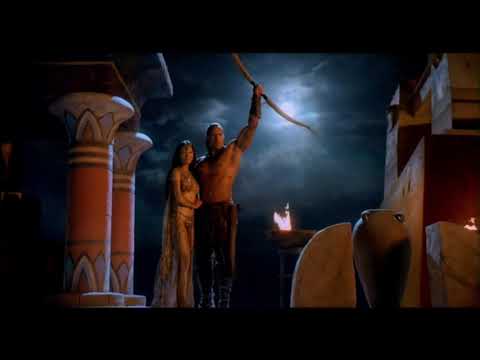
When Mathayus stalks through torchlit halls, the score leans low drums and snarling cellos — stealth with teeth. When the siege ignites, brass and choir widen the frame, turning close-quarters fighting into myth. The songs handle the billboard moments: a modern guitar wall over the credits to brand the hero as a lone force, and a second heavy cut to ride the scroll.
Reception & Quotes
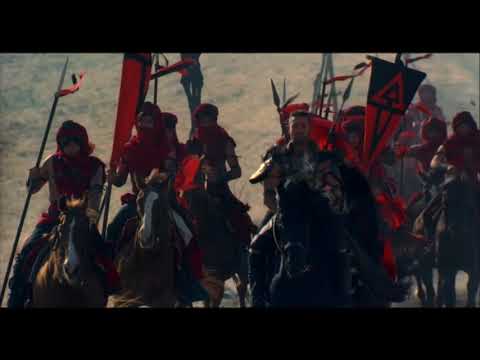
Rock listeners embraced the singles; score fans called Debney’s set a brawny, big-ensemble ride. According to album notes and coverage, the pairing sold exactly what the film promised — pulp adventure with 2002 radio muscle.
“Debney’s action writing is thunderous and surprisingly colorful.” as summarized from score reviews
“‘I Stand Alone’ became the movie’s identity — in trailers, on radio, and over the credits.” as noted in single/album coverage
Interesting Facts
- Custom single: “I Stand Alone” was written for the film and later folded onto Godsmack’s Faceless.
- Alt take: System of a Down’s “Streamline” appears here in a version associated with the soundtrack cycle rather than a featured scene.
- Color & clatter: Debney’s orchestra is spiked with duduk/ney/ram’s horn and taiko for exotic edge.
- End-credits rule: The two album tracks heard in-film play at the end; most others never appear onscreen.
- Legacy: Later deluxe score editions added demos/suites and fresh liner notes.
Technical Info
- Title (songs): The Scorpion King: Music from and Inspired by the Motion Picture
- Year: 2002
- Type: Various-artists compilation + original score (separate album)
- Lead single: “I Stand Alone” — Godsmack
- Composer (score): John Debney
- Label (songs): Universal/UMG family (release spring 2002)
- Label (score): Varèse Sarabande (original CD; later deluxe expansion)
- Notable placements (in-film): “I Stand Alone” (end credits); “Along the Way” (end credits rotation); taiko march source; Debney cues throughout action/prophesy sequences
- Availability: Songs and score streaming/digital; physical releases for both (multiple editions)
Questions & Answers
- Who composed the film’s score?
- John Debney — full orchestra/choir with Middle-Eastern colors and pounding percussion.
- Which songs actually play in the movie?
- Primarily “I Stand Alone” (Godsmack) and “Along the Way” (Mushroomhead) over the end credits; most other album cuts are “inspired by.”
- Was “I Stand Alone” written for the film?
- Yes. It was commissioned for The Scorpion King and later appeared on Godsmack’s Faceless.
- Is there a separate score album?
- Yes — 14 tracks (~40 minutes) of Debney’s score; later a deluxe expansion added suites and demos.
- Did the soundtrack chart or certify?
- The compilation earned RIAA Gold status and logged Canadian chart placements.
Canonical Entities & Relations
| Subject | Relation | Object |
|---|---|---|
| Chuck Russell | directed | The Scorpion King (2002 film) |
| John Debney | composed | The Scorpion King (Original Motion Picture Score) |
| Godsmack | performed | “I Stand Alone” (lead single; end credits) |
| Mushroomhead | performed | “Along the Way” (end-credits rotation) |
| Universal/UMG | released | Songs compilation (2002) |
| Varèse Sarabande | released | Original score (2002; later deluxe) |
Sources: Discogs release/master notes; Apple Music & Spotify album pages; Wikipedia film entry (soundtrack/score/certification); Filmtracks review page; single coverage for Godsmack; trailer archive.
November, 26th 2025
A-Z Lyrics Universe
Cynthia Erivo Popular
Ariana Grande Horsepower
Post Malone Ain't No Love in Oklahoma
Luke Combs Good Riddance (Time of Your Life)
Green Day Bye Bye Bye
*NSYNC You're the One That I Wan
John Travolta & Olivia Newton-John I Always Wanted a Brother
Braelyn Rankins, Theo Somolu, Kelvin Harrison Jr. and Aaron Pierre The Power of Love
Frankie Goes to Hollywood Beyond
Auli’i Cravalho feat. Rachel House MORE ›