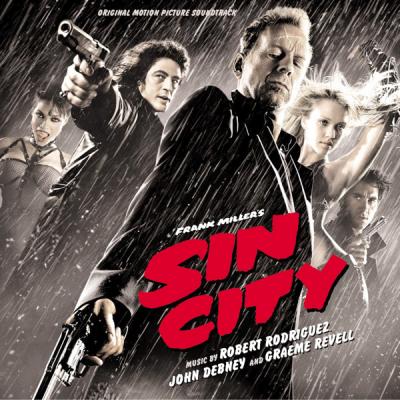
"Sin City" Soundtrack Lyrics
Movie • 2005
Track Listing
Fluke
The Servant
"Sin City (Original Motion Picture Soundtrack)" – Album Guide to Tracks and Key Scenes
Overview
What does a comic-book city sound like when morality snaps to black and white? Sin City answers with a triptych of scores — arrival → adaptation → rebellion → collapse — each tailored to a different novella: Marv’s bruised elegy, Dwight’s hard-edged caper, Hartigan’s tragic vigilante ballad.
The album is unusual: three composers trade chapters and share motifs. Graeme Revell roughs in iron-and-amber textures for The Hard Goodbye; John Debney’s The Big Fat Kill flexes with brass, twang and razor-string suspense; Robert Rodriguez frames That Yellow Bastard with noir bass lines, chiming ostinati and a mournful end-title. The whole thing is shot through with one precision needle drop — Fluke’s “Absurd” — and a concert-hall ringer, Revueltas’s “Sensemayá.”
Genres & phases: stealthy low brass and brushed snares (stakeouts), electric-guitar noir (pursuits), timpani-heavy doom (showdowns), and an industrial pulse where the picture needs sweat. As the soundtrack’s notes and discographies put it, Revell scored Hard Goodbye, Debney handled Big Fat Kill, and Rodriguez scored That Yellow Bastard, with everyone cross-pollinating on cues to keep Basin City’s sound coherent.
How It Was Made
Rodriguez brought in two trusted stylists — Debney and Revell — and split the film by story. That gave each thread its own timbral signature while preserving a single vocabulary (Hollywood Studio Symphony on the stage, noir palettes in the booth). The official album dropped via Varèse Sarabande in late March 2005, a 23-cue runtime that moves like the film: terse, graphic, percussive. The trailer’s now-famous sting? An instrumental of The Servant’s “Cells,” used heavily in marketing and briefly sampled in ancillary materials, while Japan got Namie Amuro’s “Violet Sauce” as local theme.

Tracks & Scenes
“Sin City” — Robert Rodriguez
Where it plays: Main title motif and returning city signature — muted trumpets, bass figure, toms like boots on wet pavement.
Why it matters: Sets the grammar: pulp swagger with a funeral pulse.
“Goldie’s Dead” — Graeme Revell
Where it plays: Marv wakes with the angel gone. Thunder outside, grit underfoot; the cue holds a single low note like a swallowed scream.
Why it matters: Marv’s origin chord — grief that turns into motion.
“Marv” → “Bury the Hatchet” — Graeme Revell (with Rodriguez)
Where it plays: Jacket on; trench through Basin City’s alleys; interrogation by plumbing. Percussion like chains on concrete.
Why it matters: A rhythm section that hits as hard as the protagonist.
“The Hard Goodbye” — Graeme Revell
Where it plays: Confession-voiceover, the priest, the farm. Strings saw while trombones grind.
Why it matters: Noir lament; Marv’s absolution is violence.
“Dwight” — John Debney
Where it plays: Bathroom mirror, a plan against Jackie Boy, and the drive that follows. Guitar twang cuts through brass stabs.
Why it matters: Debney’s palette flips us into caper mode.
“Old Town” → “Deadly Little Miho” — John Debney (with Rodriguez)
Where it plays: The women’s streets: Katana hiss, cords snapping through night air; Miho’s arrival is a whip-crack motif.
Why it matters: Sleek, lethal; character as timbre.
“Jackie Boy’s Head” → “The Big Fat Kill” — John Debney
Where it plays: The tar pits run, the severed-head gambit, cops closing. Snare patterns tighten until they snap.
Why it matters: Momentum scorecraft — every bar is a deadline.
“Nancy” — Robert Rodriguez
Where it plays: Hartigan’s heartbeat down the hallway to Kadie’s, the first sight of her onstage (intercut with the club’s diegetic sound). A guitar line threads longing into danger.
Why it matters: Hartigan’s vow in a melody.
“Absurd” — Fluke
Where it plays: Nancy’s whip-smart dance at Kadie’s when Hartigan first enters; the track’s industrial bounce drives spotlights and catcalls.
Why it matters: Only true club cut in the film — a crowd-pleasing jolt that throws sparks against the score’s noir cool.
“Prison Cell” → “Kiss of Death” — Robert Rodriguez
Where it plays: Hartigan’s years in a box, then the Roark showdown march. Slow, inexorable low-string figures with bell accents.
Why it matters: Duty recast as doom.
“Sensemayá” — Silvestre Revueltas (concert performance)
Where it plays: The end movement of That Yellow Bastard — ritual power, bass-clarinet bite, drums like a heartbeat in the dark.
Why it matters: A startling orchestral import that deepens the mythic finish.
Trailer/TV spots: “Cells” (Instrumental) — The Servant
Where it plays: Marketing cornerstone; its staccato piano and strings became synonymous with the campaign.
Why it matters: Off-album for many regions, but the sound of Sin City to millions.
Notes & Trivia
- The soundtrack credits three composers split by story: Revell (The Hard Goodbye), Debney (The Big Fat Kill), Rodriguez (That Yellow Bastard).
- “Absurd” by Fluke underscores Nancy’s marquee dance at Kadie’s; it’s the film’s most recognizable needle drop.
- Classical ringer: Silvestre Revueltas’s “Sensemayá,” conducted in the licensed recording by Eduardo Mata.
- Marketing theme: The Servant’s “Cells” (instrumental) dominated trailers/TV spots; Japan used Namie Amuro’s “Violet Sauce.”
- Album issued by Varèse Sarabande in March 2005; many editions credit the Hollywood Studio Symphony.
Music–Story Links
Score as character: Marv’s cues clank and punch; Dwight’s swagger and snares scheme; Hartigan’s themes walk a tightrope between tenderness and doom. When Nancy appears, the score softens — until the club drops “Absurd,” reminding us Basin City performs its sins. Revueltas’s concert piece in the endgame lifts Hartigan’s sacrifice out of pulp into ritual — the city takes, the city sings.
Reception & Quotes
Fans praised the triptych approach — three tones, one city — and the album’s blunt, replayable cuts. Reviewers also clocked the savvy trailer choice: “Cells” welded the film’s look to a hook in 30 seconds. As one capsule put it, this is noir that thumps.
“Three composers, one brutal voice — a graphic score for a graphic novel.” — an album review summary
“Fluke’s ‘Absurd’ turns Kadie’s into a pressure cooker.” — a soundtrack FAQ noted

Interesting Facts
- The Varèse CD (catalog VSD-6644) is a brisk listen — 23 cuts, no bloat.
- Eduardo Mata’s name appears in some album credits for the licensed “Sensemayá.”
- Some cues are co-credited (e.g., Revell/Rodriguez; Debney/Rodriguez) where textures cross stories.
- “Cells” doesn’t play as a full track in the U.S. film, but its association is so strong many assume it does.
- Japanese marketing tied in Namie Amuro’s “Violet Sauce” as a country-specific theme single.
Technical Info
- Title: Sin City (Original Motion Picture Soundtrack)
- Year / Type: 2005 — Feature film score + select licensed tracks
- Composers: Robert Rodriguez; John Debney; Graeme Revell
- Orchestra: Hollywood Studio Symphony
- Label / release: Varèse Sarabande — March 29, 2005 (CD; later digital)
- Notable placements: Fluke “Absurd” (Nancy’s dance at Kadie’s); Silvestre Revueltas “Sensemayá” (final movement of That Yellow Bastard); The Servant “Cells” (instrumental, trailers/TV spots).
- Album highlights: “Sin City,” “Goldie’s Dead,” “Marv,” “The Hard Goodbye,” “Dwight,” “Old Town,” “Deadly Little Miho,” “Jackie Boy’s Head,” “The Big Fat Kill,” “Nancy,” “Prison Cell,” “Kiss of Death,” “Sin City End Titles.”
Questions & Answers
- Who scored each story?
- Graeme Revell — The Hard Goodbye; John Debney — The Big Fat Kill; Robert Rodriguez — That Yellow Bastard (with cross-credited cues for continuity).
- What song plays when Nancy dances?
- “Absurd” by Fluke — the club floor pounds while Hartigan watches from the shadows.
- Is the trailer song on the album?
- The trailers used The Servant’s “Cells” (instrumental). It’s tied to marketing; many soundtrack editions focus on the score.
- What’s the orchestral piece in the finale?
- Silvestre Revueltas’s “Sensemayá” — a licensed concert work used in That Yellow Bastard.
- Who released the soundtrack?
- Varèse Sarabande, March 2005 (CD and later digital reissues).
Canonical Entities & Relations
| Subject | Verb | Object |
|---|---|---|
| Robert Rodriguez | composed | score for That Yellow Bastard & shared motifs |
| John Debney | composed | score for The Big Fat Kill |
| Graeme Revell | composed | score for The Hard Goodbye |
| Hollywood Studio Symphony | performed | Sin City score |
| Fluke | performed | “Absurd” (Kadie’s dance cue) |
| Silvestre Revueltas | wrote | “Sensemayá” (licensed concert piece) |
| Varèse Sarabande | released | Sin City (Original Motion Picture Soundtrack) (2005) |
| The Servant | performed | “Cells” (instrumental; trailers/TV spots) |
Sources: Wikipedia (film & soundtrack entries); AllMusic (album page); Varèse/Discogs listings; IMDb Soundtracks; SoundtrackINFO Q&A for scene IDs; Sin City Wiki (music pages).
November, 27th 2025
A-Z Lyrics Universe
Cynthia Erivo Popular
Ariana Grande Horsepower
Post Malone Ain't No Love in Oklahoma
Luke Combs Good Riddance (Time of Your Life)
Green Day Bye Bye Bye
*NSYNC You're the One That I Wan
John Travolta & Olivia Newton-John I Always Wanted a Brother
Braelyn Rankins, Theo Somolu, Kelvin Harrison Jr. and Aaron Pierre The Power of Love
Frankie Goes to Hollywood Beyond
Auli’i Cravalho feat. Rachel House MORE ›