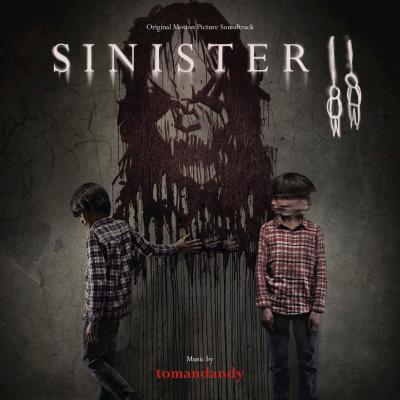
"Sinister 2" Soundtrack Lyrics
Movie • 2015
Track Listing
Ulver
Patricia Ann Dickinson
Accurst
Ulver
Jordan Yaeger, Jason Gleed and Lauren Adams
Simon Heath
Simon Heath
Accurst
Highway Down
Boards of Canada
“Sinister II (Original Motion Picture Soundtrack)” – Album Guide to Tracks and Key Scenes
Overview
What’s more frightening — what you see, or the format you hear it on? Sinister 2 pushes the franchise’s “cursed media” idea into a new register: the sequel swaps the original’s 8mm fetish for 16mm reels, vinyl records, and even ham-radio broadcasts. The soundtrack follows suit — hiss, hum, and mechanical rhythm become characters, and the score slithers around them.
Tomandandy’s writing lives in the crack between pulse and silence: scraped-metal textures, near-subsonic throb, sudden tape edits that feel like a hand on your shoulder. Around that, a few source pieces (a Norwegian nursery tune, black-ambient cuts by Atrium Carceri/Simon Heath, and a returning Ulver piece) stitch the diegesis to the franchise’s sonic DNA. According to the label notes, the album was issued by Varèse Sarabande day-and-date with release, a tidy encapsulation of the film’s nervous system.
The film’s arc — arrival → coercion → contamination → attempted escape — is mirrored musically. Early cues just suggest the ritual; mid-film pieces let the machinery grind (projector sprockets, needle crackle); the finale detonates in low-frequency dread. Genres move in phases: dark ambient and drone (threat made texture), found-sound collage (kids’ media turned weapon), and stark minimalist motifs (the human cost).
How It Was Made
Composer duo tomandandy (Andy Milburn & Tom Hajdu) crafted the score around the sequel’s new media ecology — not just “music for scenes,” but music that behaves like corrupted playback. In interviews, Milburn notes that horror’s power often lies in restraint: thin orchestrations, brittle electronics, and patience. The production also leans on the franchise’s curatorial throughline: experimental pieces recur to tether the sequel to the first film’s sensibility.
Production-wise, Ciarán Foy’s film integrates 16mm for the “kill films,” while the main unit shot digitally — a choice the team used as a musical prompt: write cues that sound like artifacts dragged between formats. Republic-era horror aesthetics meet boutique label craft: the commercial album (28 tracks) arrived via Varèse Sarabande with the movie’s August 2015 opening, later turning up widely on digital platforms.
Tracks & Scenes
“It Begins” — tomandandy
Where it plays: Opening dread cue: the film’s first home movie (scarecrows in a cornfield) bleeds into present-day unease. Non-diegetic, tight runtime, pure tone-setting.
Why it matters: Establishes the sequel’s palette — brittle highs, stomach-level lows, and sudden cut-outs.
“The Corruptor” — Atrium Carceri (Simon Heath)
Where it plays: In-story playback as the boys explore the rectory’s crawlspace “screening room.” A record spins; the room swallows the low beat while ghost kids loom. Diegetic/source that spills into underscore.
Why it matters: Black-ambient ritual — the groove sounds like footsteps to an altar.
“Bae Bae Lille Lam” — arranged/performed by Paul Hackner
Where it plays: Distorted nursery interlude threaded around the children’s nighttime visitations; a lullaby turned threat. Often diegetic (on record) then echoed by score.
Why it matters: Innocence, curdled — the sequel’s creepiest “found” motif.
“Silence Teaches You How to Sing” — Ulver
Where it plays: A returning franchise texture during snuff-film viewings; the piece’s ghost-choir and insectoid rustle bind this film to the first one’s family-annihilation reels. Non-diegetic needle-drop within the viewing sequences.
Why it matters: Carries continuity — the franchise’s most infamous sound returns like a curse.
“Pins” / “Milo’s Place” / “Like Kids” — tomandandy
Where it plays: Mid-film domestic dread: kitchen shadows, flashlight sweeps, the Deputy connecting dots. Non-diegetic, short cues used modularly.
Why it matters: Clicks and wire-brushed percussion mimic projector mechanics — music that “rolls.”
“Same Deal” → “Rare” → “All of You” — tomandandy
Where it plays: Escalation arc as Zach turns from witness to conduit. The trio of cues ratchets tension across confrontations and the lead-up to the cornfield set-piece.
Why it matters: Rhythm tightens, harmony thins — a slow choke to the payoff.
“A Stroll Through the Ancient City” — Simon Heath
Where it plays: Crawlspace ambience between reels; a cold-stone reverberation that makes the rectory feel older than it is. Source/ambient, very low in mix.
Why it matters: Place as omen — the room itself becomes an instrument.
Finale cues (“Red Dream” / “Zack” / “The New Ending”) — tomandandy
Where it plays: Cornfield conflagration and the desperate flight through rows of stalks; then the motel tag with the ham radio. Non-diegetic, then a last stinger.
Why it matters: The score finally “screams” — bass surges as punishment arrives.
Notes & Trivia
- The sequel’s mythology expands the media — 16mm, vinyl records, and ham-radio broadcasts — and the music leans into those textures.
- Varèse Sarabande released the score album the day the movie opened; digital first, with a later physical issue.
- Ulver’s cult EP piece reappears in the sequel, echoing its notorious use in the first film’s “home movies.”
- Atrium Carceri/Simon Heath cuts (“The Corruptor,” etc.) supply in-world darkness — not just background mood.
- Tomandandy’s cues are short and modular — built to drop in like splices rather than swell like themes.
Music–Story Links
When the boys place a record on the turntable, the source becomes the score — ambient pulses bleed out of the speaker and into the room, and with it, the ghost kids’ resolve; the scene teaches us the rules: play media, feed Bughuul. During “Sunday Service” and “Kitchen Remodel” viewings, the score pares back to let machine noise and grain do character work — the children’s seduction is procedural, not mystical. In the cornfield climax, stacked bass swells replace melody altogether; the film’s last note is literally a transmission — the ham radio clicks alive and the timbre says, “the signal survives.”
Reception & Quotes
Reviews hit the film hard but often singled out the craft of the sound and music as the thing still doing damage. The album, meanwhile, found a second life on streaming, where horror fans prize its “useful dread.”
“A slapdash second installment… but sound and texture still carry a chill.” — Variety
“Horror needs restraint; the wrong note ruins the spell.” — tomandandy’s Andy Milburn, on the sequel’s score approach
Interesting Facts
- New media, new muscles: The first film worshipped 8mm; the sequel’s 16mm/records/radio let sound design drive the horror.
- Label drop: Varèse Sarabande handled the commercial score album; it landed the same day the film opened.
- Creepy crib song: “Bae Bae Lille Lam” (Norwegian “Baa Baa Little Lamb”) appears as a corrupted, in-world lullaby.
- Scene glue: Atrium Carceri’s “The Corruptor” is the record-room mood everyone remembers.
- Continuity thread: Ulver’s “Silence Teaches You How to Sing” returns, tying both movies’ ritual footage together.
Technical Info
- Title: Sinister II (Original Motion Picture Soundtrack)
- Year: 2015
- Type: Film score with select source/needle-drops (guide)
- Composer: tomandandy (Andy Milburn & Tom Hajdu)
- Label: Varèse Sarabande (digital; later physical)
- Notable licensed/source cues: “The Corruptor” (Atrium Carceri/Simon Heath); “Bae Bae Lille Lam” (arr. Paul Hackner); “Silence Teaches You How to Sing” (Ulver); “A Stroll Through the Ancient City” (Simon Heath).
- Release context: Album issued August 21, 2015 alongside the film; widely available on Apple Music/Spotify thereafter.
- Production note: 16mm for the “kill films,” with vinyl and ham-radio elements folded into the story’s sound world.
Questions & Answers
- Who composed the score for Sinister 2?
- tomandandy — the duo behind The Strangers and other modern horror staples.
- Is there an official soundtrack album?
- Yes. Varèse Sarabande released a 28-track album on the film’s opening day; it’s available on major streamers.
- Does the sequel reuse music from the first Sinister?
- It keeps the aesthetic thread; notably, Ulver’s “Silence Teaches You How to Sing” returns during viewing sequences.
- What’s the creepy song that sounds like a children’s rhyme?
- “Bae Bae Lille Lam,” arranged/performed by Paul Hackner — a twisted take on a Norwegian lullaby.
- Why do the cues feel so “mechanical”?
- By design — the film’s cursed media (16mm, vinyl, ham radio) dictates a hiss-and-hum sound the score mirrors.
Canonical Entities & Relations
| Subject | Verb | Object |
|---|---|---|
| Ciarán Foy | directed | Sinister 2 (2015) |
| tomandandy | composed | Sinister II (Original Motion Picture Soundtrack) |
| Varèse Sarabande | released | Sinister II (Original Motion Picture Soundtrack) (2015) |
| Ulver | performed | “Silence Teaches You How to Sing” (fragment featured in franchise; referenced in sequel) |
| Atrium Carceri (Simon Heath) | performed | “The Corruptor” (licensed for film) |
| Paul Hackner | arranged/performed | “Bae Bae Lille Lam” (source cue) |
| Gramercy Pictures | distributed | Sinister 2 theatrically (U.S.) |
Sources: Wikipedia (film entry & media formats), Film Music Reporter (album/label), Motion Picture Association “The Credits” (composer interview), Apple Music & Spotify (album availability & track names), Discogs (release details & cue credits), press kit/production notes (16mm & playback motif), Variety (review).
Pretty predictable story of a horror, when the family arrives at the new house, which contains a terribly negative karma, about which they, of course, did not know before moving in. Although the standard plot, delivery of video material is quite interesting and unusual – many moves are used with skill, and sound is picked up in super high quality. The music producers make the same exclusive selection of the material of a motion picture. What only costs super creepy Silence Teaches You How To Sing by Ulver . It's not even a song, it's 24 minutes of continuous dreadful-sounding, but not because it is bad – no, this composition makes blood run cold. Many of the songs in this collection are long, from 6 minutes up to almost half an hour. With the exception of two funny ( Cotton‐Eyed Joe and Upside of Down ) they create an impenetrable sense of hopelessness, fear and nightmarishness of everything around. Not musical sounds are mixed in many of the works here – guttural hissing, gurgling wheezing of the chest, cries of zombies, screams, horrifying steps. Disgusting tunes that perfectly match the film of this genre. Why do composers so lovingly create such work for horrors and many of the producers of boring songs don’t even approach closely to such enthusiasm in their works? Perhaps the horror is the highest stage of evolution of cinema. Most dark melodies here in the collection created by Simon Heath, who skillfully flouts our consciousness and pulls our hidden fears inside out with his two compositions. Perfect collection to qualitative and disgusting-attracting horror movies. We don’t know what about you, but we wanted to hear urgently after this collection something beautiful and light, for example, Say Something by A Great Big World and Christina Aguilera.November, 27th 2025
Visit movie profile on IMDb and Rotten TomatoesA-Z Lyrics Universe
Cynthia Erivo Popular
Ariana Grande Horsepower
Post Malone Ain't No Love in Oklahoma
Luke Combs Good Riddance (Time of Your Life)
Green Day Bye Bye Bye
*NSYNC You're the One That I Wan
John Travolta & Olivia Newton-John I Always Wanted a Brother
Braelyn Rankins, Theo Somolu, Kelvin Harrison Jr. and Aaron Pierre The Power of Love
Frankie Goes to Hollywood Beyond
Auli’i Cravalho feat. Rachel House MORE ›