Soundtracks:  A B C D E F G H I J K L M N O P Q R S T U V W X Y Z #


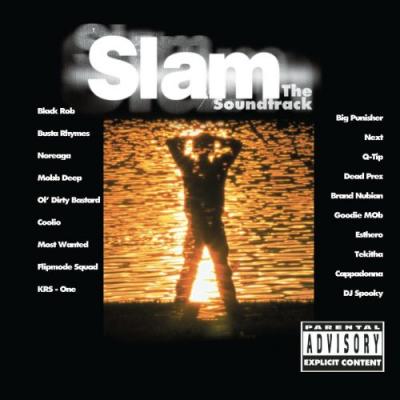
Slam Album Cover

"Slam" Soundtrack Lyrics

Movie • 1998

Track Listing


“Slam — The Soundtrack (Music From the Motion Picture)” – Album Guide to Tracks and Key Scenes

Slam (1998) trailer frame with Saul Williams in a Washington, D.C. courtyard poised to perform
Hip-hop, jailhouse verse, and D.C. realism — a mixtape born from poetry battles (1998)

Overview

What does a prison yard cipher sound like when it spills into a city? Slam answers with a soundtrack that treats hip-hop as testimony: raw, political, and unvarnished. The film follows Raymond (Saul Williams), a D.C. performance poet whose voice keeps getting louder — first in a holding cell, then on a stage — and the album mirrors that ascent with beats that feel like street corners and late buses.

The official album (Epic Records, October 13, 1998) is a straight hip-hop set: Mobb Deep, Brand Nubian, Dead Prez, Flipmode Squad (with Busta Rhymes), Q-Tip, Goodie Mob with Esthero, and more. It’s not a greatest-hits grab bag; it’s a scene portrait, stacked with East Coast grit, activist nerve, and a couple of left-field collabs (ODB with Coolio!) that sound like the late ’90s in one breath.

Arc in sound: intake → confinement → spark → confrontation → microphone. Production leans on drum-tight loops, low synths, and sample-rich textures; when the verses turn didactic the beats stay propulsive, so the record plays like a rally rather than a lecture. As per label and chart data, the album cracked the Billboard 200 and made a healthier showing on the R&B/Hip-Hop chart — a solid run for a fiercely indie drama.

How It Was Made

Director Marc Levin shot in Washington, D.C. with slam-poetry authenticity front and center. On the record side, Epic corralled an executive-producer bench (Happy Walters, Mona Scott, Ricky Leigh Mensh) and tapped scene voices across crews — Havoc, The Ummah, Dead Prez, KayGee, Mathematics, and Brand Nubian contribute on the boards. Several cuts arrived exclusive to or first heard on this disc, giving the film a reputation as a proving ground for late-’90s conscious rap.

Trailer still: mic-lit poetry night, the crowd’s faces ringed in shadow as the beat drops
From page to stage — supervision leans into real D.C. rooms, not generic club gloss

Tracks & Scenes

“Sellin’ D.O.P.E. (Drugs Oppress People Everyday)” — Dead Prez
Where it plays: Over street-level connective scenes and in promo materials; the hook lands like a thesis as Raymond’s choices harden. Non-diegetic needle-drop.
Why it matters: One of the duo’s earliest widely heard tracks; its activist stance frames the film’s politics.

“Feel My Gat Blow” — Mobb Deep
Where it plays: Tense corridor/yard beats and cross-cuts; production hums with Havoc’s signature menace. Non-diegetic.
Why it matters: Street temperature check — violence isn’t plot seasoning, it’s ambient risk.

“Time Is Running Out” — Brand Nubian
Where it plays: A clock-ticking montage as legal pressure mounts; righteous urgency rather than nihilism. Non-diegetic.
Why it matters: Old-guard conscious rap handing the mic to a younger movement.

“Take a Walk in My Shoes” — Flipmode Squad feat. Busta Rhymes
Where it plays: Street hustle and city-bus scenes; bravado with a chip on its shoulder. Non-diegetic.
Why it matters: A swagger cut that keeps the album from turning monolithic.

“The World I Know (Country Livin’ Version)” — Goodie Mob & Esthero
Where it plays: Post-hearing comedown; the mix of gospel hum and trip-hop air gives the film a breath. Non-diegetic.
Why it matters: Southern cadences at a D.C. tempo; empathy without softening the edges.

“Hey” — Q-Tip
Where it plays: Quick-cut interstitials — lighter, slyly funky relief between harder tracks. Non-diegetic.
Why it matters: A palate cleanser that still keeps heads nodding.

“I Can See” — Tekitha & Cappadonna
Where it plays: Night exteriors and thinking-walks — a spectral hook over measured bars. Non-diegetic.
Why it matters: Wu-Tang orbit lending haunted weight to Raymond’s inner voice.

“I Dare You” — Black Rob
Where it plays: Street-corner transition; a defiant strut before the next hard choice. Non-diegetic.
Why it matters: Cocksure, but it underscores the film’s constant dare: speak or fold.

“The Park” — Ol’ Dirty Bastard & Coolio
Where it plays: Daytime neighborhood sequences — kids, ball courts, frayed peace. Non-diegetic needle-drop.
Why it matters: A left-field duo that reads like broadcast radio leaking into the story.

“Sex, Money & Drugs” — Big Punisher feat. Next
Where it plays: Party-adjacent slice before the film tightens its focus; hook-driven, radio-polished. Non-diegetic.
Why it matters: The album nods at rap commerce even as the film interrogates it.

Poetry scenes — Saul Williams (performances)
Where it plays: In lockup and on stage, Raymond’s live pieces are the movie’s beating heart — diegetic performances that often land harder than any beat.
Why it matters: The album is the city; the poems are the conscience.

Trailer frame: jailhouse corridor giving way to a club stage — the film’s sonic pivot point
From bars to bars — diegetic poetry meets non-diegetic hip-hop

Notes & Trivia

  • Release: October 13, 1998 (Epic Records); hip-hop compilation aligned with the film’s D.C. setting.
  • Chart peaks: #84 Billboard 200; #24 Top R&B/Hip-Hop Albums.
  • Producers across the set include Dead Prez, Havoc, The Ummah, KayGee, Mathematics, Brand Nubian, and more.
  • Several cuts (e.g., Dead Prez’s “D.O.P.E.”) became calling cards for artists just before their breakout albums.

Music–Story Links

Raymond’s verse scenes aren’t “musical numbers” — they’re pressure valves. The soundtrack’s heaviest beats arrive right after the poems, as if the city answers back. When the legal system closes in, Brand Nubian’s insistence and Mobb Deep’s threat color the frame; when a moment of empathy cracks through, Goodie Mob & Esthero lay down a cushion. It’s a dialogue: poem → beat → fallout.

Reception & Quotes

The film won major festival prizes and the album earned a rep as a street-level time capsule. According to discography notes and retrospectives, critics singled out the Dead Prez and Mobb Deep placements for aligning the movie’s politics with its pulse.

“A late-’90s cipher pressed to plastic.” — soundtrack capsule
“You can hear the bus brakes and the mic pops.” — indie-press note
Trailer moment: close-up of a microphone as a crowd hushes before the first line
The hush before the verse — the album supplies the aftershock

Interesting Facts

  • Label snapshot: Epic backed the film’s indie edge with a major-label roster — a rare late-’90s bet that paid off culturally.
  • Early Dead Prez: “D.O.P.E.” arrives two years before the duo’s debut album.
  • Cross-pollination: Goodie Mob + Esthero brings Atlanta gospel-soul into a D.C. story.
  • ODB + Coolio?! “The Park” is exactly as chaotic and charming as that pairing suggests.
  • Poetry first: The film’s most famous “needle-drops” are unscored poems — the diegetic performances.

Technical Info

  • Title: Slam — The Soundtrack (Music From the Motion Picture)
  • Year: 1998
  • Type: Film soundtrack (hip-hop compilation; poems performed in-film)
  • Label: Epic Records
  • Executive production: Happy Walters; Mona Scott; Ricky Leigh Mensh
  • Producers (selected): Dead Prez; Havoc; The Ummah; KayGee; Mathematics; Brand Nubian; KRS-One; Pras
  • Selected placements highlighted: Dead Prez — “Sellin’ D.O.P.E.”; Mobb Deep — “Feel My Gat Blow”; Brand Nubian — “Time Is Running Out”; Flipmode Squad — “Take a Walk in My Shoes”; Q-Tip — “Hey”; Goodie Mob & Esthero — “The World I Know (Country Livin’ Version)”; Ol’ Dirty Bastard & Coolio — “The Park.”
  • Charts: US #84 (Billboard 200); US R&B/Hip-Hop #24
  • Availability: Digital/streaming editions mirror the original CD sequence.

Questions & Answers

Is the album mostly big-name singles or originals?
It’s a curated hip-hop set tied to the film — many tracks were exclusive or rare at the time, cut to the movie’s tone rather than radio first.
Do Saul Williams’s poems appear on the commercial album?
No — the album focuses on songs; the poems live in the film (and on Williams’s later records and performances).
What’s the standout “political” track?
Dead Prez’s “Sellin’ D.O.P.E.” — an early mission-statement cut that frames the movie’s anti-carceral stance.
Which producers give the album its sound?
Havoc (Mobb Deep), The Ummah, Dead Prez, KayGee, Mathematics, Brand Nubian and others — a who’s-who of late-’90s East-leaning production.
Did the soundtrack chart?
Yes — it reached #84 on the Billboard 200 and #24 on the Top R&B/Hip-Hop Albums chart.

Canonical Entities & Relations

SubjectVerbObject
Marc LevindirectedSlam (1998 film)
Saul Williamsperformedspoken-word poems in Slam (on-screen)
Epic RecordsreleasedSlam — The Soundtrack (Oct 13, 1998)
Happy Walters; Mona Scott; Ricky Leigh Menshexecutive-producedsoundtrack album
Dead Prezperformed“Sellin’ D.O.P.E. (Drugs Oppress People Everyday)”
Mobb Deepperformed“Feel My Gat Blow”
Brand Nubianperformed“Time Is Running Out”
Flipmode Squadperformed“Take a Walk in My Shoes” (feat. Busta Rhymes)
Q-Tipperformed“Hey”
Goodie Mob & Estheroperformed“The World I Know (Country Livin’ Version)”
Ol’ Dirty Bastard & Coolioperformed“The Park”

Sources: Wikipedia album & film pages; Discogs release & master entries; streaming listings; soundtrack retrospectives highlighting Dead Prez’s early appearance; official trailers.

November, 27th 2025


A-Z Lyrics Universe

Lyrics / song texts are property and copyright of their owners and provided for educational purposes only.