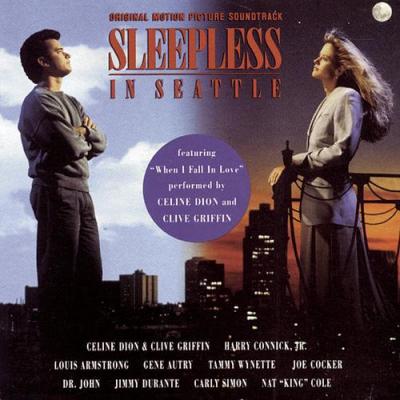
"Sleepless In Seattle" Soundtrack Lyrics
Movie • 1993
Track Listing
Durante, Jimmy
Armstrong, Louis
Cole, Nat King
Dr. John
Simon, Carly
Autry, Gene
Cocker, Joe
Connick, Harry Jr
Wynette, Tammy
Vic Damone
Durante, Jimmy
Dion, Celine
"Sleepless in Seattle (Original Motion Picture Soundtrack)" – Album Guide to Tracks and Key Scenes
Overview
How do you score a love story where the lovers barely meet? Nora Ephron doubles down on longing: vintage standards, midnight cabaret moods, and radio waves that feel like fate. The Sleepless in Seattle soundtrack curates American songbook comfort food—Louis Armstrong warmth, Nat King Cole velvet, Carly Simon after-hours glow—then sprinkles in sly jokes and a perfect bow on the Empire State Building.
The plot is a transcontinental duet: Sam (a widowed architect in Seattle) and Annie (a journalist in Baltimore) circle each other via a late-night call-in show. Music does the touching they can’t. Needle-drops stand in for hand-holds; crooners speak the subtext. A Jimmy Durante benediction opens the heart; a Harry Connick Jr. shuffle gives permission to hope; a modern power ballad closes the fairy tale.
What makes this album distinct is the editorial precision. It’s not just “romantic”; it’s curated counterpoint. Old recordings argue with new desires. When the film riffs on An Affair to Remember, the soundtrack mirrors that cinephile conversation—nostalgia versus now—until the last cue gives the final say.
Genres & themes by phase: early-act standards (safety, memory); mid-film country/western wink (re-entering life, dating jitters); late-act big-band swing (momentum, destiny); end-credits torch/pop ballad (closure, fantasy fulfilled).
How It Was Made
Composer Marc Shaiman provides connective tissue, but the spine is licensed repertoire. A planned score by John Barry reportedly fell through when the film’s wall-to-wall song plan became clear; Shaiman inherited the gig and threads cues between era-spanning selections. The studio loved the contemporary pop finish—Céline Dion & Clive Griffin’s “When I Fall in Love”—while Ephron fought for a classic closer: Jimmy Durante’s “Make Someone Happy.” Test audiences validated the gentler ending; the movie keeps the Durante benediction before rolling into the modern ballad in the credits.
Music supervision leaned into pre-rock elegance so the talk-radio fairy tale felt timeless, with a few playful detours (Gene Autry’s cowboy classic; Tammy Wynette for a wry self-read). The album release on Epic Soundtrax became a sleeper hit in its own right, buoyed by radio-ready singles and relentless airplay.

Tracks & Scenes
“As Time Goes By” — Jimmy Durante
Where it plays: Early in the film as tone-setting source music, the gravel-soft croon frames Sam’s grief with old-world kindness. The cue functions like a prologue, easing us into a world where love stories come with a melody attached (opening stretch, non-diegetic).
Why it matters: Establishes the soundtrack’s thesis: classic songs as emotional compass.
“A Kiss to Build a Dream On” — Louis Armstrong
Where it plays: Over transitional cityscape and letter-writing beats, the trumpet glow and Satchmo smile underline the country-wide swoon rising around “Sleepless in Seattle” (non-diegetic, mid-Act I montage).
Why it matters: Turns Sam’s radio moment into a public love story, sonically inclusive and communal.
“Stardust” — Nat King Cole
Where it plays: As Annie second-guesses her engagement, Cole’s velvet nocturne floats like conscience in a quiet interior scene (non-diegetic, late Act I).
Why it matters: Old standards become Annie’s inner monologue—elegant doubt.
“Makin’ Whoopee” — Dr. John feat. Rickie Lee Jones
Where it plays: Needle-drop irony for modern complications: the sly, smoky swing colors conversations about commitment with a wink (non-diegetic, mid-film).
Why it matters: A sardonic counterpoint to hearts-and-flowers—Ephron’s sense of humor, musically.
“In the Wee Small Hours of the Morning” — Carly Simon
Where it plays: A late-night montage bridges coasts: Sam stares at the water, Annie watches snow and city lights. The arrangement is intimate, barely above a whisper (non-diegetic; extended montage, ~2–3 minutes).
Why it matters: The film’s insomnia theme in one song—lonely hours, whispered confessions.
“Back in the Saddle Again” — Gene Autry
Where it plays: When Sam is nudged back toward dating, the old cowboy anthem rides in playfully—cutting between Annie’s and Sam’s parallel “try again” beats (non-diegetic, mid-film).
Why it matters: A comic pep-talk in boots; says “giddy-up” without dialogue.
“Bye Bye Blackbird” — Joe Cocker
Where it plays: A brief transitional lift as plans are made and paths begin to converge (non-diegetic, late mid-film).
Why it matters: Adds gritty soul to the otherwise satin palette—momentum before the last act.
“A Wink and a Smile” — Harry Connick Jr.
Where it plays: The Valentine’s Day run-up: bustling airports, reservations, dresses, and one goofy grin. The big-band strut turns logistics into romance (non-diegetic, late Act II montage).
Why it matters: The movie’s engine song—forward motion with charm; pure “meet-cute in motion.”
“Stand by Your Man” — Tammy Wynette
Where it plays: Annie’s self-teasing moment about loyalty versus honesty, the cue lands like a country-comic aside (non-diegetic, mid-film).
Why it matters: Ephron uses a cultural touchstone to let Annie roast her own predicament, sweetly.
“Make Someone Happy” — Jimmy Durante
Where it plays: Final ascension to the Empire State Building and emotional close: Durante’s tender rasp blesses the fairy-tale ending; the modern single follows in credits (non-diegetic, finale/credits).
Why it matters: Ephron’s chosen benediction—small, human, earned.
“When I Fall in Love” — Céline Dion & Clive Griffin
Where it plays: End credits single, the glossy pop coda after the classic closer (credits).
Why it matters: Bridges eras—radio-ready 1993 sheen after the vintage vows.
Trailer note: The official theatrical trailer (1993) leans on dialogue and mood, not a single pop hook; it previews the film’s standards-heavy vibe rather than one “trailer song.”
Notes & Trivia
- The soundtrack album became a chart success in its own right, unusually strong for a romantic comedy compilation.
- Two philosophies duel at the end: classic benediction first, modern power ballad second.
- A Japanese-market companion emphasized “Winter Song” by DREAMS COME TRUE, reflecting the film’s global reach.
- Gene Autry’s cowboy anthem is the set’s curveball—used as a pep-talk gag.
- The film’s music choices nod to An Affair to Remember without quoting its exact songs.
Music–Story Links
When Jonah dials the radio show, the movie becomes a mixtape about grief turning to possibility. Standards carry Sam’s memories; swing charts Annie’s acceleration. The moment Sam agrees to try dating, “Back in the Saddle Again” gives him courage by proxy. As Annie leans into destiny, “A Wink and a Smile” puts wind at her back, syncing plane tickets and elevator rides to a tap-dance beat. Finally, the hand-hold on the observation deck needs almost no words because a small, old song (“Make Someone Happy”) speaks for them.
Reception & Quotes
The film was a box-office phenomenon, and the album rode that wave—an atypical No.-cracking compilation built on catalog gold and one new hit. Critics singled out the score-and-songs blend as a feature, not background: an intentional, character-level design.
“The hippest, frankest and funniest date movie around.” Rolling Stone
“Warm and gentle… I smiled the whole way through.” Chicago Sun-Times
“A feather-light romantic comedy… a stunt that works.” The New York Times
Availability: The original Epic Soundtrax CD/MC/LP (1993) remains widely streamable; the soundtrack has seen vinyl reissues, keeping the album in print for new listeners.
Interesting Facts
- Music supervisor/producer choices favored pre-rock intimacy; even the “new” single is a 1952 standard reframed for 1993 radio.
- Marc Shaiman’s original cues are minimal but crucial—seams you feel more than notice.
- “A Wink and a Smile” was the film’s Oscar-nominated song; the single became a Connick signature on tour setlists.
- Releases in some territories appended extra tracks (e.g., DREAMS COME TRUE’s “Winter Song”) to align with local promotions.
- Multiple vinyl reissues (including “sunset” color variants) helped re-introduce the album to collectors.
- The trailer campaign emphasized dialogue over needle-drops—rare for the 1990s.
- Jimmy Durante bookends the experience: tender welcome in, tender send-off out.
Technical Info
- Title: Sleepless in Seattle (Original Motion Picture Soundtrack)
- Year: 1993
- Type: Various-artists compilation; original score by Marc Shaiman (select cues)
- Key recordings: Jimmy Durante, Louis Armstrong, Nat King Cole, Carly Simon, Gene Autry, Joe Cocker, Harry Connick Jr., Tammy Wynette; end-credits single by Céline Dion & Clive Griffin
- Label: Epic Soundtrax (Sony)
- Release context: Summer 1993 alongside the film’s theatrical run; later worldwide reissues and vinyl pressings
- Notable placements: Finale underscored by “Make Someone Happy”; Valentine’s montage propelled by “A Wink and a Smile”; insomnia montage to “In the Wee Small Hours of the Morning”
- Chart/availability notes: Strong U.S. Billboard performance for a film compilation; widely available on streaming and in print on vinyl reissues.
Questions & Answers
- Why do so many songs come from the Great American Songbook?
- Because the film is about belief—old standards carry cultural memory, letting the movie feel “classic” the first time you see it.
- Is the Céline Dion & Clive Griffin duet actually in the story proper?
- It’s the end-credits single. The story’s emotional climax is cued by Jimmy Durante’s gentler classic first.
- Which cue best represents the film’s momentum?
- “A Wink and a Smile.” It turns travel and logistics into swoony propulsion.
- What’s the purpose of the Gene Autry song tonally?
- Comic courage. It reframes re-entering the dating world as a playful Western “ride again.”
- Does the soundtrack include score?
- Yes, but sparingly on album; the film primarily leans on curated songs with Shaiman stitching between them.
Canonical Entities & Relations
| Subject | Verb | Object |
|---|---|---|
| Nora Ephron | directed | Sleepless in Seattle (1993) |
| Marc Shaiman | composed | Original score cues |
| Epic Soundtrax | released | Sleepless in Seattle: Original Motion Picture Soundtrack (1993) |
| Jimmy Durante | performed | “As Time Goes By”; “Make Someone Happy” |
| Carly Simon | performed | “In the Wee Small Hours of the Morning” |
| Harry Connick Jr. | performed | “A Wink and a Smile” |
| Céline Dion & Clive Griffin | performed | “When I Fall in Love” (end credits) |
| Louis Armstrong | performed | “A Kiss to Build a Dream On” |
| Nat King Cole | performed | “Stardust” |
| Gene Autry | performed | “Back in the Saddle Again” |
Sources: Wikipedia; IMDb Soundtracks; Apple Music; Spotify; Discogs; Real Gone Music store notes; Entertainment Weekly (retrospective list).
Note: This guide references placements and release details drawn from publicly available soundtrack credits and reputable discographic entries; where exact timestamps are not universally standardized, scene descriptions emphasize narrative context over minute:second markers.
November, 27th 2025
A-Z Lyrics Universe
Cynthia Erivo Popular
Ariana Grande Horsepower
Post Malone Ain't No Love in Oklahoma
Luke Combs Good Riddance (Time of Your Life)
Green Day Bye Bye Bye
*NSYNC You're the One That I Wan
John Travolta & Olivia Newton-John I Always Wanted a Brother
Braelyn Rankins, Theo Somolu, Kelvin Harrison Jr. and Aaron Pierre The Power of Love
Frankie Goes to Hollywood Beyond
Auli’i Cravalho feat. Rachel House MORE ›