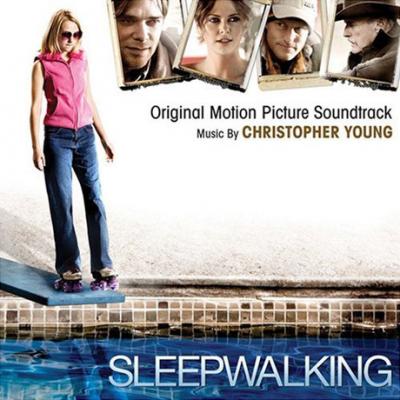
"Sleepwalking" Soundtrack Lyrics
Movie • 2008
Track Listing
A Fine Frenzy
Christopher Young
Christopher Young
Christopher Young
Christopher Young
Christopher Young
Christopher Young
Christopher Young
Christopher Young
Christopher Young
Christopher Young
Christopher Young
Christopher Young
Christopher Young
Christopher Young
Christopher Young
"Sleepwalking (Original Motion Picture Soundtrack)" – Album Guide to Tracks and Key Scenes
Overview
How do you score a road-trip refuge that keeps turning back into a wound? Sleepwalking answers with small, human music: spare guitars, cold-air piano, and instrumentals that move like breath on a winter window. Christopher Young—often associated with big-gesture genre scores—writes intimately here, letting silence be part of the harmony.
The film follows James (Nick Stahl) and his niece Tara (AnnaSophia Robb) after Tara’s mother Joleen (Charlize Theron) vanishes. The soundtrack’s mood is weathered but tender. Pieces start as lullabies and grow teeth; motifs return like memories you can’t shake. A single modern song—A Fine Frenzy’s “Come On, Come Out”—opens the album like a porch light in the dark.
Distinctiveness comes from restraint. Instead of wall-to-wall pop, a handful of licensed tracks (classic rock, post-rock, even a Verdi stadium cut) puncture the hush when the story needs air. The rest trusts Young’s palette—strings and piano that never oversell, just steady two broken people down the road.
Genres & themes by phase: Folk-tinged minimalism (fleeing/fragility) → post-rock bloom (brief hope/expanse) → classic rock grit (collision with the past) → hushed elegy (reckoning & release).
How It Was Made
Christopher Young composed the score, paring down to chamber textures—solo guitar, piano figures, light strings—with the occasional synth halo. The approach suits director William Maher’s debut: close, unsentimental, and winter-bright around the edges. Music supervision was handled by Kevin Edelman, whose needle-drops thread older catalog cuts through the contemporary score (according to published credits).
The official album arrived via Lakeshore Records (catalog LKS 33994) with a 17-track program and a release window aligned to the film’s limited rollout. It begins with A Fine Frenzy’s “Come On, Come Out,” then settles into Young’s cue suite—titles like “Ferris Wheel,” “Mad Bad Dad,” and “Shine On” that map directly to story beats.
Tracks & Scenes
“Come On, Come Out” — A Fine Frenzy
Where it plays: Album opener and featured in the film; it sets a fragile optimism as James and Tara try, briefly, to imagine a normal night (early going, non-diegetic).
Why it matters: A soft lamp against the cold—introduces the score’s “small mercies” tone.
“Sleepwalking” — Christopher Young
Where it plays: Over the first stretch of the road journey: empty lanes, fields swallowed by frost, a borrowed car that feels like confession booth (non-diegetic).
Why it matters: Establishes the main motif—two-note resignation tipping into guarded warmth.
“Ferris Wheel” — Christopher Young
Where it plays: A memory-tinged interlude for Tara—bright melody over a queasy drone as she clings to a happier snapshot (non-diegetic, mid-film).
Why it matters: Shows Young’s knack for bittersweet counterpoint; innocence surrounded by weather.
“Mad Bad Dad” — Christopher Young
Where it plays: The return to the family farm and the volatile presence of the grandfather (Dennis Hopper). Low strings and guitar slide underscore danger without shouting (late act).
Why it matters: The score grows a spine—this is the album’s darkest, tensest knot.
“Shine On” — Christopher Young
Where it plays: Closing movement: after consequences land, the cue stretches toward a bruised grace. Piano climbs; strings hold like breath in winter air (finale/credits).
Why it matters: Earns the title—no triumph, just light enough to keep going.
“The Only Moment We Were Alone” — Explosions in the Sky
Where it plays: Used in the film as an expansive release valve—the landscape seems wider, time slows, and the two leads share rare quiet (non-diegetic, travel sequence).
Why it matters: Post-rock bloom that momentarily lifts the film out of claustrophobia.
“Funk #49” — James Gang
Where it plays: A jolt of classic-rock swagger in a world of whispered cues—brief source-music relief around a scene with adult noise and trouble lurking (diegetic feel).
Why it matters: Breaks the score’s hush; reminds us the world outside their bubble is loud and careless.
“Get in a Hurry” — Eugene Blacknell
Where it plays: Needle-drop spark during a transitional beat; guitars itch, nerves rise (non-diegetic).
Why it matters: Funk grit that pushes the plot forward.
“Nel di Della Vittoria” — (from Verdi)
Where it plays: A brief classical sting on a TV/radio/source moment—ironic pomp against the film’s shabby reality (diegetic).
Why it matters: A brittle joke: victory music in a story about survival.
“Crash and Burn” — Bob Mair & Frankie Blue
Where it plays: Source-leaning needle drop around a bar/roadside environment; the title says it—temptation and fallout (diegetic).
Why it matters: Adds a contemporary rough edge to the otherwise tender palette.
Notes & Trivia
- The score was recorded and released by Lakeshore Records; the CD clocks in at ~53 minutes with 17 tracks.
- Christopher Young—famous for horror/thrillers—plays against type here with chamber restraint.
- Needle-drops range from post-rock (Explosions in the Sky) to classic rock (James Gang) and even an operatic sports staple (Verdi), per official listings.
- The working title during production was Ferris Wheel, echoed by a cue name on the album.
- The film premiered at Sundance in January 2008 before its limited U.S. theatrical run in March.
Music–Story Links
When Joleen disappears, Young’s motif contracts: piano and guitar trace the hollow she leaves. On the road, the instrumentation opens—gentle arpeggios riding over pale strings—mirroring the long, flat distances. A sudden blast of “Funk #49” or Eugene Blacknell’s groove reminds us how chaotic the adult world feels to Tara. And when they step into the grandfather’s orbit, harmony frays into drones and low figures; the music stops offering exits and starts offering resolve.
Reception & Quotes
Critics were mixed on the film, but several reviews singled out Young’s restraint. The album became a quiet favorite among fans of the composer’s indie-drama work, and the inclusion of A Fine Frenzy broadened the record’s reach. As one review put it, the score is “small and intimate,” built for breath and winter light.
“A chamber-sized return to Young’s indie roots—guitar, piano, and silences that say as much as the notes.” contemporary score review
“Not a feel-good film, but the music keeps faith with the characters.” album review summary
Interesting Facts
- The soundtrack opens with A Fine Frenzy—the only vocal track on the album proper.
- Lakeshore’s catalog number (LKS 33994) and April 8, 2008 street date align with the film’s limited release window.
- Several cue titles (“Ferris Wheel,” “Mad Bad Dad”) double as plot signposts—an old school practice that makes the album read like a scene outline.
- Explosions in the Sky’s “The Only Moment We Were Alone” (from a 2003 album) appears in-film, bridging indie post-rock to the drama’s prairie scale.
- Music supervision by Kevin Edelman kept the needle-drops sparse, so they land like elbows to the ribs rather than wallpaper.
Technical Info
- Title: Sleepwalking (Original Motion Picture Soundtrack)
- Year: 2008
- Type: Original score album with select song feature
- Composer: Christopher Young
- Music Supervisor: Kevin Edelman
- Key placements (in film): Explosions in the Sky — “The Only Moment We Were Alone”; James Gang — “Funk #49”; Eugene Blacknell — “Get in a Hurry”; Verdi — “Nel di Della Vittoria”; Bob Mair & Frankie Blue — “Crash and Burn”
- Label / Catalog: Lakeshore Records — LKS 33994
- Album runtime / tracks: ~53:01 — 17 tracks
- Release context: Premiered at Sundance (Jan 22, 2008); album streeted April 8, 2008 alongside limited U.S. run
- Availability: Streaming and digital storefronts; original CD circulates via specialty retailers and catalog sellers
Questions & Answers
- Is this mostly songs or mostly score?
- Mostly score—Christopher Young’s chamber textures carry the album, with a few notable needle-drops heard in the film.
- What’s the one vocal track on the album?
- “Come On, Come Out” by A Fine Frenzy—used in the film and sequenced as the album’s opener.
- Who supervised the licensed music?
- Kevin Edelman handled music supervision, shaping a small set of strategic drops.
- Does the album include everything heard in the film?
- No; the Lakeshore CD focuses on score plus the A Fine Frenzy cut. Some source songs are film-only.
- What cues map to the story’s darkest turn?
- “Mad Bad Dad” and the closing “Shine On”—one tightens the screws; the other offers a fragile release.
Canonical Entities & Relations
| Subject | Verb | Object |
|---|---|---|
| William Maher | directed | Sleepwalking (2008) |
| Christopher Young | composed | Sleepwalking (Original Motion Picture Soundtrack) |
| Kevin Edelman | supervised | Licensed music for the film |
| Lakeshore Records | released | Soundtrack CD (LKS 33994) |
| Overture Films | distributed | Sleepwalking theatrically in the U.S. |
| A Fine Frenzy (Alison Sudol) | performed | “Come On, Come Out” |
| Explosions in the Sky | performed | “The Only Moment We Were Alone” |
| James Gang | performed | “Funk #49” |
Sources: Apple Music album page; MovieMusic store listing; IMDb (soundtracks, credits); Wikipedia (film overview & song note); soundtrackINFO listing; contemporary score reviews.
November, 27th 2025
A-Z Lyrics Universe
Cynthia Erivo Popular
Ariana Grande Horsepower
Post Malone Ain't No Love in Oklahoma
Luke Combs Good Riddance (Time of Your Life)
Green Day Bye Bye Bye
*NSYNC You're the One That I Wan
John Travolta & Olivia Newton-John I Always Wanted a Brother
Braelyn Rankins, Theo Somolu, Kelvin Harrison Jr. and Aaron Pierre The Power of Love
Frankie Goes to Hollywood Beyond
Auli’i Cravalho feat. Rachel House MORE ›