Soundtracks:  A B C D E F G H I J K L M N O P Q R S T U V W X Y Z #


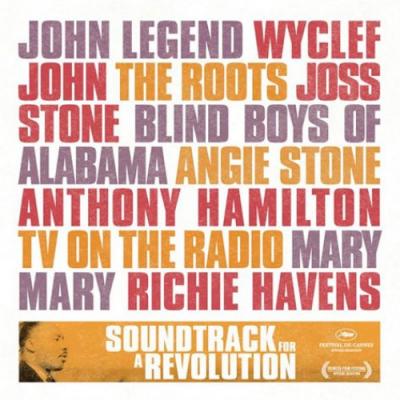
Soundtrack for a Revolution Album Cover

"Soundtrack for a Revolution" Soundtrack Lyrics

Movie • 2012

Track Listing


"Soundtrack for a Revolution (Original Motion Picture Soundtrack)" – Album Guide to Tracks and Key Scenes

Trailer still: freedom marchers arm-in-arm as a chorus rises — Soundtrack for a Revolution trailer frame
Freedom songs as lived history — trailer imagery.

Overview

What do you sing when the law says wait and your heart says go now? Soundtrack for a Revolution answers by letting the Civil Rights Movement speak through its freedom songs — then asking contemporary artists to answer back. Arrival → adaptation → rebellion → collapse: field hymns become marches, jailhouse choruses turn into courtroom echoes, and by the time credits roll the repertoire feels like muscle memory.

The film (premiered 2009) intercuts archival footage and first-person testimony with new performances by John Legend, The Roots, Joss Stone, Wyclef Jean, Richie Havens, The Blind Boys of Alabama, Mary Mary, and more. The companion album arrived later — February 14, 2012 — and condenses those reinterpretations into a lean ten-track set. According to PBS’s American Experience profile and album listings, the result bridges sit-ins and studio, protest and pop, without sanding off the songs’ purpose.

Genres & themes in phases: spirituals & work chants (arrival — roots and resolve) → folk/gospel call-and-response (adaptation — organizing) → drum-tight soul & blues bite (rebellion — marching tempo) → solemn hymns (collapse → mourning and promise). Handclaps = solidarity; that third-line harmony = courage gathering in real time.

How It Was Made

Directors Bill Guttentag and Dan Sturman shot testimony with movement veterans (John Lewis, Harry Belafonte, Andrew Young) while staging fresh, studio-clean recordings of classic freedom songs. Music direction steers artists toward arrangements that honor field-hymn DNA but speak in 21st-century colors — The Roots grind a march groove; John Legend holds space with voice and piano; Wyclef flips a Phil Ochs broadside for present tense. Festival notes and PBS materials underline that the film was conceived as a braid: history, song, and lived memory.

Trailer frame: studio microphones and archival placards cross-cut — new performances inside an old fight
Archival grit, modern mics — the method and the message share a frame.

Tracks & Scenes

Doc runtime ~86 minutes; cues appear as performance set-pieces around movement chapters. “Diegetic” here means sung on-camera in the film’s world; others are staged performances cut against archival.

“We Shall Not Be Moved” — The Blind Boys of Alabama
Where it plays: Opening orientation (~00:03). Archival black-and-white faces tilt toward the sun as an organ peeks in; then the Blind Boys’ voices arrive like a front porch turning into a picket line. Non-diegetic performance intercut with footage.
Why it matters: A thesis in four words — stubborn love as politics.

“Ain’t Gonna Let Nobody Turn Me Around” — The Roots
Where it plays: Sit-in/streets montage (~00:20). Baton shadows and shoe-leather marches; Questlove’s pocket turns feet into a metronome. Non-diegetic performance that bleeds into chant audio.
Why it matters: Takes a call-and-response chant and makes it stomp — a drum lesson in persistence.

“Woke Up This Morning” — John Legend
Where it plays: Jail-and-resolve chapter (~00:34). Legend at the piano, camera close; his melisma lands over images of mugshots and bond slips. Diegetic studio performance, then cutaways.
Why it matters: Soft vocal, hard truth — faith that makes you get up again.

“Eyes on the Prize (Keep Your Eyes on the Prize)” — Joss Stone
Where it plays: Voting-rights arc (~00:48). Registration lines, Selma footage, handlers whispering “keep steady.” Non-diegetic; choir pads on the last refrain.
Why it matters: Turns patience into voltage; the phrase becomes a breathing exercise.

“Wade in the Water” — Mary Mary
Where it plays: Training and church-basement organizing (~00:56). The camera watches hands fold flyers; a deacon nods time. Non-diegetic gospel swell.
Why it matters: Baptismal imagery repurposed as strategy: move together, unseen, unstoppable.

“Will the Circle Be Unbroken” — Richie Havens
Where it plays: Memorial passage (~01:02). Murders and funerals; Havens rasps the refrain like a vow. Non-diegetic, sparse guitar and voice.
Why it matters: Grief without collapse; the circle holds.

“Here’s to the State of Mississippi” — Wyclef Jean
Where it plays: Broadside interlude (~01:10). Ochs’ 1965 lyric recast over modern acoustic-beat textures while headlines flash. Non-diegetic.
Why it matters: Names names — protest as receipt-keeping.

“Oh Freedom” — The Blind Boys of Alabama
Where it plays: Late-film resolve (~01:18). Faces from then and now; elders smile at kids singing the chorus back. Non-diegetic performance cross-cut with present-day choirs.
Why it matters: The most radical promise is still simple: freedom tomorrow, demanded today.

“We Shall Overcome” — All-cast finale
Where it plays: End montage/credits (~01:23 →). Archival marches dissolve into studio close-ups; verses stack like signatures. Non-diegetic performance.
Why it matters: A benediction that refuses to end — the “amen” the movie earns.

Also heard/album-adjacent: “This May Be the Last Time” (trad.), additional interstitial hymns and narration underscoring key marches and courtroom scenes; trailer/promos feature the Roots/Legend performances prominently.

Trailer frame: close-up of a snare and clapping hands — protest tempo as heartbeat
Footsteps + backbeat: the march turns rhythm into message.

Notes & Trivia

  • The film is a 2009 documentary; the official soundtrack album streeted February 14, 2012.
  • Artists include John Legend, The Roots, Joss Stone, Wyclef Jean, Richie Havens, Mary Mary, The Blind Boys of Alabama, and Anthony Hamilton.
  • The film premiered internationally at Cannes and in North America at Tribeca; it later aired on PBS’s American Experience in May 2011.
  • The album’s compact 10-track program focuses on the new performances; many archival snippets remain film-only.

Music–Story Links

When sit-ins hold, the Roots’ groove holds your spine upright. Legend’s “Woke Up This Morning” sits next to booking slips and bruises — quiet but unblinking. As registration lines stretch, “Eyes on the Prize” slows your breathing long enough to keep going. And every time a funeral clip bites, Havens’ weathered “Will the Circle Be Unbroken” keeps the community from splintering. The coda’s “We Shall Overcome” doesn’t close a book; it hands you a page.

Reception & Quotes

Festival write-ups and PBS coverage consistently praised the film’s braid of testimony and re-performed songs; album reviewers called the 2012 set “short but strong,” a purposeful sampler rather than a museum piece.

“A fresh, exhilarating take on the movement — history you can hum.” — synopsis capsules
“New voices, old fire — the performances honor the originals without embalming them.” — album notes summaries
“Interviews, archives, and anthems lock like gears.” — festival blurbs
Trailer close-up: church pews and a handheld mic — the songs’ church roots in focus
Sanctuary to street — the soundtrack keeps both doors open.

Interesting Facts

  • Shortlist nod: The film made the Academy’s 2009 Documentary Feature shortlist; the writers earned a WGA nomination.
  • Phil Ochs bridge: Wyclef’s cut revives a 1960s protest song word-for-word for a new audience.
  • PBS handoff: After the festival run, the film’s 2011 broadcast vastly expanded its classroom life.
  • Lean album: Ten cuts, ~36 minutes; the film contains more music than the album can carry.
  • Call-and-response: Several recordings keep congregational textures — you hear the architecture as much as the melody.

Technical Info

  • Title: Soundtrack for a Revolution — Original Motion Picture Soundtrack
  • Film Year: 2009 (documentary feature)
  • Album Year: 2012 (release date: February 14, 2012)
  • Type: Various-artists soundtrack (new performances of freedom songs)
  • Directors (film): Bill Guttentag; Dan Sturman
  • Key performers (album/film): John Legend; The Roots; Joss Stone; Wyclef Jean; Richie Havens; The Blind Boys of Alabama; Mary Mary; Anthony Hamilton
  • Label (album): MNRK One Music (formerly eOne)
  • Availability: Widely streaming; physical CD issued 2012
  • Selected notable placements: “Ain’t Gonna Let Nobody Turn Me Around” (streets/sit-ins); “Woke Up This Morning” (jail/resolution); “Eyes on the Prize” (voting rights); “Will the Circle Be Unbroken” (memorials); “We Shall Overcome” (finale)

Questions & Answers

Is the film from 2012?
The documentary premiered in 2009 (Cannes/Tribeca) and aired on PBS in 2011; the album released in 2012.
Are these the original 1960s recordings?
No — the album features contemporary recordings inspired by the originals, cut for the film.
Is Phil Ochs’ protest writing represented?
Yes — Wyclef Jean performs “Here’s to the State of Mississippi,” Ochs’ pointed 1965 broadside.
What’s the album’s scope?
Ten performances (~36 minutes). The film includes additional hymns/snippets not on the album.
Where can I watch the film?
PBS’s American Experience hosted it after the festival run; it also circulates on major digital storefronts.

Canonical Entities & Relations

SubjectVerbObject
Bill GuttentagdirectedSoundtrack for a Revolution (film)
Dan SturmandirectedSoundtrack for a Revolution (film)
John Legendperformed“Woke Up This Morning” (for film/album)
The Rootsperformed“Ain’t Gonna Let Nobody Turn Me Around”
Joss Stoneperformed“Eyes on the Prize”
Wyclef Jeanperformed“Here’s to the State of Mississippi” (Phil Ochs)
Richie Havensperformed“Will the Circle Be Unbroken”
The Blind Boys of Alabamaperformed“We Shall Not Be Moved”; “Oh Freedom”
Mary Maryperformed“Wade in the Water”
MNRK One MusicreleasedSoundtrack for a Revolution (album, 2012)
PBS — American Experiencebroadcastthe film (2011)
Cannes Film Festivalpremieredthe film internationally (2009)
Tribeca Film Festivalpremieredthe film in North America (2009)

Sources: PBS American Experience (film page, background, airdate); Cannes Film Festival listing; AllMusic album page; Discogs release page; Amazon album listing; Wikipedia synopsis & artist assignments; official trailer and performance uploads; Spotify compilation for performer–song pairings.

November, 27th 2025

'Soundtrack for a Revolution': find information on IMDb and Wikipedia
A-Z Lyrics Universe

Lyrics / song texts are property and copyright of their owners and provided for educational purposes only.