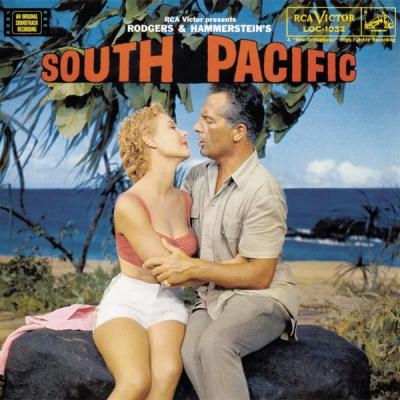
"South Pacific" Soundtrack Lyrics
Musical • 2000
Track Listing
Nellie and Cable
"Rodgers & Hammerstein’s South Pacific (Music from the ABC Premiere Event)" – Album Guide to Tracks and Key Scenes
Overview
How do you re-sing a canon without embalming it? The 2001 ABC film of South Pacific asks that question and answers with refreshed orchestrations, TV-close vocals, and a song list tweaked for character focus. Arrival → adaptation → rebellion → collapse: the soundtrack moves from palm-shaded optimism to wartime uncertainty, pushes hard on the show’s racial themes, then lands on reconciliation without losing the ache.
The companion album Rodgers & Hammerstein’s South Pacific (Music from the ABC Premiere Event) captures Glenn Close (Nellie), Harry Connick Jr. (Lt. Cable), and Rade Šerbedžija (Émile) in newly cut studio/film takes. The program trims and reorders familiar numbers (notably shortening “Bali Ha’i” and omitting “Happy Talk”) while restoring “My Girl Back Home” in the home-video version — a choice that underlines Cable’s interior life. According to the album’s release notes, it streeted March 20, 2001, a few days ahead of ABC’s broadcast.
Genres & themes in phases: Broadway lyricism & lush strings (arrival — flirt and wonder) → ballad grandeur & woodwind color (adaptation — longing) → march rhythms & brass (rebellion — duty and doubt) → hymn-like reprises (collapse → acceptance). Bright woodwinds = innocence; muted brass = consequences.
How It Was Made
Directed by Richard Pearce, the film was shot largely in Australia and Tahiti-adjacent locations, with musical staging by Vincent Paterson. The soundtrack producers — Michael Gore, Joel Moss, and Paul Bogaev — balanced on-set performances and studio polish so the vocals sit intimate on television while still blooming on album. Casting leans actor-forward: Close’s characterization pulls emphasis toward Nellie’s moral awakening; Connick’s lighter, crooner-inflected Cable sits beside a less-operatic, spoken-through Émile, which shifts duets into conversational drama.
Tracks & Scenes
Timings reference the ~129-minute broadcast/master; “diegetic” refers to music the characters hear on screen.
“Overture” — Orchestra
Where it plays: Title montage with island aerials (~00:01). Non-diegetic; broad, sunny brass sets the canvas.
Why it matters: Establishes the romance-adventure scale before the story narrows to faces.
“A Cock-Eyed Optimist” — Nellie (Glenn Close)
Where it plays: Early on, as Nellie readies at the nurses’ quarters (~00:07). Semi-diegetic staging with ambient base-hum.
Why it matters: Character thesis: bright surface, deeper grit — Close sings it like a manifesto.
“Some Enchanted Evening” — Émile (Rade Šerbedžija)
Where it plays: Night at the officer’s club/balcony (~00:16). Non-diegetic lead vocal, danced through in long takes.
Why it matters: The remake leans into the spoken warmth of Émile; the melody becomes storytelling, not operatic showpiece.
“There Is Nothin’ Like a Dame” — Seabees & Billis
Where it plays: Beachwork montage and mess-tent high jinks (~00:24). Diegetic camp-chorus energy with drumline stomp.
Why it matters: World-building: the island’s male chorus as comic engine and pressure valve.
“Bali Ha’i” — Bloody Mary (Lori Tan Chinn)
Where it plays: At the cliffside vista when Cable first senses the pull (~00:33). Non-diegetic lead with shortened second half in this version.
Why it matters: Invitation as spell — the edit keeps the trance brief, which tightens Cable’s arc.
“Younger Than Springtime” — Lt. Cable (Harry Connick Jr.)
Where it plays: The glade with Liat (~00:39). Non-diegetic vocal riding strings and winds, cut against hushed close-ups.
Why it matters: Connick croons it intimate, almost whispered; desire without swagger.
“Twin Soliloquies” — Nellie & Émile
Where it plays: After-party quiet corners (~00:46). Split-melody staging across two rooms.
Why it matters: Two interior monologues dovetail; the film frames it like parallel close-ups.
“I’m Gonna Wash That Man Right Outa My Hair” — Nellie & nurses
Where it plays: Beach shower sequence (~00:58). Diegetic dance-song as the women reclaim mood and momentum.
Why it matters: The most purely “TV musical” set-piece — handheld cameras, splashes, grin-tempo.
“You’ve Got to Be Carefully Taught” — Lt. Cable
Where it plays: Bare stage-space/cleared hut (~01:20). Non-diegetic; the camera holds, lyrics first.
Why it matters: The moral core — delivered spare, unadorned. It resets Nellie’s compass and the audience’s, too.
“This Nearly Was Mine” — Émile
Where it plays: Before the mission (~01:33). Non-diegetic lament against surf and dusk.
Why it matters: A goodbye to the life that might have been; melody darkens, strings sigh.
“Honey Bun” — Nellie & company
Where it plays: Thanksgiving show gag (~01:41). Diegetic vaudeville within the story.
Why it matters: Comic release before the plot tightens again — the album preserves its bounce.
“My Girl Back Home” — Nellie & Cable (restored on home video)
Where it plays: Late, as shared reflection (~01:49). Non-diegetic duet in the home-media cut; album includes the track as a coda.
Why it matters: Re-grounds Cable; the added song rebalances the second half toward memory and cost.
Notes & Trivia
- The ABC broadcast premiered March 26, 2001; the soundtrack album released March 20, 2001.
- “Happy Talk” is omitted in this version; “Bali Ha’i” is abbreviated; “My Girl Back Home” returns for the home release.
- Producers on the album: Michael Gore, Joel Moss, and Paul Bogaev; distribution via Sony Music.
- Vincent Paterson choreographed; location work took place in Australia and near Tahiti.
Music–Story Links
When Émile turns “Some Enchanted Evening” into spoken-song, the romance feels adult, not operatic. “Younger Than Springtime” frames Cable’s rush without heroic brass — so the hard truth of “Carefully Taught” lands with even more sting. “Wash That Man…” lets Nellie posture confidence; “This Nearly Was Mine” shatters it. And the restored “My Girl Back Home” threads memory through duty, giving the finale a quieter aftertaste.
Reception & Quotes
Reviews split on the vocal casting but praised the production’s craft and the decision to foreground the story’s racial critique. Per official site roundups and contemporary coverage, Close’s Nellie drew particular notice for warmth and steel.
“Beautifully produced… better than the stagy 1958 film.” — as quoted from a major newspaper review
“There’s a heightened sense of drama and tension in the remake… the rewards are great.” — a New York tabloid summary
“Actor-first readings make the songs feel like scenes.” — broadcast capsules
Interesting Facts
- TV-first mix: Vocals sit close and dry so dialogue can snap right back in scene changes.
- Song order tweaks: The film re-sequences a few numbers to align with added scenes (officer’s club, confidante beats).
- Actor-led Émile: Šerbedžija’s approach swaps operatic heft for narrative intimacy — a deliberate recalibration.
- Single-disc run time: The album clocks ~46 minutes, a leaner pass through the score than stage cast recordings.
- Label breadcrumbs: Early retail copies list Sony Music Distribution; some listings tag producers in the packaging credits.
Technical Info
- Title: Rodgers & Hammerstein’s South Pacific (Music from the ABC Premiere Event)
- Year: Film 2001 (ABC broadcast March 26) — Album 2001 (released March 20)
- Type: Television soundtrack (new performances)
- Music & Lyrics: Richard Rodgers & Oscar Hammerstein II
- Album Producers: Michael Gore; Joel Moss; Paul Bogaev
- Label/Distribution: Sony Music (US distribution)
- Selected placements (as staged): “Some Enchanted Evening” (officer’s club balcony); “Bali Ha’i” (cliffside vision); “Younger Than Springtime” (glade); “Wash That Man…” (beach showers); “You’ve Got to Be Carefully Taught” (stripped staging); “This Nearly Was Mine” (dusk farewell); “My Girl Back Home” (home-media cut duet)
- Availability: Streaming and CD; common US UPCs tie to Sony-distributed pressings
Questions & Answers
- Is this the 1958 film soundtrack?
- No — this album is from the 2001 ABC television remake with new recordings by the cast.
- Why is “Happy Talk” missing?
- The 2001 film drops it and trims “Bali Ha’i” to streamline pacing and tone.
- Does the album include “My Girl Back Home”?
- Yes — it appears with the home-video restoration of the scene; the disc includes it as a late track.
- Who produced the recordings?
- Michael Gore, Joel Moss, and Paul Bogaev are credited on CD issues distributed by Sony.
- Wait, I see South Pacific CDs dated 2000 — what are those?
- Those are reissues of the 1958 film soundtrack. The ABC TV remake’s album is 2001.
Canonical Entities & Relations
| Subject | Verb | Object |
|---|---|---|
| Richard Rodgers & Oscar Hammerstein II | wrote | South Pacific (stage score) |
| Richard Pearce | directed | South Pacific (ABC television film, 2001) |
| Glenn Close | performed | Nellie vocals on the 2001 soundtrack |
| Harry Connick Jr. | performed | Lt. Cable vocals on the 2001 soundtrack |
| Rade Šerbedžija | performed | Émile vocals on the 2001 soundtrack |
| Michael Gore; Joel Moss; Paul Bogaev | produced | the 2001 soundtrack album |
| Sony Music | distributed | the 2001 soundtrack CD in the US |
| Vincent Paterson | choreographed | the musical numbers (2001 film) |
Sources: AllMusic album entry; Rodgers & Hammerstein Organization film page; ABC/press coverage; Playbill (DVD/broadcast dates); Wikipedia (2001 film page — music/number changes); IMDb Soundtracks/credits; retail listings confirming producers and Sony distribution; 2001 ABC promo (video reference).
November, 27th 2025
A-Z Lyrics Universe
Cynthia Erivo Popular
Ariana Grande Horsepower
Post Malone Ain't No Love in Oklahoma
Luke Combs Good Riddance (Time of Your Life)
Green Day Bye Bye Bye
*NSYNC You're the One That I Wan
John Travolta & Olivia Newton-John I Always Wanted a Brother
Braelyn Rankins, Theo Somolu, Kelvin Harrison Jr. and Aaron Pierre The Power of Love
Frankie Goes to Hollywood Beyond
Auli’i Cravalho feat. Rachel House MORE ›