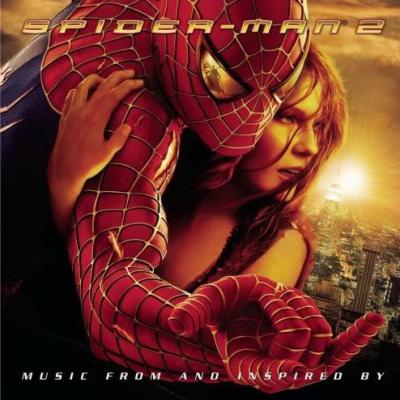
"Spider-Man 2" Soundtrack Lyrics
Movie • 2004
Track Listing
Hoobastank
Train
Dashboard Confessional
Dolores O'Riordan (The Cranberries)
Taking Back Sunday
Maroon 5
Smile Empty Soul
Jet
The Distillers
Yellowcard
The Ataris
Lostprophets
Midtown
Ana
Jimmy Gnecco feat. Brian May
Danny Elfman
Danny Elfman
Mew
Switchfoot
Killing Heidi
"Spider-Man 2: Music from and Inspired by" – Album Guide to Tracks and Key Scenes
Review
What happens when a superhero movie about burnout gets a soundtrack that sounds like an early-2000s breakup mixtape and a symphonic crisis of faith? Spider-Man 2 threads that needle. The film follows Peter Parker trying to juggle college, rent, his job, his relationship with Mary Jane, and the tiny detail of being New York’s favorite wall-crawler. The music constantly reminds us that Peter is one person being pulled in two directions: urgent, swirling orchestral cues when he suits up, and bruised alt-rock when he retreats into his own head. Danny Elfman’s score leans harder into melancholy and awe than in the first film, while the compilation album leans into emo, post-grunge, and radio rock that sound like the inner monologue of a chronically exhausted 20-something.
What makes this soundtrack distinct is how often the songs sit just outside the story rather than blasting through every action scene. Many of the rock tracks live on the album, the trailers, the music videos, or over the end credits, while the film itself uses a very specific set of diegetic cues — lounge standards, polka in a dingy hallway, a street violinist sawing away at the Spider-Man theme — to ground Peter in an oddly romantic New York. Rising strings and choir help sell the scale of Doc Ock’s experiments and the train fight, but it is a dusty pop tune like “Raindrops Keep Fallin’ on My Head” that makes Peter’s short-lived happiness feel both sincere and slightly ridiculous. The result is a score that carries the plot and a song album that captures how it felt to be obsessed with this movie in 2004.
Stylistically, the soundtrack is split into phases: alt-rock and emo (Dashboard Confessional, Taking Back Sunday, Yellowcard) map onto Peter’s self-doubt and romantic angst; post-grunge and adult-leaning rock (Train, Hoobastank, Switchfoot) supply a steadier, grown-up resilience; big-band jazz (Michael Bublé’s Spider-Man theme) brings playful swagger to the credits; and old-school pop and classical cues (“Raindrops Keep Fallin’ on My Head,” Schubert and Bach) underline how Peter keeps trying to live a “normal,” almost old-fashioned life. Elfman’s orchestral writing ties it together — high brass and choral surges for heroism, tense string ostinatos for Doc Ock, heavy low brass when responsibility crashes back down — so the score feels like the spine and the songs feel like Peter’s diary scribbles.
How It Was Made
The song album, Spider-Man 2: Music from and Inspired by, was built the old-school blockbuster way: Columbia Records and Sony’s soundtrack team, led by executive producers like Glen Brunman and music supervisor Laura Wasserman, commissioned new tracks from bands that were huge on rock radio in 2004 and then threaded them around Danny Elfman’s themes from the first film. Dashboard Confessional wrote “Vindicated” at high speed after being brought in as the emotional tentpole, Train recorded a punchier “rock version” of “Ordinary” for the album, and Ana Johnsson’s “We Are” became a European promo anthem. In parallel, Elfman returned to score the film but clashed with director Sam Raimi during post-production; large chunks of the film’s action — the “birth” of Doctor Octopus, the train sequence, several romantic or comedic inserts — were reworked with additional music by John Debney and Christopher Young. Years later, La-La Land Records’ 20th-anniversary 3-CD set finally folded all of those alternates, source cues, and previously unreleased pieces into one massive, remastered presentation.
Tracks & Scenes
Spider-Man 2 uses songs very surgically. Most of the album’s rock cuts live in the marketing ecosystem — trailers, TV spots, CDs spinning in teenagers’ bedrooms — while the film itself drops in specific pieces to punctuate emotional pivots: Peter quitting the suit, Mary Jane stepping into someone else’s orbit, a landlord complaining about rent over polka. Below are some of the key cues and how they function in the story.
“Vindicated” (Dashboard Confessional)
- Where it plays:
- The main version plays over the first stretch of the end credits, right after the final image of Mary Jane watching Peter swing away. For roughly two minutes, as names for cast and top crew scroll by, the song’s surging guitars and rapid-fire confessions carry us out of Peter’s last-minute choice to embrace his double life.
- Why it matters:
- The lyrics track Peter’s arc almost too perfectly — selfish, wrong, then “vindicated” by choosing responsibility anyway. It turns the credits into one last interior monologue and became, for a lot of fans, the emotional shorthand for the whole movie.
“Ordinary” (Train)
- Where it plays:
- After “Vindicated” is abruptly faded out in the credits, Train’s rock-version of “Ordinary” takes over as the second song. It covers a big mid-section of the scroll with a steadier, mid-tempo groove, effectively soundtracking the “crew wall” of names you half-watch while still sitting in your seat.
- Why it matters:
- The song leans into Peter’s desire to be just another guy — its lyrics about feeling small and overlooked mirror his early-film burnout. Sonically, it smooths the jump from emo urgency into something more adult and resigned.
“We Are (Video Version)” (Ana Johnsson)
- Where it plays:
- The song is not used prominently in the U.S. cut of the film itself, but it saturates the marketing. International TV spots and a dedicated music video intercut Ana Johnsson performing in a warehouse with footage from the movie — Spidey swinging past glass, Doc Ock’s arms flaring, and Peter and MJ’s near-kiss — turning it into a kind of unofficial European theme.
- Why it matters:
- “We Are” became a chart hit in several European countries and, for a lot of listeners, was their first exposure to the film’s emotional palette. It extends the soundtrack’s identity beyond the cinema, aligning Spider-Man 2 with a more global, female-fronted rock sound.
“Gifts and Curses” (Yellowcard)
- Where it plays:
- The track is an album highlight rather than a major on-screen needle drop, but it hangs around the film’s orbit in bonus content and fan edits. The lyrics read like commentary on the train sequence and Peter’s sense of his powers as a burden.
- Why it matters:
- Violin-laced pop-punk matches Spider-Man almost too well. Even if you never hear it in the theatrical mix, the song feels like the inner life of the kid the crowd gently passes overhead after the train fight.
“Raindrops Keep Fallin’ on My Head” (B. J. Thomas)
- Where it plays:
- Roughly mid-film, right after Peter decides he is done being Spider-Man, we cut into a bright, almost goofy montage: Peter sleeps soundly, eats hot dogs, aces a test, and strolls past a crime scene while police cars scream by in the background. The song plays non-diegetically over the whole sequence, only fading as real-world consequences creep back in at the edges.
- Why it matters:
- The cue is deliberately corny — a 1969 soft-rock hit dropped into a 2004 superhero film — and that clash is the point. It makes Peter’s fantasy life feel fragile and slightly off, and because the song is so famously tied to another movie, it hints that this happiness cannot last.
“Special Delivery” (John Debney)
- Where it plays:
- Early in the film, when Peter is racing to deliver pizzas in costume, the cue kicks in as he swings between buildings with stacked boxes balanced on one arm. Debney’s music briefly quotes Elfman’s heroic motif but twists it into something lighter and more comedic as the delivery goes from bad to worse, ending with the famous “He stole that guy’s pizza!” gag.
- Why it matters:
- This is Peter’s life in microcosm: superheroics applied to minimum-wage problems. Musically, it shows how the additional composers could riff on Elfman’s themes to give everyday mishaps a mythic, but jokey, scale.
“Suicide Polka” (“Happy” Bernie Goydish and His Orchestra)
- Where it plays:
- The piece plays diegetically from inside Peter’s run-down apartment building, tied to his landlord’s world. We hear it bleeding through walls and across the hallway as Peter dodges questions about the rent, hauls his laundry, and navigates awkward encounters with his neighbor.
- Why it matters:
- It is comic, old-world, and a little sour, underlining how far Peter’s cramped life is from the glossy heroism of the score. The polka becomes a running joke that says, “Yes, he saves New York, but he still lives in a place where this plays at full volume on weeknights.”
“Piano Quintet in A, D.667 (‘The Trout’)” (Franz Schubert)
- Where it plays:
- This chamber piece underscores Peter’s first proper lunch with Dr. Otto Octavius and his wife Rosie, around the first act turn. It plays softly in the background of the apartment as they talk about science, poetry, and the burden of genius, with the music gently filling the silences.
- Why it matters:
- The refined classical texture marks Octavius as a cultured, aspirational figure — a mentor Peter wants to emulate. When the same character later becomes Doc Ock, the memory of this civil, music-filled lunch makes his fall feel even sharper.
“I Only Have Eyes for You” (Peter Cincotti and The Peter Cincotti Trio)
- Where it plays:
- At the charity ball, we drift into a jazz-club atmosphere as Cincotti’s trio performs live onstage. While the band plays this standard, Peter weaves through the crowd and ends up in a tense conversation with Harry, who is drunk, jealous, and still obsessed with Spider-Man’s role in his father’s death.
- Why it matters:
- The romantic lyrics contrast with Harry’s simmering resentment, and the smooth performance makes the whole scene feel like a dance Peter cannot quite step into. It is a love song underscoring a friendship coming apart.
“Stars and Stripes Forever” (Peter Cincotti and The Peter Cincotti Trio)
- Where it plays:
- Later in the same event, the band shifts into this patriotic march as Mary Jane and astronaut John Jameson descend the grand staircase at the planetarium. The camera tracks them with a kind of pageant-like ceremony while Peter watches from the sidelines.
- Why it matters:
- The choice of song frames their entrance like a state occasion — America’s golden couple — making Peter feel even more like the outsider who has lost his chance. It also gently mocks the pomp of the engagement the film will soon blow up.
“Love Is the Sweetest Thing” (Peter Cincotti and The Peter Cincotti Trio)
- Where it plays:
- Still at the ball, this tune plays as Peter and MJ finally have a fraught conversation in the corridor. The music drifts in from the main room while they argue about their history and his distance, before Peter storms off and runs into Harry, sparking another confrontation.
- Why it matters:
- It is bittersweet irony: a smooth, old-fashioned declaration of love underscoring two people who cannot say what they feel. The cue ties MJ’s romantic storyline to the film’s classier, more adult spaces.
“Suite No. 2 in B Minor” (Johann Sebastian Bach)
- Where it plays:
- This classical suite is heard as accompaniment to Mary Jane’s stage performance in the play Peter keeps missing. The camera alternates between the onstage action — formal costumes, controlled blocking — and Peter arriving late or peering through doors.
- Why it matters:
- The music’s baroque precision accentuates how structured MJ’s professional life is compared with Peter’s chaotic double schedule. Every time we hear it, we are reminded of opportunities he is letting slip.
“Runaway Train” (Christopher Young & Danny Elfman)
- Where it plays:
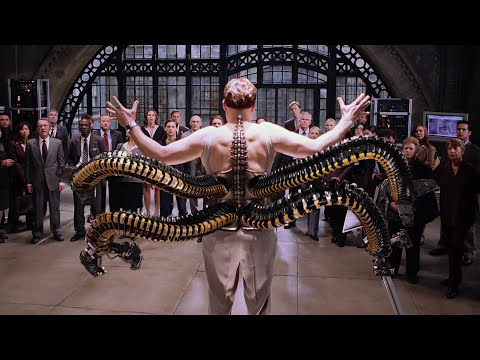
- During the elevated train battle, this cue explodes beneath the sound design as Doc Ock sabotages the controls and Peter fights both the villain and the physics of a runaway carriage. Choir, full orchestra, and pounding percussion all surge as he throws himself in front of the train and webs the city together to stop it.
- Why it matters:
- This is the score at full superhero scale. It turns a relatively contained stunt sequence into an operatic trial, and the exhausted silence that follows — broken only by murmured thanks from the passengers — hits harder because the music has pushed everything to the brink.
“Bridal Chorus” (Richard Wagner)
- Where it plays:
- Near the end, as MJ’s wedding to John collapses off-screen, the famous bridal march starts up in the church. We then cut to chaos in the back rooms as a bridesmaid hands John a note, Jonah yells to cancel the caterer, and we realize MJ has run to find Peter instead.
- Why it matters:
- The cue is iconic wedding shorthand, so using it right as everything falls apart gives the scene an almost screwball-comedy energy. Musically it underlines that MJ is stepping away from a “perfect” life into something riskier and messier.
“Theme from Spider-Man” (violin street version – Elyse Dinh)
- Where it plays:
- At street level, a busker plays the classic Spider-Man cartoon theme on violin while pedestrians drift by. Peter walks through the frame like any other New Yorker, listening to his own legend turned into background entertainment.
- Why it matters:
- The gag is simple but sharp: within the world of the film, Spider-Man is already a pop icon whose theme can be busked for spare change. It blurs the line between the character we know from comics and the one living in this movie’s New York.
“Theme from Spider-Man” (Michael Bublé)
- Where it plays:
- Later in the end credits, after the rock tracks, Bublé’s big-band take on the classic theme rolls in as the third song. Lush horns, crooner vocals, and a swinging rhythm send audiences out of the theater once most of the primary credits have passed.
- Why it matters:
- It is a victory lap — self-aware, jazzy, a little camp. It connects the movie to the character’s older TV incarnations and has since become one of Bublé’s cult favorite tracks, even though it was initially treated as a novelty.
“Switchback” (Celldweller)
- Where it plays:
- Outside the film itself, this industrial-rock track is used as a second song in the theatrical trailer, kicking in after the more traditional score-driven beginning. It blasts under quick-cut shots of web-slinging, tentacles smashing glass, and Peter’s life unravelling in rapid montage.
- Why it matters:
- “Switchback” is a snapshot of how trailers in 2004 sold superhero movies — heavier guitars, processed beats, and a mood closer to a video game commercial. It frames Spider-Man 2 as edgier than the actual film, while still echoing its themes of losing and regaining control.
Notes & Trivia
- The score heard in the film is a patchwork of Danny Elfman’s main cues and additional, often heavily revised music by John Debney and Christopher Young, reflecting a turbulent post-production where temp tracks and reshoots forced rewrites.
- Some beloved pieces, like the full “Train/Appreciation” cue and alternates such as “Cake Girl,” were effectively mythical for years, circulating only on composer promos until the 20th-anniversary expansion finally made them widely available.
- Several songs tightly associated with Spider-Man 2 — “We Are,” “Gifts and Curses,” “Meant to Live” — are more present in the marketing and fan culture than in the theatrical mix, creating a split between how the movie sounds and how it is remembered.
- MJ’s theatre scenes quietly show off Sam Raimi’s love of classical music: the Bach suite and traditional stage accompaniment are chosen to make her world feel as “serious” as Peter’s scientific mentors.
- The polka and lounge cues tied to Peter’s apartment and the charity ball form a little sonic map of class — cheap, slightly abrasive music for his daily grind, and lush standards for the rich people whose parties he crashes.
Reception & Quotes
Commercially, Music from and Inspired by Spider-Man 2 was a hit: it debuted in the U.S. top 10, hit number one on the Billboard soundtrack chart, and earned a Gold certification while also charting in the UK, Australia, and France. Individual singles like “Vindicated,” “We Are,” and “Ordinary” found their own lanes on alternative, adult-contemporary, and European charts. Over time, though, the compilation album’s reputation settled into “snapshot of 2004 rock culture” — nostalgic, uneven, and very much of its era — while the orchestral score’s stock has steadily risen thanks to reappraisals and the 20th-anniversary release.
Critically, the song album drew mixed notices. IGN’s review praised the emotional punch of “Vindicated” and a handful of strong cuts but called the collection more mellow and less focused than the first Spider-Man soundtrack. A Honolulu newspaper went much harder, dismissing most tracks as generic “copycat” rock and pointing to Jet’s “Hold On” as the lone standout, while AllMusic’s two-star rating echoed the idea that the singles outweighed the filler. Fans, especially those who were teenagers when the film released, often remember it more warmly as a formative emo-rock gateway.
Elfman’s score, on the other hand, has been hailed in film-music circles as one of the stronger superhero scores of the 2000s. Contemporary and modern reviews highlight how it deepens the original Spider-Man themes, gives Doc Ock a tragic edge, and sells action scenes like the train fight as almost operatic. The score received awards attention at the Saturn Awards and later write-ups praised La-La Land’s expanded edition for finally showing how much detailed thematic work was hiding beneath the film’s sometimes choppy music edits.
“A more mellow companion to the first film’s soundtrack, anchored by a genuinely sweeping opener in ‘Vindicated.’”
— Spence D., IGN (paraphrased)
“A collection of mostly disposable modern rock, with ‘Hold On’ the rare track worth replaying on its own.”
— Jessica Labrador, Honolulu Advertiser (paraphrased)
“Elfman’s sequel score is vivid, agile, and thematically satisfying — stronger on album than the film’s mix sometimes suggests.”
— Filmtracks review (paraphrased)
“The expanded Spider-Man 2 score finally feels like the full story — warmer, richer, and almost absurdly generous to fans.”
— Zanobard Reviews on the 20th-anniversary set (paraphrased)
Interesting Facts
- “We Are” was marketed so heavily with Spider-Man 2 in Europe that it appears on some regional releases almost like a co-title, helping launch Ana Johnsson internationally.
- 3 Doors Down’s “Let Me Go” and Sia’s “Where I Belong” were both pitched for the soundtrack; label politics and creative shifts kept them off the final album, even though Sia’s single artwork featured a Spider-Man tie-in.
- Different territories got different “local hero” tracks: Australia’s CD added “I Am” by Killing Heidi; Japan got T.M. Revolution’s “Web of Night”; some Portuguese and Brazilian editions folded in a local Spider-Man theme.
- The Spider-Man 2 soundtrack sits between The Punisher: The Album and other early-2000s Marvel tie-ins in label catalogues, forming part of a brief boom of “Music from and Inspired by” compilations that doubled as rock samplers.
- Michael Bublé’s Spider-Man theme, once treated as a quirky one-off, has since been embraced enough to appear on his own best-of collections after fans kept requesting it.
- The 20th-anniversary 3-CD score set is limited to a few thousand copies, which immediately made it a collector’s item for film-music fans and Raimi-trilogy die-hards.
- “Vindicated” itself has a mythic backstory: Chris Carrabba has talked about writing and recording it under intense time pressure after diving into the film’s themes, with the song effectively finished in a single inspired sprint.
Technical Info
- Title: Spider-Man 2: Music from and Inspired by (song compilation) / Spider-Man 2: Original Motion Picture Score / Spider-Man 2: 20th Anniversary Motion Picture Score
- Year: 2004 original albums; 2024 expanded 20th-anniversary score; film released 2004.
- Type: Rock and alternative compilation soundtrack plus symphonic film score for a superhero feature.
- Composers: Danny Elfman (primary score composer); additional score by John Debney and Christopher Young on key sequences and source cues.
- Music supervision & production: Executive producers and supervisors including Glen Brunman and Laura Z. Wasserman coordinated artist selection, licensing, and album sequencing; individual rock tracks were produced by names like Don Gilmore, Howard Benson, Dave Sardy, Neal Avron, and others.
- Selected notable placements: “Vindicated” and “Ordinary” in the end credits; “We Are” across international marketing; “Raindrops Keep Fallin’ on My Head” over Peter’s “no more Spider-Man” montage; Schubert’s “Trout” Quintet at Octavius’s lunch; Cincotti’s standards at the charity ball; “Runaway Train” underscoring the elevated train fight; Wagner’s “Bridal Chorus” at MJ’s aborted wedding.
- Release context: Song album released June 22, 2004, ahead of the film’s June 30 theatrical opening; original score album followed in July 2004; the expanded La-La Land Records score set arrived in November 2024 as part of renewed interest in Raimi’s trilogy.
- Labels: Columbia Records / Sony Music Soundtrax (song compilation); Sony Classical and related Sony imprints (2004 score album); La-La Land Records (20th-anniversary expanded score).
- Commercial performance: Soundtrack album debuted around number 7 on the Billboard 200, hit number 1 on the U.S. soundtrack chart, charted in multiple territories, and was certified Gold by the RIAA.
- Awards & honors: Elfman’s score contributed to the film’s Saturn Award recognition for music and has been singled out in later retrospectives as one of his notable comic-book scores.
- Availability: The song compilation and original score are widely available on major streaming platforms and digital stores; the 20th-anniversary 3-CD set is a limited physical release from La-La Land, with some tracks also licensed to digital distributors and new vinyl editions.
Key Contributors
| Subject | Relation | Object |
|---|---|---|
| Sam Raimi | directed | Spider-Man 2 (film) |
| Danny Elfman | composed | Spider-Man 2: Original Motion Picture Score |
| John Debney | wrote additional music for | Spider-Man 2 score and source cues (“Special Delivery”, romantic inserts) |
| Christopher Young | scored | key action material in Spider-Man 2, including Doc Ock and train sequences |
| Dashboard Confessional (Chris Carrabba) | performed and wrote | “Vindicated” for the soundtrack album and end credits |
| Ana Johnsson | performed | “We Are”, promoted as a Spider-Man 2 single, especially in Europe |
| Train (band) | recorded | “Ordinary (Rock Version)” specifically for the soundtrack album |
| Peter Cincotti & Trio | performed on-screen | charity-ball standards (“I Only Have Eyes for You”, “Stars and Stripes Forever”, “Love Is the Sweetest Thing”) |
| Michael Bublé | recorded | a big-band “Theme from Spider-Man” used in the closing credits |
| Columbia Records / Sony Music Soundtrax | released | Spider-Man 2: Music from and Inspired by worldwide |
| Sony Classical | released | the 2004 original motion picture score album |
| La-La Land Records | produced and released | the 20th-anniversary expanded and remastered 3-CD score edition |
Questions & Answers
- Does the Spider-Man 2 soundtrack album include every song used in the film?
- No. The main compilation focuses on rock and alternative cuts plus two Elfman suites. Several diegetic pieces — the Cincotti performances, “Suicide Polka,” some classical cues — appear in the movie but were originally left off the main CD, though many of the score-side cues later resurfaced on the expanded 20th-anniversary release.
- What is the difference between the song album and the score album?
- The song album, Music from and Inspired by, collects band tracks tied to the film’s promotion plus two symphonic suites. The score album is pure Elfman: it presents his orchestral cues in narrative order, without the rock songs, and emphasizes thematic development for Peter, Doc Ock, and the big set pieces.
- Which edition should I buy if I mainly care about the orchestral music?
- If you want a concise listen, the 2004 Sony Classical score album works well. If you are a deep-dive fan, the 3-CD 20th-anniversary set from La-La Land is the one to track down — it adds alternates, additional Debney and Young material, and previously unreleased versions of cues like the train music and “Special Delivery.”
- Is “We Are” actually in the movie, or only on the soundtrack?
- For most viewers, “We Are” lives in the marketing: it is on the album, in music videos, on TV spots, and in some regional edits, but it is not a major needle-drop in the standard theatrical cut. It is still strongly associated with Spider-Man 2 because of how heavily it was promoted with the film.
- Does the extended cut, Spider-Man 2.1, change the music much?
- Spider-Man 2.1 adds and tweaks scenes — including more material around the elevator gag and certain action beats — which shifts some music edits and occasionally uses alternate score takes. The overarching themes, key songs, and big moments (“Raindrops,” the train fight, the credits songs) remain the same, so the musical identity is very close to the theatrical version.
Sources: Wikipedia (Spider-Man 2 film and soundtrack); Grokipedia Spider-Man 2 (soundtrack) overview; MoviesOST track usage listings; IGN and Honolulu Advertiser contemporary album reviews; Filmtracks and other score reviews; La-La Land Records and related announcements for the 20th-anniversary score; articles and interviews on “Vindicated,” “We Are,” and other singles; chart and certification data from Billboard and international chart archives.
November, 27th 2025
A-Z Lyrics Universe
Cynthia Erivo Popular
Ariana Grande Horsepower
Post Malone Ain't No Love in Oklahoma
Luke Combs Good Riddance (Time of Your Life)
Green Day Bye Bye Bye
*NSYNC You're the One That I Wan
John Travolta & Olivia Newton-John I Always Wanted a Brother
Braelyn Rankins, Theo Somolu, Kelvin Harrison Jr. and Aaron Pierre The Power of Love
Frankie Goes to Hollywood Beyond
Auli’i Cravalho feat. Rachel House MORE ›