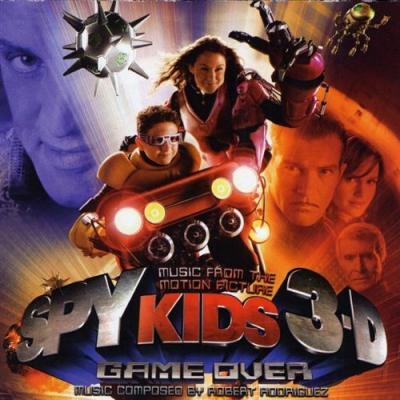
"Spy Kids 3-D: Game Over" Soundtrack Lyrics
Movie • 2003
Track Listing
Alexa Vega
Bobby Edner and Alexa Vega
Dave Curtin for DeepMix
Dave Curtin for DeepMix
"Spy Kids 3-D: Game Over (Music From the Motion Picture)" – Album Guide to Tracks and Key Scenes

Overview
What happens when a spy series dives into a video game and hands the composer a joystick? Spy Kids 3-D: Game Over answers with arrival — a neon tutorial, adaptation — leveling up through set-piece “stages,” rebellion — kids rewriting rules, and collapse — a villain disarmed by forgiveness.
The album mirrors that flow. Robert Rodriguez’s solo score turns level names into cue titles and gameplay verbs into orchestral hits: heavy brass for boss fights, chopped electronics for HUD-blink tension, surf-rock guitar stabs for gags. The pop single “Game Over” (vocals by Alexa Vega) crowns the credits like a high-score screen. Across 40-odd minutes, textures slide from chunky, mid-2000s electronica to old-school adventure writing; it’s a joystick in one hand, baton in the other.
Genres & phases: arcade-electronic pulses — tutorial jitters; brass/low strings — boss intimidation; quick-picking guitar & drum kit — speed trials; choir/synth pads — virtual awe; pop single — victory lap. As per album notes and label materials, the “Texas Philharmonic” sessions keep the franchise’s homespun-blockbuster feel intact.
How It Was Made
For the third film, Rodriguez took sole composer credit while still leaning on his Austin crew. Themes were written to map directly onto game levels (“Robot Arena,” “Mega Racer,” “Lava Monster Rock”), letting the cut structure feel like a playlist. Alexa Vega’s “Game Over” was produced alongside additional mixes for the album; a duet, “Heart Drive,” pairs Vega with Bobby Edner (one of the in-game rivals), blurring cast and soundtrack in classic Spy Kids fashion. According to label and discographic listings, Milan handled the U.S. release in late July 2003.
Tracks & Scenes
“Welcome to the Game” — Robert Rodriguez
Where it plays: Early entry into Level 1 as Juni plugs into the VR world; UI pings, vertigo cuts, and tutorial text set the rules. Non-diegetic.
Why it matters: It’s the start-button cue — bright synth arpeggios promise agility, brass says “stakes.”
“Robot Arena” — Robert Rodriguez
Where it plays: The giant-mech duel where Juni meets Demetra in a steel amphitheater. Impact hits follow each robo-slam; tempo surges with combo blows. ~First act, Level 2. Non-diegetic.
Why it matters: Establishes the punch-and-parry vocabulary that returns in later boss encounters.
“Mega Racer” — Robert Rodriguez
Where it plays: The white-knuckle track race to reach the next portal; camera whips through jumps and tunnels as rivals crash out. Mid-film, Level 3. Non-diegetic.
Why it matters: A speed cue: drum kit ostinato + guitar chugs = joystick sweat.
“Bonus Life” — Robert Rodriguez
Where it plays: Checkpoint balm after near-wipeouts; HUD hearts refill and the mix relaxes before the next spike. Non-diegetic.
Why it matters: A tiny anthem for resilience — musical extra lives.
“Programmerz” — Robert Rodriguez
Where it plays: The code-room interlude where insider knowledge (maps, glitches) changes the party’s odds. Non-diegetic.
Why it matters: Sequenced ostinati and glitch percussion sell the “inside the machine” vibe.
“Toymaker” — Robert Rodriguez
Where it plays: Sylvester Stallone’s antagonist motif across strategy cutaways and final confrontation. Non-diegetic.
Why it matters: Low-brass statements frame the villain as architect rather than bruiser — fitting the puppet-master concept.
“The Real Guy” — Robert Rodriguez
Where it plays: The infamous “The Guy” entrance and instant fail — an over-confident cameo meets a one-hit trap. Late Level 4/5 transition. Non-diegetic.
Why it matters: A heroic flourish that collapses into comic silence; the album preserves the gag’s musical rimshot.
“Lava Monster Rock” — Robert Rodriguez
Where it plays: The molten-cavern showdown and ascending platforms sequence. Non-diegetic.
Why it matters: Guitar-forward swagger + choir pads = arcade-mythic.
“Game Over” — Alexa Vega
Where it plays: End credits single (with alternate “Level 5 Mix” on album). Non-diegetic.
Why it matters: Pop closer that flips gameplay trash-talk into post-victory celebration.
“Heart Drive” — Bobby Edner & Alexa Vega
Where it plays: Album feature tied to the teens-vs-beta-testers rivalry vibe; used in promo/credit contexts. Non-diegetic in album form.
Why it matters: Cast-voiced energy that extends the movie’s teen-arc beyond the screen.
Also heard/associated: franchise motifs (“Spy Kids Main Title” tags) and short stingers for lives lost/won; trailer cuts rearrange score fragments for punchier hooks.

Notes & Trivia
- Rodriguez takes his first solo score credit in the series here — and plays in the “Game Over” band on multiple instruments.
- Track titles double as scene labels, a tidy match to the film’s level-based structure.
- Alexa Vega’s single appears in two versions on the album (standard and “Level 5 Mix”).
- George Oldziey conducts the Texas Philharmonic Orchestra on the score cues.
- The album landed days before U.S. release; CD copies carry Milan catalog number M2-36024.
Music–Story Links
When Juni faces Demetra in the Robot Arena, metallic hits and descending brass flatten the comedy into “boss logic”; the cue teaches us how the game punishes hubris. The Mega Racer sprint welds drum kit to camera movement — when the rhythm stutters, a rival wrecks. Bonus Life cues soften edges after losses, musically signaling “don’t quit.” And the title single clicks in only after the Toymaker is forgiven, tying the win to empathy rather than pure domination.
Reception & Quotes
“More arcade than orchestra at times — but that’s the brief, and it delivers a sugar-rush.” — a contemporary soundtrack blurb
“Rodriguez’s first solo franchise score leans into level-based cue titles that make a great standalone listen.” — an album catalog note
“Vega’s end-title song is a catchy capstone for younger listeners.” — a capsule review
The general take: brisk, theme-tagged, and unapologetically “gamey.” Availability has stayed steady via streaming and catalog CDs; region dates vary slightly by storefront.

Interesting Facts
- The album streeted July 22, 2003 in the U.S. (CD/digital) — a tight tie-in to the July 25 opening.
- “Game Over” lists Rebecca Rodriguez and Robert Rodriguez as writers; Carl Thiel co-produced mixes for release.
- “Heart Drive” pairs cast voices (Bobby Edner/Alexa Vega) and became a fan-favorite extra outside the film proper.
- Track ordering on some services shows a 2002 metadata stamp, but discography entries confirm a 2003 release window.
- Orchestra credit reads “Texas Philharmonic Orchestra,” conducted by George Oldziey with Rodriguez on the podium for select cues.
Technical Info
- Title: Spy Kids 3-D: Game Over (Music From the Motion Picture)
- Year: 2003 (U.S. album release July 22, 2003)
- Type: Film soundtrack (score + singles)
- Composer: Robert Rodriguez
- Featured songs: “Game Over” (Alexa Vega); “Heart Drive” (Bobby Edner & Alexa Vega)
- Notable cues: “Robot Arena,” “Mega Racer,” “Bonus Life,” “Toymaker,” “Lava Monster Rock,” “The Real Guy.”
- Label: Milan Records (catalog M2-36024)
- Availability/editions: CD/digital; streaming on major platforms; alternate “Level 5 Mix” of the single included on album.
Questions & Answers
- Who composed the score?
- Robert Rodriguez — his first solo score credit in the series, with Austin collaborators.
- What song plays over the end credits?
- “Game Over,” sung by Alexa Vega; the album also includes a “Level 5 Mix.”
- Which cue underscores the giant robot duel?
- “Robot Arena” — a percussion-heavy fight track aligned to the mech brawl with Demetra.
- What music scores the racing level?
- “Mega Racer” — drum kit ostinato, guitar chugs, and brass hits to match the track mayhem.
- When did the album release?
- U.S. street date July 22, 2003, a few days before the film’s July 25 opening.
Canonical Entities & Relations
| Subject | Relation | Object |
|---|---|---|
| Robert Rodriguez | composed & produced | Spy Kids 3-D: Game Over soundtrack |
| Alexa Vega | performed | “Game Over” (end-credits single) |
| Bobby Edner | performed with | Alexa Vega on “Heart Drive” |
| George Oldziey | conducted | Texas Philharmonic Orchestra |
| Milan Records | released | album (catalog M2-36024) |
| Dimension Films | distributed | Spy Kids 3-D: Game Over (feature) |
| Sylvester Stallone | portrays | The Toymaker (villain motif “Toymaker”) |
| Daryl Sabara | portrays | Juni Cortez (protagonist underscored by level cues) |
Sources: Milan Records catalog; Soundtrack.net (album page); SoundtrackCollector (catalog & date); Discogs (track/credit details); Apple Music/Spotify listings; film Wikipedia (music section); IMDb soundtrack page.
November, 27th 2025
A-Z Lyrics Universe
Cynthia Erivo Popular
Ariana Grande Horsepower
Post Malone Ain't No Love in Oklahoma
Luke Combs Good Riddance (Time of Your Life)
Green Day Bye Bye Bye
*NSYNC You're the One That I Wan
John Travolta & Olivia Newton-John I Always Wanted a Brother
Braelyn Rankins, Theo Somolu, Kelvin Harrison Jr. and Aaron Pierre The Power of Love
Frankie Goes to Hollywood Beyond
Auli’i Cravalho feat. Rachel House MORE ›