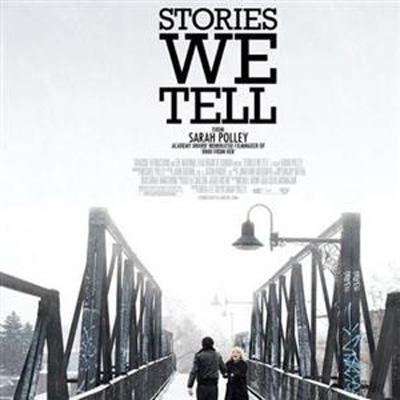
"Stories We Tell" Soundtrack Lyrics
Movie • 2013
Track Listing
Abraham Lass
Bon Iver
Abraham Lass
Abraham Lass
Abraham Lass
Abraham Lass
Abraham Lass
Abraham Lass
Abraham Lass
Fats Waller
Abraham Lass
Timber Timbre
Abraham Lass
"Stories We Tell (Documentary Soundtrack & Score)" – Album Guide to Tracks and Key Scenes
Overview
How do you score a memory that keeps rewriting itself? Stories We Tell solves it with restraint. Sarah Polley’s documentary floats on a chamber-small score by composer Jonathan Goldsmith and a handful of licensed songs that feel like artifacts pulled from a family attic — tender, haunted, occasionally playful. Nothing is over-scored; the film lets music surface like breath between confessions.
Goldsmith’s cues sit close to the image — solo piano and understated textures that hold space while interviews, 8mm recreations, and home movies braid together. Around them, a few hand-picked songs (Bon Iver’s “Skinny Love,” Timber Timbre’s “Demon Host,” vintage standards) arrive as emotional waypoints rather than declarations. The soundtrack’s job isn’t to answer; it’s to listen.
Styles & phases: chamber score (intimacy, doubt); indie-folk (tender fracture); mid-century standards (nostalgia, family myth); public-domain/library cuts (playroom innocence, montage glue).
How It Was Made
Polley shot across years with the National Film Board of Canada, then cut a mosaic of interviews and staged Super-8 recreations. Music-wise, she kept a light footprint: Jonathan Goldsmith composed and arranged the score, while archival/music clearance specialist Elizabeth Klinck wrangled the period songs and library cues (including multiple Folkways “Play Me a Movie” tracks that match the film’s home-movie aesthetic). There was no commercial OST album — the music lives in the film and on the artists’ own releases.
Tracks & Scenes
Selections below (not a full tracklist). Time notes are relative to the ~109-minute cut — early / mid / late.
“Skinny Love” (Bon Iver)
- Where it plays:
- Used in a reflective montage as family testimony rubs against the limits of memory — the vocal sits like a confession beside the images. Non-diegetic; mid-late.
- Why it matters:
- The fragile folk timbre mirrors the film’s core: love, but complicated; love, but fraying at the edges.
“Demon Host” (Timber Timbre)
- Where it plays:
- A low-glow needle-drop over footage that hints at hauntings that aren’t supernatural at all — lineage, secrecy, and the stories we inherit. Non-diegetic; mid.
- Why it matters:
- Folkloric unease without jump scares — perfect for a film where ghosts are living people and old choices.
Vintage standards: “Ain’t Misbehavin’” • “Stormy Weather” (period recordings)
- Where it plays:
- Briefly in transitions and memory passages, evoking the era of the family romances being recalled. Source-like; scattered.
- Why it matters:
- They color the memories with the music those memories would have known — sweetness with an aftertaste.
Library cues from Folkways’ Play Me a Movie (Abraham Lass)
- Where it plays:
- Short archival-style stingers (“Tranquility,” “The Light Fantastic Toe,” “A Funeral Procession,” etc.) under 8mm-look footage and connective montage. Non-diegetic; throughout.
- Why it matters:
- They sound like what old home films would have used — a sly, self-aware frame for the movie’s reconstruction game.
Score by Jonathan Goldsmith — piano and small ensemble
- Where it plays:
- Soft, exact placements around interviews (Michael Polley’s narration sessions, revelations around parentage, aftermath breaths). Non-diegetic; across.
- Why it matters:
- The cues never push. They listen — then they let the room exhale.
Notes & Trivia
- Composer: Jonathan Goldsmith — his name appears on the film’s principal credits; reviews singled out the restrained piano writing.
- Clearances: Elizabeth Klinck handled music/archival clearances — key to landing those Folkways and vintage sides.
- No retail OST: There isn’t a commercial “Original Soundtrack” album; songs live on the artists’ own releases/compilations.
- Canadian core: Produced by the National Film Board of Canada; festival run began Venice/Telluride/Toronto, with wider releases into 2013.
- Timber Timbre connection: The band has publicly noted “Demon Host”’s use in the film; it’s become the most-cited non-score cue.
Music–Story Links
Goldsmith underscores the act of telling — not the “reveal.” When Michael Polley reads, the music stays near-silent so the voice can carry weight. Indie-folk cues like “Skinny Love” fold into confessional montage, echoing the film’s ache without summarizing it. The Folkways stingers wink at nostalgia even as the movie questions it. Every song is a thread; none declare the answer.
Reception & Quotes
Critics lauded the film’s emotional precision — and noticed how the music helps without intruding.
“The music, arranged by Jonathan Goldsmith, adds a gentle ache without tipping the scale.” — critics’ roundups
“A documentary that listens — the score follows suit.” — festival write-ups
Interesting Facts
- Library gold: Several short cues come from the Folkways LP Play Me a Movie — a perfect tonal match for Super-8 aesthetics.
- ‘No OST’ reality: Because cue sheets span modern indie and older standards, a one-label soundtrack release never materialized.
- Festival to canon: After Venice/Telluride/TIFF, the film entered Canada’s Top 10 list of all-time films (TIFF list).
- Title truth: The songs often contradict the images — on purpose. The film is about unreliable narrators, including music.
- Composer continuity: Goldsmith’s long Canadian screen career made him a natural fit for Polley’s understated approach.
Technical Info
- Title: Stories We Tell
- Year: 2012 (Canada); U.S. release 2013
- Type: Documentary — score + licensed songs (no official OST album)
- Composer/Arranger: Jonathan Goldsmith
- Music/Archival Clearances: Elizabeth Klinck
- Key songs heard: Bon Iver — “Skinny Love”; Timber Timbre — “Demon Host”; period standards including “Ain’t Misbehavin’,” “Stormy Weather”; multiple short cues from Folkways’ Play Me a Movie library.
- Studio: National Film Board of Canada (NFB)
- Release path: Venice → Telluride → TIFF (2012); broader theatrical in 2013
- Availability: NFB digital platforms & standard VOD; songs available on their respective artist releases.
Questions & Answers
- Who composed the score?
- Jonathan Goldsmith, whose restrained piano/ensemble cues support the film’s intimate tone.
- Is there an official soundtrack album?
- No — the film uses a mix of original score, indie-folk, standards, and library music spread across different rights holders.
- What’s the best-known song from the film?
- Timber Timbre’s “Demon Host” is the most-cited needle-drop; Bon Iver’s “Skinny Love” also appears memorably.
- Who handled the music clearances?
- Elizabeth Klinck (also a veteran archival/visual researcher) handled music and archive clearances.
- Where can I watch it?
- Via the National Film Board of Canada’s site/app in select regions and standard VOD platforms.
Key Contributors
| Entity | Relation |
|---|---|
| Sarah Polley | Director/Writer — orchestrates interviews and recreations |
| Jonathan Goldsmith | Composer/Arranger — chamber score |
| Elizabeth Klinck | Music & archival clearances; visual research |
| National Film Board of Canada | Producer/Studio |
| Bon Iver | Performer — “Skinny Love” |
| Timber Timbre | Performer — “Demon Host” |
| Smithsonian Folkways / Abraham Lass | Library music — Play Me a Movie cues (e.g., “Tranquility”) |
Sources: National Film Board of Canada film page; film credits & databases; soundtrack/song databases and artist discographies; festival/press materials; Timber Timbre discography notes.
November, 27th 2025
'Stories We Tell' is a 2012 Canadian documentary film written and directed by Sarah Polley and produced by the National Film Board of Canada. Learn more on Wikipedia, visit movie profile and read user reviews on Internet Movie DatabaseA-Z Lyrics Universe
Cynthia Erivo Popular
Ariana Grande Horsepower
Post Malone Ain't No Love in Oklahoma
Luke Combs Good Riddance (Time of Your Life)
Green Day Bye Bye Bye
*NSYNC You're the One That I Wan
John Travolta & Olivia Newton-John I Always Wanted a Brother
Braelyn Rankins, Theo Somolu, Kelvin Harrison Jr. and Aaron Pierre The Power of Love
Frankie Goes to Hollywood Beyond
Auli’i Cravalho feat. Rachel House MORE ›