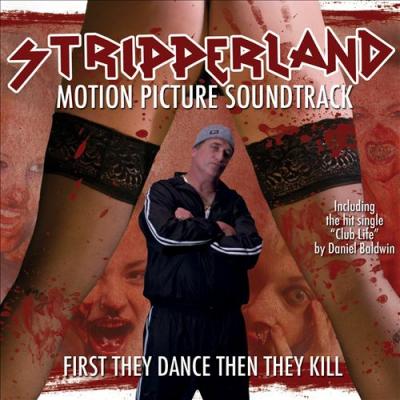
"Stripperland" Soundtrack Lyrics
Movie • 2011
Track Listing
Daniel Baldwin (Double D) feat. Pale Soul
Western Aerial
Sheena G
Smoochknob
Christian Burghardt & Cory Bold
Wayne Gacy Trio
Toxic Zombie
Cellar Door
Blue Ember
13 Cent Bob
Rogue Shot
Dj Kenoy & Jason Flynn
Christian Burghardt
Sickamore
The Dragonflies
Marca Luna
"Stripperland (Original Motion Picture Soundtrack)" – Album Guide to Tracks and Key Scenes
Overview
What if the apocalypse arrived with neon, pasties, and a mixtape built by local bands? Stripperland turns a shoestring Portland parody into a label sampler: rap-novelty, bar-rock, punk-horror, and a cheeky dose of classical, all glued to road-movie hijinks about a crew trekking to Grandma’s house. The soundtrack carries the joke — and the worldbuilding.
It’s a compilation-first release: regional artists (Western Aerial, Smoochknob, Toxic Zombie, Blue Ember), a cameo single by Daniel Baldwin (a.k.a. Double D) produced with Pale Soul, and lighter indie fare (Christian Burghardt) rub shoulders with synth-and-breaks cuts (“This Is My Techno”) and even a straight-faced Bach “Air.” On screen, songs swing between diegetic (club speakers, radios, a music video drop-in) and non-diegetic montages that stitch together gas stations, back roads, and the odd pole-dance ambush.
Genres & themes in phases — party-rap/novelty hip-hop = bait-the-horde bravado; alt-rock & pop-punk = road camaraderie and gallows humor; horror-punk/industrial = attack beats; classical needle-drop = ironic elegance over trash-fire chaos.
How It Was Made
Director Sean Skelding and Cheezy Flicks built the album around an open-call/contest for bands; winning tracks made the film and the disc. The label released the soundtrack the same spring as the DVD, with executive producer Ritchie Bristol pushing the music campaign and Baldwin’s in-character single “Club Life.” Digital editions vary slightly by territory (16–17 tracks; just over an hour).
Tracks & Scenes
“Club Life” (Daniel Baldwin a.k.a. Double D, feat. Pale Soul)
- Where it plays:
- Used as a diegetic–meets–promo moment: Baldwin’s rap persona shows up on screen (snippets from the shot-in-Oregon music video), and the hook bleeds into a highway montage — the gang rolling past shuttered clubs and handmade warning signs.
- Why it matters:
- It’s the campaign single and a worldbuilding gag — music as a way to “keep stripper-zombies at bay,” at least in Double D’s mind.
“Stripperland” (Western Aerial)
- Where it plays:
- Title-sequence/early-film energy: guitars over quick-cuts of pole-lit ruins, a half-empty gentlemen’s club, and the survivors raiding a convenience store for snacks and duct tape.
- Why it matters:
- Names the world and sets the tone — tongue-in-cheek swagger with a local-band bite.
“Weirdo (2011 Remix)” (Smoochknob)
- Where it plays:
- Comic relief under a mall-walk chase: escalator gags, mannequin jump-scares, and a tossed shoe that somehow becomes a projectile.
- Why it matters:
- Turns a pursuit into a joke beat; the punky snarl keeps the stakes silly until they suddenly aren’t.
“Season of Nightmares” (Toxic Zombie)
- Where it plays:
- Night exterior by an abandoned strip-mall; the crew baits a pack with a boombox, then sprints when the plan backfires. Non-diegetic power-chords cut against handheld panic.
- Why it matters:
- Signature horror-punk cue — it’s where the soundtrack drops the smirk and gnashes its teeth.
“How Did We End Up Like This” (Christian Burghardt)
- Where it plays:
- Dawn breather on the road — cracked windshield, thermos coffee, a debate about whether Grandma’s place even exists. Gentle vocal over wides, then a punchline smash-cut back to chaos.
- Why it matters:
- Provides the movie’s rare earnest beat; the album needed one quiet track and this is it.
“Get Your Pants Off” (Wayne Gacy Trio)
- Where it plays:
- Strip-club flashback gag — a sleazy, surf-swing shuffle over slow-motion bills and a stage tumble that ends badly.
- Why it matters:
- Leans fully into the premise’s bad-taste humor; a pure diegetic jukebox moment.
“Like Space” (Cellar Door)
- Where it plays:
- Cabin interlude — a lantern, hushed bickering, then quiet. The indie drift underlines the “found family” vibe for about a minute before the next crash.
- Why it matters:
- Gives dimension to characters who are otherwise running punchlines.
“This Is My Techno” / “I F!@# With Strippers” (Blue Ember)
- Where it plays:
- Warehouse rave fake-out — flickering lights, a whiff of smoke machines, and the ugly realization that the dancers aren’t dancing for tips anymore. Non-diegetic tracks slam between stingers.
- Why it matters:
- Electronic cuts amp the exploitation tone and give the editor sharp attack transients to cut on.
“Orchestral Suite No. 3 in D major, BWV 1068: II. Air” (J.S. Bach)
- Where it plays:
- Irony needle-drop over slo-mo carnage — a “classy” overlay as our heroes plow through a gaggle of glitter-smeared zombies in a sedan that has definitely seen better days.
- Why it matters:
- Classic “beautiful music over terrible behavior” gag — and it lands.
Notes & Trivia
- The soundtrack came from an open contest; winning submissions landed on the CD/digital release and in the film.
- Daniel Baldwin’s “Club Life” was cut as a full music video; clips double as a diegetic gag in the movie.
- Digital editions differ: Apple Music shows 16 tracks (≈62 min); some Spotify releases list 17 (≈66 min).
- The label/℗ credit is Cheezyflicks Productions LLC — the film’s own Portland-based outfit.
Music–Story Links
- Diegetic vs. non-diegetic is a rhythm joke: club speakers and car radios kick off a cue that then “goes cinematic” for the chase.
- Local rock cuts (“Stripperland,” “Weirdo”) signal that every stop on the road is still Oregon — the album keeps the sense of place.
- Horror-punk and industrial cues arrive with night scenes; when the sun comes up, singer-songwriter textures take the edge off.
- That Bach “Air” drop mocks the idea of classy apocalypse — the movie knows exactly how trashy it is, and winks.
Reception & Quotes
Reviews were mixed-to-amused, but even critics who bounced off the movie noted the extras-heavy disc and the soundtrack’s DIY flavor — half promo machine, half community mixtape.
“A parody that finds some gruesome laughs; extras include music videos.” — Horror News
“Starts as a spoof, becomes a pretty amusing comedy-horror.” — Mrs. Giggles
Availability: The album released alongside the DVD in April 2011; it streams on major platforms and pops up on CD through indie retailers.
Interesting Facts
- The movie leans on inserted music videos; one review singles out Baldwin’s “City/Club Life” clip as a bonus feature.
- Classical cameo: Bach’s “Air” is a licensed ringer among otherwise indie/unsigned cuts.
- Several soundtrack artists are Portland locals (Western Aerial, Smoochknob, Toxic Zombie), anchoring the film’s micro-budget geography.
- Some streaming tracklists credit both Blue Ember and individual writers for the same two electronic cuts — metadata varies by platform.
- Ritchie Bristol is credited on press materials as soundtrack executive producer and campaign point person.
Technical Info
- Title: Stripperland — Original Motion Picture Soundtrack
- Year: 2011
- Type: Compilation (songs), with a few library/classical cues
- Label / ℗: Cheezyflicks Productions LLC
- Runtime: ~1:02 (Apple edition) to ~1:06 (Spotify edition)
- Signature placements (film): “Club Life” (music-video gag & montage); “Stripperland” (title/early run); “Weirdo (2011 Remix)” (pursuit comedy); “Season of Nightmares” (night attack); “How Did We End Up Like This” (dawn breather); “Get Your Pants Off” (club flashback); “Like Space” (quiet interior); “This Is My Techno” / “I F!@# With Strippers” (warehouse/rave fake-out); Bach “Air” (irony carnage).
Questions & Answers
- Is this a score album?
- No — it’s mostly songs from Portland/PNW artists, plus a few electronic and classical pieces.
- Why are there different track counts on streaming?
- Region and platform — Apple Music lists 16 tracks; some Spotify editions list 17. Same core lineup, minor variations.
- Who’s behind the “Club Life” single?
- Daniel Baldwin (as Double D), co-writing/performing with producer Pale Soul. It appears in the film as a gag and as a full music video.
- Did the film really use a Bach track?
- Yes — “Air” from Bach’s Orchestral Suite No. 3 pops up as a tongue-in-cheek contrast to the mayhem.
- How did the songs get picked?
- Cheezy Flicks ran an open contest and selected winners for the film and soundtrack release.
Key Contributors
| Entity | Relation |
|---|---|
| Sean Skelding | Director/Producer — assembled DIY genre tone; integrated music videos |
| Ritchie Bristol | Executive Producer (soundtrack campaign) |
| Daniel Baldwin (“Double D”) | Performer — “Club Life” (feat. Pale Soul); appears in-film/music video |
| Pale Soul | Producer/Co-writer — “Club Life” |
| Western Aerial | Band — “Stripperland” (title cut) |
| Smoochknob | Band — “Weirdo (2011 Remix)” |
| Toxic Zombie | Band — “Season of Nightmares” |
| Blue Ember | Artist — “This Is My Techno,” “I F!@# With Strippers” |
| Christian Burghardt | Artist — “How Did We End Up Like This,” “Never Again” |
| Cheezyflicks Productions LLC | Label/℗ — released the soundtrack |
Sources: platform album pages; soundtrack indexes; label/press posts; film listings; reviews noting extras/music videos; trailer uploads for the YouTube ID.
November, 27th 2025
A-Z Lyrics Universe
Cynthia Erivo Popular
Ariana Grande Horsepower
Post Malone Ain't No Love in Oklahoma
Luke Combs Good Riddance (Time of Your Life)
Green Day Bye Bye Bye
*NSYNC You're the One That I Wan
John Travolta & Olivia Newton-John I Always Wanted a Brother
Braelyn Rankins, Theo Somolu, Kelvin Harrison Jr. and Aaron Pierre The Power of Love
Frankie Goes to Hollywood Beyond
Auli’i Cravalho feat. Rachel House MORE ›