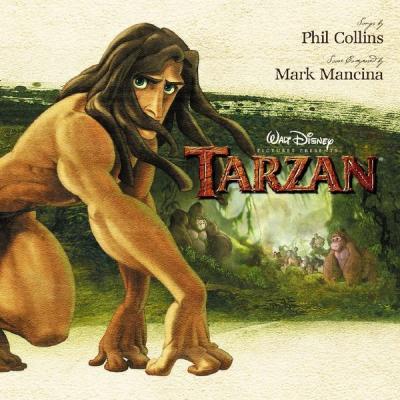
"Tarzan" Soundtrack Lyrics
Cartoon • 1999
Track Listing
Phil Collins
Phil and 'N Sync
"Tarzan (Original Walt Disney Records Soundtrack)" – Album Guide to Tracks and Key Scenes
Overview
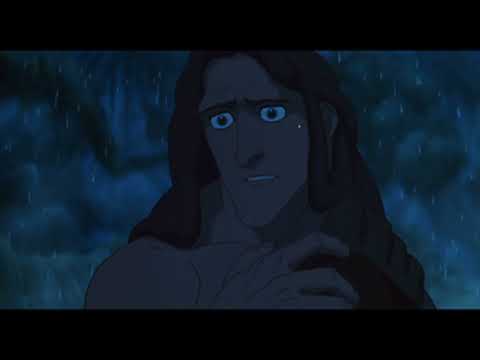
How do you sing a life lived between two families — one of vine and bark, one of ship and memory? Tarzan answers with an unusual split: pop-forward songs by Phil Collins that narrate to us, and a muscular orchestral score by Mark Mancina that breathes inside the frame. The result is a jungle opera told like a diary: intimate, propulsive, and surprisingly tender.
Collins’ set of story-songs — “Two Worlds,” “You’ll Be in My Heart,” “Son of Man,” “Strangers Like Me,” and the scat-happy “Trashin’ the Camp” — carry the film’s major emotional moves, while Mancina’s action writing (“A Wondrous Place,” “The Gorilla Attack,” “The Final Game”) does the swinging and sprinting. Distinctive touch: Collins recorded the songs in multiple languages himself, so the film’s heart voice stays consistent across markets — a rare, risky, very Disney choice that paid off.
Genres and themes move in phases — drum-driven pop rock for belonging and rite of passage; lullaby pop for found family; wordless vocal percussion for comedy-in-chaos; orchestral adventure for speed and jeopardy. Translation: toms and guitars = identity in motion; soft keys = protection; mouth beats = play; big brass and strings = survival math.
How It Was Made
Disney paired Phil Collins (songs, co-producer) with Mark Mancina (score, co-producer). Collins wrote and performed the film’s principal songs; Mancina built set-piece cues and wove Collins’ motifs into the score’s DNA. Walt Disney Records released the official soundtrack in May 1999 with a compact song suite and action cues, plus a pop end-credit variant of “You’ll Be in My Heart.” A separate single sanded the radio edges; the album also includes an *NSYNC-featured version of “Trashin’ the Camp.”
Key creative call: the songs don’t break for character solos on screen — the narrator voice (Collins) sings for the world while characters act inside it. That choice keeps peril sharp and pacing quick, then yields to score when bodies start moving at jungle speed.
Tracks & Scenes
Below — the core songs (album titles in quotes) and how they play in the film. Times vary slightly by cut/edition; scene descriptions follow story order.
“Two Worlds” (Phil Collins)
- Where it plays:
- Prologue and opening act — shipwreck to jungle adoption. Drums and low guitar mark parallel tragedies: infant Tarzan losing birth parents; Kala and Kerchak losing a child. The cue returns at key junctures (arrival of the Porter expedition; finale) as a thematic bookend.
- Why it matters:
- States the film’s thesis: two families, one heart. It’s the motif that holds the plot’s braids together.
“You’ll Be in My Heart” (Glenn Close & Phil Collins)
- Where it plays:
- In-film, Kala (Glenn Close) sings a soft lullaby to baby Tarzan — near-whisper, close-mic intimacy as she promises safety. The pop single version by Collins rolls over end credits.
- Why it matters:
- Defines the adoptive bond and the movie’s emotional center — a promise that rescues more than once.
“Son of Man” (Phil Collins)
- Where it plays:
- Growth-and-training montage: young Tarzan fails, learns, innovates. Rhythms sync to vine-surfing discoveries and clever tools; the harmony lifts as he matches the troop stride for stride.
- Why it matters:
- Montage as character arc — perseverance turned kinetic.
“Trashin’ the Camp” (Rosie O’Donnell, Phil Collins & cast; pop version with *NSYNC)
- Where it plays:
- Mid-film mischief: Terk and the gorillas dismantle the Porters’ campsite and jam on cookware. Pure mouth percussion, brass pops, and junkyard rhythm; later, a separate studio version with *NSYNC appears on the album and in promotional rotation.
- Why it matters:
- Comic breather and sonic showpiece — musicality without a single lyric.
“Strangers Like Me” (Phil Collins)
- Where it plays:
- Discovery montage as Tarzan studies Jane, language, and human tools — chalk sketches, gramophones, hand-in-hand lessons. The track leans bright, racing curiosity against duty.
- Why it matters:
- Cristallizes the pull toward the human world — knowledge as romance.
“Two Worlds (Reprise/Finale)” (Phil Collins & Mark Mancina)
- Where it plays:
- End-game resolution: family lines re-drawn, choices made. The motif returns with fuller harmony and choral lift as the jungle breathes again.
- Why it matters:
- Closes the circle — two worlds, yes, but one chosen life.
Score set-pieces (Mark Mancina)
- Where it plays:
- “A Wondrous Place” and allied cues power vine-surfing, stampedes, and the final shipboard showdown. Big toms, low brass, and agile strings cut to the geometry of branches and rope.
- Why it matters:
- Gives the film its physical language — the feel of weight, speed, and risk.
Notes & Trivia
- Collins recorded full versions of the songs in English, French, German, Italian, and Spanish — an unusual step for a Disney feature.
- “You’ll Be in My Heart” won the Academy Award and Golden Globe for Best Original Song; the soundtrack later won the Grammy for Best Soundtrack Album.
- Rosie O’Donnell leads the on-screen “Trashin’ the Camp”; the album also features a studio version with *NSYNC.
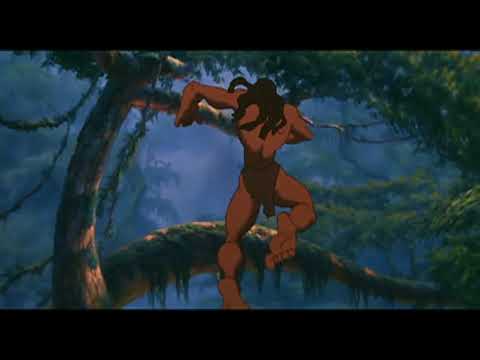
- Mancina’s percussive writing mirrors the film’s invented “tree-surfing” movement style — rhythm equals physics.
- The album’s first pressing arrived with a holographic, numbered cover on some retail runs — a tiny late-90s flex.
Reception & Quotes
The film’s music landed big with families and awards bodies alike — pop singles on radio, score cues in school bands, and that lullaby everywhere new parents needed a soft promise.
“Collins’ narrator-pop lets the action breathe; Mancina supplies the adrenaline.” Album overview
“You’ll Be in My Heart” took the Oscar — a lullaby that became a generational keepsake.
Availability: the standard Walt Disney Records album remains widely streamed; international editions feature Collins’ multilingual takes.
Interesting Facts
- Non-diegetic songs: Characters don’t burst into song — Collins sings over action, a rare Disney strategy that keeps peril sharp.
- Family voices: Glenn Close appears on the soundtrack’s lullaby version; her in-film take is the tenderest cut on the album.
- Junkyard jazz: “Trashin’ the Camp” is percussion built from pots, pans, and breath — the film’s purest “music from nothing.”
- Global Collins: Hearing him in five languages turned the soundtrack into its own localization experiment.
- Chart life: The album hit the U.S. top ten and went multi-platinum during the film’s run.
Technical Info
- Title: Tarzan (An Original Walt Disney Records Soundtrack)
- Year: 1999
- Type: Animated film soundtrack — songs + score
- Songs by: Phil Collins (writer/performer)
- Score by: Mark Mancina (composer)
- Label: Walt Disney Records
- Key songs: “Two Worlds,” “You’ll Be in My Heart,” “Son of Man,” “Strangers Like Me,” “Trashin’ the Camp” (+ *NSYNC version)
- Notable score cues: “A Wondrous Place,” “Gorilla Attack,” “The Final Game” (titles vary by edition)
- Awards: Academy Award & Golden Globe — Best Original Song (“You’ll Be in My Heart”); Grammy — Best Soundtrack Album
- International note: Collins recorded complete song vocals in English, French, German, Italian, and Spanish
Questions & Answers
- Who wrote the songs in Tarzan?
- Phil Collins — he composed and performed the main songs; Mark Mancina composed the instrumental score.
- Does anyone in the movie sing on screen?
- Not in the usual Disney way. Collins’ narrator voice carries the songs while characters act; the one exception is the on-screen jam “Trashin’ the Camp.”
- What song plays during Tarzan’s training montage?
- “Son of Man” — a drum-driven pop rocker that tracks him from misfit to master.
- Which track underscores Tarzan learning human culture?
- “Strangers Like Me” — a curiosity anthem that scores his lessons with Jane and the Porters.
- Did “You’ll Be in My Heart” win major awards?
- Yes — it won the Academy Award and Golden Globe for Best Original Song and helped the album take home a Grammy.
Key Contributors
| Entity | Relation | Notes |
|---|---|---|
| Phil Collins | songwriter, vocalist, producer | Recorded English, French, German, Italian, Spanish versions |
| Mark Mancina | composer, producer | Action-forward orchestral score; integrates Collins’ motifs |
| Glenn Close | featured vocal (Kala) | Lullaby performance in “You’ll Be in My Heart” (film version) |
| Rosie O’Donnell & cast | performers | Lead on on-screen “Trashin’ the Camp” jam |
| *NSYNC | featured artists | Studio version of “Trashin’ the Camp” on album/airplay |
| Walt Disney Records | label | Released the official soundtrack (1999) |
| Walt Disney Animation Studios | main creative work | Produced the 1999 feature film |
Sources: Walt Disney Records / album listings; Discography entries for track details; Spotify album page; Academy Awards and press coverage; interviews/features on Collins’ multilingual recordings; official trailers.
November, 27th 2025
A-Z Lyrics Universe
Cynthia Erivo Popular
Ariana Grande Horsepower
Post Malone Ain't No Love in Oklahoma
Luke Combs Good Riddance (Time of Your Life)
Green Day Bye Bye Bye
*NSYNC You're the One That I Wan
John Travolta & Olivia Newton-John I Always Wanted a Brother
Braelyn Rankins, Theo Somolu, Kelvin Harrison Jr. and Aaron Pierre The Power of Love
Frankie Goes to Hollywood Beyond
Auli’i Cravalho feat. Rachel House MORE ›