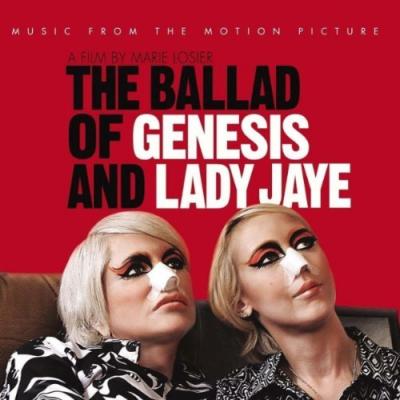
"The Ballad Of Genesis & Lady Jaye" Soundtrack Lyrics
Movie • 2012
Track Listing
Unknown
Genesis Breyer P-Orridge, Lady J, Bryin Dall, Alice Genese, Psychic TV / PTV3
Psychic TV / PTV3
Psychic TV / PTV3
Psychic TV / PTV3
Genesis Breyer P-Orridge, Bryin Dall
Psychic TV / PTV3
Thee Majesty
Thee Majesty
Lady Jaye, Genesis Breyer P-Orridge, Bryin Dall, Derek Rush
Genesis Breyer P-Orridge, Derek Rush
Psychic TV
Psychic TV
Psychic TV / PTV3
Psychic TV / PTV3
Psychic TV / PTV3
Psychic TV / PTV3
Tony Conrad, Genesis Breyer P-Orridge, Edley ODowd
Psychic TV
"The Ballad of Genesis & Lady Jaye (Music From the Motion Picture, 2012)" – Album Guide to Tracks and Key Scenes
Overview
What does a love story sound like when it’s also a manifesto? In The Ballad of Genesis & Lady Jaye, the soundtrack maps intimacy onto experiment: Psychic TV/PTV3 vamps and Thee Majesty spoken-word drift sit alongside collaged studio pieces, while hushed duets feel like notes passed between co-conspirators. It’s a document of the “Pandrogyny” project—two artists choosing to become one—told in the grain of 16mm and the pulse of underground music.
The compilation album (2012) pulls from Genesis Breyer P-Orridge’s sonic families—Psychic TV/PTV3, Thee Majesty—and collaborators (Bryin Dall, Derek Rush, Tony Conrad), assembling cues that double as diary entries. On screen, songs score kitchen-table tenderness, studio ritual, stage apparitions, and the ache of absence; on record, they read as a single suite: devotion, disruption, devotion again.
Genres & themes in phases: industrial/psych-folk drones — method and trance; spoken-word over ambience — vows and philosophy; art-rock pulses — public ritual; minimalist strings — grief and grace. Translation: noise → transformation; mantra → promise; groove → communion; hush → memory.
How It Was Made
Directed, shot, and edited by Marie Losier, the film premiered at the Berlinale in 2011, then opened in the US on March 8, 2012. Losier’s collage grammar—home movies, performances, interviews—pairs with music curated from Genesis’s own projects, with composer/producer Bryin Dall contributing original score and overseeing album assembly. The commercial release arrived via Sweet Nothing/Cargo as a 19-track set; digital editions mirror that program on major platforms.
Editorially, Losier lets songs play long, letting the couple’s philosophy land without cutaway snark. The album holds to that ethic: minimal crossfades, faithful dynamics, and sequencing that mirrors the film’s drift from giddy discovery to elegy.

Tracks & Scenes
Not a full tracklist — key placements and what they score. Timings vary by cut; descriptions follow canonical beats in the feature.
“I Love You, I Know” (Genesis Breyer P-Orridge, Lady J., Bryin Dall, Alice Genese)
- Where it plays:
- Intimate apartment footage and close-mic confessions. Grainy film, soft lamp light, hands touching. The vocal feels almost whispered to the camera, like a promise repeated until it becomes a spell.
- Why it matters:
- States the thesis with no armor: love as collaboration and experiment.
“Boys Are Girls and Girls Are Boys” (Psychic TV / PTV3)
- Where it plays:
- Performance montage: club strobes, flower-crowned mic stands, audience faces lit by stage wash. The lyric collapses binaries while edits bounce between rehearsal and show.
- Why it matters:
- Turns the Pandrogyny idea into a chant you can shout with strangers.
“The Truth” → “Wisdom” (Thee Majesty)
- Where it plays:
- Voice-and-drone interludes over still portraits and altar-like domestic arrangements. Words arrive as benedictions; the room tone feels part of the music.
- Why it matters:
- Speech as score — these pieces frame the film’s philosophy without lecture.
“White Nights” (Psychic TV)
- Where it plays:
- Archival passages and city drift. Street sodium lights stutter; the song’s melancholic sway folds night into memory.
- Why it matters:
- Links the long corridor of GPO’s life and work—the past hums under the present.
“Mother Jack (A Children’s Story)” (Psychic TV)
- Where it plays:
- Home-ritual textures: costuming, talismans, a joke shared mid-makeup. The track’s nursery-rhyme unease sharpens Losier’s fairy-tale framing.
- Why it matters:
- Shows how play, myth, and performance blur inside this relationship.
“Demilitarized Ozone” (Tony Conrad, Genesis Breyer P-Orridge & Edley O’Dowd)
- Where it plays:
- Sound/art studio imagery: tape loops, contact mics, bow-on-string. The drone blooms against images of process—ritual, not recipe.
- Why it matters:
- A lineage moment: Conrad’s minimalism meets GPO’s cut-up ethos, underscoring the film’s art-history thread.
“The Final War” (Lady Jaye & Genesis Breyer P-Orridge with Bryin Dall & Derek Rush)
- Where it plays:
- Late-film text/altar montage. Objects, scars, and vows. The piece rises like a letter written to be read forever.
- Why it matters:
- A love note and a thesis defense — tenderness built from noise.
“The Orchids” (Psychic TV)
- Where it plays:
- Closing stretch/credits: photographs linger, breath returns, and the song’s wistful melody carries the story into the viewer’s own quiet.
- Why it matters:
- Grace note. After theory and practice, an afterglow.
Notes & Trivia
- The film won the Teddy Award for Best LGBT Documentary at the Berlinale.
- US theatrical roll-out began March 8, 2012 (distributed by Adopt Films) after the festival run.
- The album was compiled/produced by Bryin Dall with Edward “Edley” O’Dowd (Psychic TV/PTV3), sequencing pieces from multiple GPO projects.
- Several album cuts pre-exist the film, reframed here by context and edit length—closer to a curated portrait than a wall-to-wall score.
Reception & Quotes
Critics praised the tenderness beneath the transgressive legend—the music doing as much talking as any interview. The theatrical release made the soundtrack a handy gateway into P-Orridge’s vast catalog.
“A love story—radical, handmade, moving.” NYC release-day coverage
“Cut-up aesthetics with a beating heart.” Festival and US-press consensus
Availability: the 19-track compilation is on CD/LP (Sweet Nothing via Cargo) and streaming services; the film is available on digital platforms in many regions.
Interesting Facts
- Composer credit: The film credits Bryin Dall with original music; the album expands out to PTV/PTV3, Thee Majesty, and collaborators.
- One suite, many rooms: Sequencing places voice pieces (Thee Majesty) as chapter headers inside the playlist.
- Conrad connection: Tony Conrad’s appearance on “Demilitarized Ozone” ties the documentary to minimalism’s roots.
- Mantra engine: Titles like “Boys Are Girls and Girls Are Boys” function as singable theory—philosophy with a backbeat.
- From club to candlelight: The album toggles between stage voltage and bedroom hush without losing flow.
Technical Info
- Title: The Ballad of Genesis & Lady Jaye — Music From the Motion Picture
- Year: 2012 (album); Film premiered 2011 (Berlinale); US theatrical March 8, 2012
- Type: Documentary soundtrack compilation (songs + original pieces)
- Composer (film credit): Bryin Dall
- Primary artists on album: Psychic TV / PTV3, Thee Majesty, Genesis Breyer P-Orridge with collaborators (Bryin Dall, Derek Rush), Tony Conrad
- Label: Sweet Nothing Records (UK) / distributed via Cargo; digital on major platforms
- Notable placements: “I Love You, I Know”; “Boys Are Girls and Girls Are Boys”; “White Nights”; “Mother Jack”; “The Truth”/“Wisdom”; “Demilitarized Ozone”; “The Orchids”
- Release context: Feature directed by Marie Losier; Teddy Award winner; US distributor Adopt Films
- Availability/Notes: CD/LP out of print in some markets; streaming album widely available
Questions & Answers
- Is there an official soundtrack album?
- Yes — a 19-track compilation (2012) curated around the film, issued by Sweet Nothing/Cargo and on streaming services.
- Who’s credited for the film’s music?
- Bryin Dall is credited as the film’s composer; the album includes pieces by Psychic TV/PTV3, Thee Majesty, and collaborators.
- Does the album include classic Psychic TV songs?
- Yes — selections like “White Nights” and “The Orchids,” plus later PTV3 material, appear alongside spoken-word works by Thee Majesty.
- Where does the movie fit in time?
- It premiered at the Berlinale in 2011 and opened in US theaters on March 8, 2012.
- What’s the best entry point track?
- Try “I Love You, I Know” for the relationship’s heartbeat, then “Boys Are Girls and Girls Are Boys” for the Pandrogyny thesis with audience energy.
Key Contributors
| Subject | Relation | Object |
|---|---|---|
| Marie Losier | wrote/directed/shot/edited | The Ballad of Genesis & Lady Jaye (film) |
| Genesis Breyer P-Orridge | subject & artist of | film and soundtrack works |
| Lady Jaye Breyer P-Orridge | subject & artist of | film and selected recordings |
| Bryin Dall | composed music for | film; compiled/produced album |
| Edward “Edley” O’Dowd | co-produced compilation for | soundtrack album |
| Psychic TV / PTV3 | performed | multiple album tracks featured in film |
| Thee Majesty | performed | spoken-word pieces on album |
| Tony Conrad | performed with | Genesis Breyer P-Orridge & Edley O’Dowd on “Demilitarized Ozone” |
| Adopt Films | distributed | US theatrical release (2012) |
| Berlinale | premiered | film (February 2011; Teddy Award) |
| Sweet Nothing / Cargo | released/distributed | soundtrack album (2012) |
Sources: Wikipedia (film credits, Berlinale/award, composer); Cargo Records product page (tracklisting, label, US release note); Spotify listing (album availability); Adopt Films trailer; Rotten Tomatoes (US theatrical date/credits).
November, 27th 2025
Find movie profiles and read user reviews on Internet Movie Database and Rotten TomatoesA-Z Lyrics Universe
Cynthia Erivo Popular
Ariana Grande Horsepower
Post Malone Ain't No Love in Oklahoma
Luke Combs Good Riddance (Time of Your Life)
Green Day Bye Bye Bye
*NSYNC You're the One That I Wan
John Travolta & Olivia Newton-John I Always Wanted a Brother
Braelyn Rankins, Theo Somolu, Kelvin Harrison Jr. and Aaron Pierre The Power of Love
Frankie Goes to Hollywood Beyond
Auli’i Cravalho feat. Rachel House MORE ›