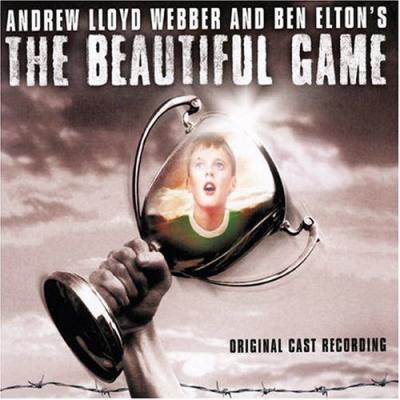
"The Beautiful Game" Soundtrack Lyrics
Musical • 2002
Track Listing
"The Beautiful Game (Original London Cast Recording, 2002 US release / 2000 UK original)" – Album Guide to Tracks and Key Scenes
Overview
Can a football chant carry a love story through a war zone? Andrew Lloyd Webber and Ben Elton’s The Beautiful Game says yes — then lets the music argue back. Set in late-1960s/early-1970s Belfast, the score swings from terrace euphoria to whispered prayer, tracing teenagers whose lives orbit a Catholic youth team as The Troubles tighten. The cast album bottles that pivot: terrace swagger, church-hall romance, and the quiet cost of choosing a side.
The recording’s heartbeat is contrast — brassy crowd songs (“The Beautiful Game,” “God’s Own Country”) meet aching ballads (“Our Kind of Love,” “Let Us Love in Peace”), and propulsive montage numbers (“The Final,” “The Craic”) sit against blunt, political setpieces (“I’d Rather Die on My Feet…”). On disc, you hear the season’s arc turn into a moral one: goals, weddings, funerals, and the question of what victory even means.
Genres & themes in phases: terrace-rock & parade brass — community and bravado; folk-hymn ballads — tenderness and doubt; martial ostinatos — ideology closing in; pub-reel pastiche — temporary absolution; lyric reprise — memory insisting on mercy.
How It Was Made
Music by Andrew Lloyd Webber, book/lyrics by Ben Elton. The show opened in London in 2000; the UK original cast recording appeared on Telstar/Really Useful the same year. A widely distributed U.S. issue followed on Decca Broadway on 26 November 2002 (23 tracks). The album is conducted by Simon Lee and produced by Andrew Lloyd Webber & Nigel Wright, tracking the stage sequence closely.
Webber and Elton later revised the piece as The Boys in the Photograph (2009), adjusting and retitling several numbers; the original hit ballad “Our Kind of Love” was cut there and its melody repurposed for Webber’s later Love Never Dies. This guide focuses on the original album/program heard in 2000–2002 releases.
Tracks & Scenes
Not a full tracklist — here are key numbers and how they function on stage. (“Diegetic” below = music heard by the characters in-world.)
“The Beautiful Game” (Company)
- Where it plays:
- Opening salute to football and friendship. Locker-room bustle, swaggering terrace rhythms, and Father O’Donnell trying to shape rowdy boys into a team. It splices rehearsal drills with street banter and sets the Catholic–Protestant fault line in motion.
- Why it matters:
- Establishes community first; politics will fracture what the chorus just welded together.
“Clean the Kit” (Company)
- Where it plays:
- After John is punished, the team scrubs mud and pride off jerseys. Comedy choreography with percussive props (buckets, brushes), trading jibes that feel like family.
- Why it matters:
- Shows discipline as care — and how quickly rituals become identity.
“God’s Own Country” → “Protestant March” (Ensemble)
- Where it plays:
- Street-scene counterpoint as rival groups claim the same city. Drums and pipes push the Catholic lead into a Protestant reply; flags and boots drown out conversation.
- Why it matters:
- Patriotism as rhythm — exhilarating, then unsettling. The album captures the gear-shift from pride to pressure.
“The Final (A Game of Two Halves)” (Company)
- Where it plays:
- Match montage with radio-announcer urgency. John nets the winner; jubilation spills off the pitch into the pub.
- Why it matters:
- Pure dopamine hit — and the last uncomplicated one.
“The Party” / “The Craic” (Company)
- Where it plays:
- Pub celebration turns flirty, then fragile. Banter, fiddles, and raised glasses; outside threats creep in via offstage shouts and smashed glass.
- Why it matters:
- Diegetic fun that can’t seal the door — the world is coming in.
“Let Us Love in Peace” (Christine & Del)
- Where it plays:
- After sectarian thugs trash the changing room, the couple steps out of hiding and sings a plea for ordinary life: to love, to work, to stop choosing sides.
- Why it matters:
- Quiet thesis statement of the show; the cast recording preserves its hushed, prayer-like weight.
“Our Kind of Love” (Mary)
- Where it plays:
- Mary’s soaring confession to John — romance as refuge. The melody (later reused by Webber in Love Never Dies) blooms over strings while the outside world fades.
- Why it matters:
- The album’s breakout ballad; it softens the second-act seams with lyric generosity.
“The First Time” (Mary & John)
- Where it plays:
- A tender, awkward bedroom scene that refuses to sneer at innocence. Vocals sit close-mic’d, heartbeat-slow.
- Why it matters:
- Stops the plot just long enough to make later choices hurt.
“I’d Rather Die on My Feet Than Live on My Knees” (Thomas & Ensemble)
- Where it plays:
- Radicalization anthem: rhetoric turned chorus. Stomps and unison lines pull the team apart in real time.
- Why it matters:
- Shows music’s double edge — the same crowd energy that cheered a match now weaponizes belief.
“Dead Zone” (Ensemble)
- Where it plays:
- Fallout sequence: curfews, funerals, and the heaviness of keeping your head down. A dirge with motion.
- Why it matters:
- Belfast goes grayscale; the album keeps the pulse low and relentless.
“If This Is What We’re Fighting For” (Company)
- Where it plays:
- Hard reckoning for both sides — a catalog of losses that refuses triumph. Countermelodies braid opposing laments.
- Why it matters:
- The show’s conscience in ensemble form; a pressure-valve for the audience.
Finale: “The Beautiful Game (Reprise)” (Company)
- Where it plays:
- Chorus returns, slower and wiser. Community reasserts itself without false comfort.
- Why it matters:
- Closes the circle — same anthem, different world.
Notes & Trivia
- “Our Kind of Love” began life as Webber’s “The Heart Is Slow to Learn” (Kiri Te Kanawa recorded it in 1998); the melody later became “Love Never Dies.”
- Shonagh Daly performed “Let Us Love in Peace” at the October 2001 memorial service for 9/11 families.
- The show was substantially revised as The Boys in the Photograph (2009), with title/lyric changes and several new or retitled songs.
- US listeners often date the album to 2002 because of the Decca Broadway release; the original UK cast disc is 2000 (Telstar/Really Useful).
Reception & Quotes
Critics praised the ambition and performances, debated the politics, and agreed the album lands its emotional punches — terrace to tear-stained lyric in a few tracks flat.
“A football musical that dares to ask what winning costs.” Stage overviews
“‘Let Us Love in Peace’ might be Lloyd Webber’s most disarming plea.” Cast-album commentary
Interesting Facts
- Cast single: Hannah Waddingham’s single of “Our Kind of Love” promoted the London run with multiple mixes and a music-video edit.
- Field to altar: Several scenes flip between match-day noise and church-hall quiet — the album preserves the gear changes cleanly.
- Diegetic texture: Pub cues (“The Party,” “The Craic”) are staged to feel like in-room music rather than pit orchestra only.
- Title recycle: The revision’s opening number “The Boys in the Photograph” later appears as a motif in licensing/perusal materials.
Technical Info
- Title: The Beautiful Game — Original London Cast Recording
- Year: 2000 (UK original); 2002-11-26 (US Decca Broadway issue)
- Type: Stage musical cast album
- Music: Andrew Lloyd Webber
- Lyrics/Book: Ben Elton
- Label(s): Really Useful Records / Telstar (UK original); Decca Broadway (US 2002)
- Selected notable numbers: “The Beautiful Game,” “Clean the Kit,” “God’s Own Country,” “The Final,” “The Party,” “The Craic,” “Let Us Love in Peace,” “Our Kind of Love,” “The First Time,” “I’d Rather Die on My Feet Than Live on My Knees,” “Dead Zone,” “If This Is What We’re Fighting For.”
- Later revision: Reworked as The Boys in the Photograph (2009) with altered number list.
- Availability: Streaming editions list 23 tracks; CD issues (UK 2000; US 2002) circulate widely.
Questions & Answers
- Why do some sites list the album as 2002?
- That’s the U.S. Decca Broadway release date. The UK original cast CD appeared in 2000 on Telstar/Really Useful.
- Is “Our Kind of Love” in every staging?
- Not always. The melody was cut from the 2009 revision (The Boys in the Photograph) and later re-used as “Love Never Dies.”
- Are the pub songs actually “in the room” for the characters?
- They’re staged with a diegetic feel — party cues like “The Craic” and “The Party” play as in-world music while advancing story.
- Where can I license or peruse the script?
- Through the official Andrew Lloyd Webber/Concord licensing portals; perusal materials note some revision titles.
- How close is the album to the stage sequence?
- Very close for the original version, including reprises and transitional material; the later revision changes titles/ordering.
Key Contributors
| Subject | Relation | Object |
|---|---|---|
| Andrew Lloyd Webber | composed | The Beautiful Game (score) |
| Ben Elton | wrote book & lyrics for | The Beautiful Game |
| Simon Lee | conducted | Original London cast recording |
| Andrew Lloyd Webber & Nigel Wright | produced | Original cast album |
| Telstar / Really Useful Records | released | UK 2000 cast CD |
| Decca Broadway | released | US CD (Nov 26, 2002) |
| Shonagh Daly | performed | “Let Us Love in Peace” at 9/11 families’ memorial (2001) |
| Revision title | reworked as | The Boys in the Photograph (2009) |
Sources: Official show page (story/credits); Concord/ALW licensing pages; Spotify (23-track streaming edition, dated 2002); Decca Broadway listing/UPC with 2002-11-26 release; Discogs/Telstar entries for the 2000 UK cast CD; Wikipedia (show overview, number list, “Our Kind of Love” history); producer/single notes; perusal script excerpts noting revision titles.
November, 27th 2025
A-Z Lyrics Universe
Cynthia Erivo Popular
Ariana Grande Horsepower
Post Malone Ain't No Love in Oklahoma
Luke Combs Good Riddance (Time of Your Life)
Green Day Bye Bye Bye
*NSYNC You're the One That I Wan
John Travolta & Olivia Newton-John I Always Wanted a Brother
Braelyn Rankins, Theo Somolu, Kelvin Harrison Jr. and Aaron Pierre The Power of Love
Frankie Goes to Hollywood Beyond
Auli’i Cravalho feat. Rachel House MORE ›