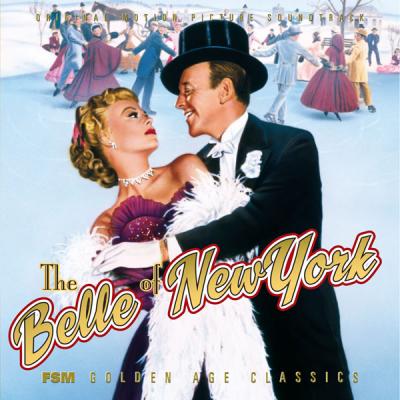
"The Belle of New York" Soundtrack Lyrics
Musical • 1991
Track Listing
"The Belle of New York (Original MGM Soundtrack — 1991 CD reissue of the 1952 film score)" – Album Guide to Tracks and Key Scenes
Overview
How do you score a romance so light the lovers literally float? With a waltz that glides, a sand-dance that whispers, and a chorus that smiles in four-part harmony. The soundtrack to the 1952 MGM musical The Belle of New York (reissued on CD in 1991) showcases songs by Harry Warren and Johnny Mercer shaped by the Freed Unit’s golden-age studio orchestra. On disc, you can hear the film’s conceit—love conquers gravity—rendered as orchestral buoyancy and tap-time finesse.
The picture pairs Fred Astaire and Vera-Ellen; the album captures their dance grammar in audio close-up: the signature waltz outside her window, the mid-air fantasy at Washington Square Arch, the rink-bright “Currier & Ives” duet, the comic streetcar pas de deux, and the sly closer “I Wanna Be a Dancin’ Man.” It’s a compact postcard from MGM’s Technicolor dream factory—sugar, sparkle, and top-shelf craft.
Genres & themes in phases: operetta-tinged waltz — innocence and courtship; patter swing — city bustle; tap & sand-dance — wit and control; ice-waltz spectacle — virtuosity as romance. Translation: strings = lift; woodwinds = flirt; brushed percussion = mischief; taps/sand = precision equals charm.
How It Was Made
The film was directed by Charles Walters and produced by Arthur Freed, with orchestral music direction/arranging credits across MGM stalwarts (including Adolph Deutsch, Conrad Salinger, and Alexander Courage). Warren & Mercer supplied an original song-score tailored to Astaire’s airy choreography. The original 1952 release appeared on MGM Records in multiple formats (10" LP/EP/78 sets). A widely circulated compact-disc reissue landed in 1991, bringing the soundtrack back into print for modern listeners.
Tracks & Scenes
Not a full tracklist — these are the anchor numbers and where they land on screen (album sequences vary by edition).
“When I’m Out with the Belle of New York” (Chorus)
- Where it plays:
- Serenaders gather beneath Angela’s window in a lilting waltz, setting the courtship frame before we ever see the couple complete a phrase.
- Why it matters:
- A postcard overture — establishes the turn-of-the-century romance tone the album sustains.
“Who Wants to Kiss the Bridegroom?” (Fred Astaire & Ensemble)
- Where it plays:
- Astaire flirts his way through a line of would-be admirers, finishing on a tabletop; the orchestration grins as big as the lyric.
- Why it matters:
- Public charm offensive in song form; the record preserves the hop-step momentum of the choreography.
“Let a Little Love Come In” (Alice Pearce; Vera-Ellen dubbed by Anita Ellis)
- Where it plays:
- First as comic counsel from Angela’s friend, then as Angela’s own softened resolve; the melody opens like a door left ajar.
- Why it matters:
- Character turn articulated in melody — a hinge between satire and sincerity.
“Seeing’s Believing” (Fred Astaire — fantasy solo)
- Where it plays:
- Charlie imagines literally walking on air atop a mock-up of the Washington Square Arch; orchestral gel and studio magic sell the levitation gag.
- Why it matters:
- The film’s conceit distilled — music as anti-gravity. On disc you hear the “lift” without the wires.
“Baby Doll” (Astaire & Vera-Ellen)
- Where it plays:
- Romantic duet with playful twirls and platform work; the tune sways, then tightens as the steps complicate.
- Why it matters:
- Virtuosity disguised as sweetness; a Warren/Mercer sleeper hit inside the score.
“Oops!” (Astaire — streetcar duet)
- Where it plays:
- Comic pas de deux in and around a moving trolley; taps, gags, and side-by-side patterns make transit feel like dance floor.
- Why it matters:
- Everyday machinery as percussion — a Freed-era calling card.
“A Bride’s Wedding Day Song (Currier & Ives)” (Astaire & Vera-Ellen)
- Where it plays:
- An ice-rink waltz that accelerates into a dazzling syncopated duet; you can hear the blades in the bite of the orchestra.
- Why it matters:
- Showpiece. Many listeners cite this as the album’s peak blend of melody and athletic grace.
“Naughty but Nice” (Vera-Ellen, voice: Anita Ellis)
- Where it plays:
- Angela’s solo turn, a wink wrapped in a lilting melody, bridging prim image and private spark.
- Why it matters:
- Gives the heroine her own musical voltage amid Astaire’s showcases.
“I Wanna Be a Dancin’ Man” (Fred Astaire — sand-dance)
- Where it plays:
- Astaire’s second solo: light vocal, whispering sand underfoot. A hymn to motion and nonchalance.
- Why it matters:
- Mercer’s lyric flatters the star; Astaire’s rhythmic underplaying keeps it sly and modern.
Notes & Trivia
- The 1952 film draws on the 1897 Broadway hit by Gustave Kerker and Hugh Morton but uses a new Warren/Mercer song-score.
- MGM issued the soundtrack in 1952 across multiple formats; the 1991 CD brought the program back to market for collectors.
- Vera-Ellen’s vocals are dubbed by Anita Ellis on several numbers; the record credits reflect the practice common to the era.
- “I Wanna Be a Dancin’ Man” is a rare Astaire sand-dance on film — the soundtrack preserves its soft, grainy rhythm.
Reception & Quotes
While the film underperformed theatrically, soundtrack aficionados prize the Warren/Mercer tunebook and the high-gloss MGM orchestral sound. Reissue notes praise the restored flow and the sense of “audio choreography.”
“Vintage Hollywood musical craft, front to back — a complete delight.” Reissue review
“Mercer’s tribute lyric and Astaire’s effortless sand-time — catnip.” Collector consensus
Interesting Facts
- Two Belles: The 1897 stage hit conquered London; the 1952 film reimagined the premise with a fresh song-score.
- Freed touch: Orchestration polish from MGM stalwarts (Salinger/Courage/Deutsch) gives the album its Technicolor sheen.
- Dubbed finesse: Anita Ellis’s studio vocals align tightly to Vera-Ellen’s phrasing — a textbook in careful ADR.
- Process magic: “Seeing’s Believing” uses process photography to sell gravity-defying romance; the cue feels airborne even without the visuals.
- 1991 revival: The CD reissue helped put rarer 1950s MGM scores back on shelves during the early soundtrack-collector boom.
Technical Info
- Title: The Belle of New York — Original MGM Soundtrack (CD reissue)
- Year: 1991 (CD reissue); original film & soundtrack 1952
- Type: Film soundtrack (songs from the 1952 MGM musical)
- Music/Lyrics: Harry Warren / Johnny Mercer
- Music department highlights: Adolph Deutsch (music direction), Conrad Salinger & Alexander Courage (orchestration)
- Key numbers: “When I’m Out with the Belle of New York,” “Who Wants to Kiss the Bridegroom?,” “Let a Little Love Come In,” “Seeing’s Believing,” “Baby Doll,” “Oops!,” “A Bride’s Wedding Day Song (Currier & Ives),” “Naughty but Nice,” “I Wanna Be a Dancin’ Man.”
- Label/edition notes: 1952 MGM Records (LP/EP/78); widely circulated CD reissue 1991
- Availability: Streaming and CD reissues (various territories) mirror the vintage program.
Questions & Answers
- Why is the year here listed as 1991?
- Because the commonly available CD edition dates from 1991; the music itself is from the 1952 MGM film.
- Is this the stage musical recording from 1897?
- No. It’s the film soundtrack. Kerker’s 1897 stage score is a different work (separate recordings exist).
- Who wrote the songs on this album?
- Composer Harry Warren and lyricist Johnny Mercer wrote the film’s original numbers.
- Does Vera-Ellen sing on the album?
- Her songs are dubbed by studio singer Anita Ellis, a standard MGM practice then.
- What’s the signature showpiece to sample first?
- Try the rink duet “A Bride’s Wedding Day Song (Currier & Ives)” and Astaire’s sand-dance “I Wanna Be a Dancin’ Man.”
Key Contributors
| Subject | Relation | Object |
|---|---|---|
| Charles Walters | directed | The Belle of New York (1952 film) |
| Arthur Freed | produced | 1952 film / soundtrack sessions |
| Harry Warren | composed | original songs for the 1952 film |
| Johnny Mercer | wrote lyrics for | original songs for the 1952 film |
| Adolph Deutsch | music direction for | MGM scoring sessions |
| Conrad Salinger; Alexander Courage | orchestrated | film cues |
| Fred Astaire | starred; performed | vocals & dance on multiple numbers |
| Vera-Ellen (voice: Anita Ellis) | starred; performed | featured dances; vocals dubbed on select cues |
| MGM Records | released | 1952 soundtrack (original formats) |
| CD reissue | brought back | 1991 compact disc edition for collectors |
Sources: Film & soundtrack overviews; discography listings for the 1991 CD; original 1952 MGM release formats; song-by-song scene descriptions from film references; contemporary reissue notes and streaming pages.
November, 27th 2025
A-Z Lyrics Universe
Cynthia Erivo Popular
Ariana Grande Horsepower
Post Malone Ain't No Love in Oklahoma
Luke Combs Good Riddance (Time of Your Life)
Green Day Bye Bye Bye
*NSYNC You're the One That I Wan
John Travolta & Olivia Newton-John I Always Wanted a Brother
Braelyn Rankins, Theo Somolu, Kelvin Harrison Jr. and Aaron Pierre The Power of Love
Frankie Goes to Hollywood Beyond
Auli’i Cravalho feat. Rachel House MORE ›