
"The Good Shepherd" Soundtrack Lyrics
Movie • 2007
Track Listing
Head Machine
Kipling / Galloway / Minnigerode '10/ Pomeroy '10
Vince Giordano And The Nighthawks Orchestra
Vince Giordano And The Nighthawks Orchestra
Vince Giordano And The Nighthawks Orchestra
Vince Giordano And The Nighthawks Orchestra
Vince Giordano And The Nighthawks Orchestra
Vince Giordano And The Nighthawks Orchestra
Vince Giordano And The Nighthawks Orchestra
Vince Giordano And The Nighthawks Orchestra
Vince Giordano And The Nighthawks Orchestra
Vince Giordano And The Nighthawks Orchestra
Harold Arlen / Johnny Mercer
St. Louis African Chorus
St. Louis African Chorus
Tonu Kaljuste
Isidore Godfrey
"The Good Shepherd (Original Motion Picture Soundtrack)" – Album Guide to Tracks and Key Scenes
Overview
How do you make a spy film without big spy themes? The Good Shepherd answers with a watchful hush — strings and reeds held at a low boil, period source songs drifting in like cigarette smoke. Instead of a singable motif, the album leans on atmosphere: caution, secrecy, and the long ache of consequences.
Following Edward Wilson (Matt Damon) from Yale’s secret societies to the early CIA, the soundtrack walks a tightrope between diegetic nostalgia (Yale glees, ballroom standards, wartime swing) and a modern, nerve-pricked score by Marcelo Zarvos and Bruce Fowler. The cues “Edward,” “Bay of Pigs,” and “The Interrogation” sketch paranoia in small strokes; period pieces — “The Whiffenpoof Song,” “Blue Skies,” “Embraceable You,” “So in Love” — locate the story in time, even as the characters slip further into moral fog.
Genres & themes in phases: restrained orchestral suspense — secrecy, surveillance, and compromise; collegiate choral & glee traditions — privilege and initiation; Tin Pan Alley & swing standards — romance and facade; sacred/classical cues — ritual, guilt, and fate.
How It Was Made
Robert De Niro’s film originally lined up James Horner, but the final score came from Marcelo Zarvos and Bruce Fowler, who split composing duties and co-shaped a muted, period-aware sound world. Varèse Sarabande issued the album around the film’s release window (U.S. theatrical: December 22, 2006; CD retail/ship early January 2007). Digital editions followed, keeping the 28-track program in circulation.
The album threads originals with licensed repertoire and period performances: Ivy-League glee (“The Whiffenpoof Song”), dance-hall staples (“Blue Skies,” “Embraceable You,” “So in Love”), a Broadway wink (“There Is Nothin’ Like a Dame”), hymn and chant material (“Salve Regina,” “Litany”), and later-century concert works (Arvo Pärt’s “Silouan’s Song”). The net effect is historical collage — elegant on the surface, quietly menacing underneath.

Tracks & Scenes
“The Whiffenpoof Song (Baa! Baa! Baa!)” (Yale glee standard)
- Where it plays:
- Early Yale sequences set the clubby, all-male ritual tone. The glee harmonies float over wood-paneled rooms and secret-society courtyards as Edward finds entrée into a world of coded laughter and closed doors. It’s staged as source music that characters hear in-scene.
- Why it matters:
- A sonic emblem of privilege — the “old boys” sound that will echo through government corridors.
“Embraceable You” (George & Ira Gershwin; period recording)
- Where it plays:
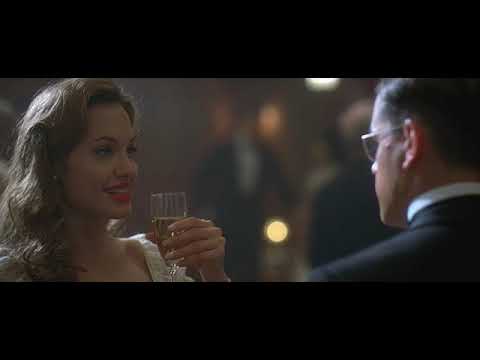
- A ballroom dance between Edward and Margaret (Angelina Jolie). The camera favors close-ups and glances as the standard spins gently, turning courtship into strategy. The track is used diegetically — band-on-the-floor ambience and all.
- Why it matters:
- Romance as performance. The sweetness of the standard undercuts how transactional the night really is.
“Blue Skies” (Irving Berlin; period performance)
- Where it plays:
- Stateside social scenes — clipped banter, polite smiles, and the kind of small talk that hides big secrets. It’s dance-hall wallpaper that the characters knowingly weaponize.
- Why it matters:
- Optimistic on its face, ironic in context — the film’s favorite musical double-bluff.
“So in Love” (Cole Porter) — Vince Giordano & The Nighthawks
- Where it plays:
- A posh reception where strings, reeds, and brushed drums glide as couples rotate. The on-screen band is part of the scene; the lyric’s swoon sits uneasily with hidden agendas.
- Why it matters:
- Perfectly period-correct, and perfectly dishonest — love language masking career calculations.
“There Is Nothin’ Like a Dame” (Rodgers & Hammerstein)
- Where it plays:
- A brief, jaunty needle-drop that punctures otherwise solemn stretches — often tied to barracks or fraternity-style male spaces. It lands as comic relief, still within the diegesis.
- Why it matters:
- A blunt, masculine chorus that sharpens the film’s portrait of mid-century male camaraderie.
“Salve Regina / Litany” (sacred music excerpts)
- Where it plays:
- Used in ceremonial and contemplative passages, with choral resonance over montage. The sound draws a line between ritual faith and secular “orders” like Skull and Bones.
- Why it matters:
- Frames secrecy as a kind of religion — habits, vows, and penance without absolution.
“Silouan’s Song” (Arvo Pärt)
- Where it plays:
- Austere string writing glides over a moral inflection point late in the film. The cue is non-diegetic — a modern work repurposed to sharpen dread.
- Why it matters:
- Cold spiritual stillness; it lets the film breathe — and judge.
Score cue — “Edward” (Marcelo Zarvos)
- Where it plays:
- Introductory character map: spare strings and piano outlining Edward’s reserve as the camera watches him watch others. The harmony never quite settles.
- Why it matters:
- Announces the score’s strategy — intimacy at a whisper.
Score cue — “Bay of Pigs” (Bruce Fowler)
- Where it plays:
- Geopolitical fallout montage: phone calls, burn bags, terse rooms. Rhythmic figures tick like a secure-line scrambler while low strings grind.
- Why it matters:
- History reduced to static and dread — a thesis on intelligence work as damage control.
Score cue — “The Interrogation” (Marcelo Zarvos)
- Where it plays:
- Small-room menace: desk lamp pools, tape reels, and a measured voice. The cue uses pressure more than volume — close-mic textures and incremental crescendos.
- Why it matters:
- Shows how the film builds tension without resorting to action beats.
Album feature — “Come Rain or Come Shine” (Harold Arlen/Johnny Mercer) — Ann Hampton Callaway
- Where it plays:
- Heard as era-appropriate source on the album (and in select cut scenes/ambient moments), aligning smoky torch-song color with Edward’s compartmentalized love life.
- Why it matters:
- A classic standard that deepens the soundtrack’s nightclub texture.
Notes & Trivia
- Marcelo Zarvos and Bruce Fowler replaced James Horner on the project during post, splitting composing duties across the album.
- The soundtrack blends original score with period repertoire — glee, jazz standards, Broadway — plus modern concert music (Arvo Pärt).
- Vince Giordano & The Nighthawks, specialists in authentic early-20th-century styles, appear on multiple period tracks.
- The album program includes “The Whiffenpoof Song,” “Blue Skies,” “Embraceable You,” “So in Love,” “There Is Nothin’ Like a Dame,” and sacred pieces (“Salve Regina,” “Litany”).
- Retail CD shipped January 2007 via Varèse Sarabande; digital editions list 28 tracks (~72 minutes).
Reception & Quotes
Reviews praised the album’s restraint and period authenticity, noting how the hushed score lets the film’s performances carry the weight.
“Muted tension — strings like held breath — with period songs doing the social camouflage.” Album reviews & film-music press
“Elegantly curated source cues… the glee and ballroom numbers are as revealing as any line of dialogue.” Critics’ roundups
Availability: Widely streamable (Apple Music/Spotify/YouTube Music) with continuing catalog presence; original CD issued by Varèse Sarabande.
Interesting Facts
- Two-composer approach: Zarvos and Fowler divide cues by scene function — political montage vs. personal fallout.
- Choir to covert: Collegiate glee numbers double as a musical motif for secret orders.
- Standards with teeth: Love songs score rooms where love is strategy.
- Concert work cameo: Arvo Pärt’s “Silouan’s Song” brings sacred austerity to a secular reckoning.
- Label lineage: Original album on Varèse Sarabande; later digital catalogs ensure steady access.
Technical Info
- Title: The Good Shepherd (Original Motion Picture Soundtrack)
- Year: 2006 film / 2007 album retail
- Type: Film soundtrack — original score + period/standard repertoire
- Composers: Marcelo Zarvos; Bruce Fowler
- Selected notable placements: “The Whiffenpoof Song” — Yale club scenes; “Embraceable You” — ballroom dance with Margaret; “Blue Skies” — social soirée ambience; “So in Love” — reception band; “There Is Nothin’ Like a Dame” — male-bonding interlude; “Silouan’s Song” — late-film moral reckoning; score cues “Edward,” “Bay of Pigs,” “The Interrogation” — character, geopolitics, pressure.
- Release context: U.S. theatrical — Dec 22, 2006; soundtrack CD shipped Jan 2007; streaming catalog available worldwide
- Label/album status: Varèse Sarabande (CD & digital)
Key Contributors
| Entity | Relation | Notes |
|---|---|---|
| Marcelo Zarvos | Composer → The Good Shepherd | Score co-composer; co-producer of album cues |
| Bruce Fowler | Composer → The Good Shepherd | Score co-composer; additional cues & arrangements |
| Robert De Niro | Director → Film | Period espionage drama |
| Eric Roth | Screenwriter → Film | Character-driven CIA origin story |
| Varèse Sarabande | Record Label → Album | Original CD release |
| Vince Giordano & The Nighthawks | Performers → period tracks | Authentic swing/ballroom sound |
| Ann Hampton Callaway | Performer → “Come Rain or Come Shine” | Torch standard on album |
| Universal Pictures | Distributor → Film | North America & select territories |
Questions & Answers
- Who composed the score?
- Marcelo Zarvos and Bruce Fowler share composing duties; they replaced an earlier plan to use James Horner.
- Is the album mostly songs or score?
- Primarily score, with key period pieces (glee, standards, sacred works) woven through.
- What song plays during the Yale scenes?
- “The Whiffenpoof Song” — a collegiate glee standard tied to club rituals and camaraderie.
- What’s the dance song for Edward and Margaret?
- “Embraceable You,” heard diegetically at a ballroom event.
- Where can I hear it?
- Streaming (Apple Music, Spotify, YouTube Music) and on the original Varèse Sarabande CD.
Sources: album listings & credits; label/catalog notes; film credits; soundtrack databases; scene/track Q&A archives; official trailers.
November, 28th 2025
A-Z Lyrics Universe
Cynthia Erivo Popular
Ariana Grande Horsepower
Post Malone Ain't No Love in Oklahoma
Luke Combs Good Riddance (Time of Your Life)
Green Day Bye Bye Bye
*NSYNC You're the One That I Wan
John Travolta & Olivia Newton-John I Always Wanted a Brother
Braelyn Rankins, Theo Somolu, Kelvin Harrison Jr. and Aaron Pierre The Power of Love
Frankie Goes to Hollywood Beyond
Auli’i Cravalho feat. Rachel House MORE ›