
"The Harvey Girls" Soundtrack Lyrics
Musical • 1996
Track Listing
"The Harvey Girls (Original Motion Picture Soundtrack)" – Album Guide to Tracks and Key Scenes
Overview
What happens when the Wild West gets a dining-car beat? The Harvey Girls answers with a whistle and a downbeat — Judy Garland leading a parade of waitresses whose arrival civilizes a rowdy frontier town. The soundtrack is wall-to-wall Harry Warren melodies with Johnny Mercer’s lyrical snap, staged as production numbers that double as civic engineering.
It’s a “songs-as-infrastructure” musical: the locomotive showstopper sells the railroad’s romance; saloon patter and dorm harmonies sketch rival tribes; a square-dance and a barroom torch song settle scores. Lennie Hayton’s MGM orchestra gives everything brass, bounce, and Technicolor polish. And then there’s the juggernaut — “On the Atchison, Topeka and the Santa Fe” — a cross-country earworm that won the Oscar and practically is the railroad.
Genres & themes in phases: locomotive swing — progress and pride; saloon cabaret — temptation and turf wars; homespun waltz — community forming; square-dance & hoe-down — reconciliation; torch & patter — power plays with a smile.
How It Was Made
Music & lyrics: Harry Warren (music) and Johnny Mercer (lyrics) wrote the score. MGM’s musical titan Lennie Hayton handled conducting/music direction; Robert Alton staged the choreography. The film opened in 1946, but a definitive expanded soundtrack surfaced in 1996 via Rhino Movie Music — hence the later “album year” many fans remember.
Hit strategy: “Atchison, Topeka and the Santa Fe” was released to record labels before filming wrapped, exploding on 1945 radio in multiple hit versions (Mercer, Crosby, Dorsey, Garland) and setting up the film’s blockbuster entrance.

Tracks & Scenes
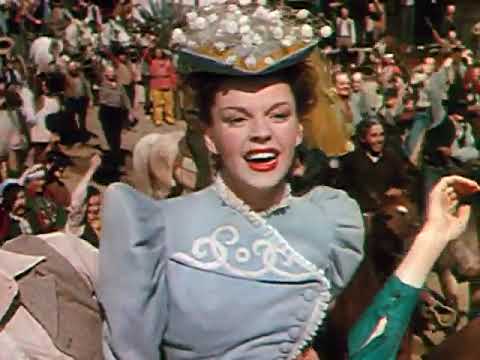
“On the Atchison, Topeka and the Santa Fe” (ensemble led by Judy Garland; music Harry Warren, lyrics Johnny Mercer)
- Where it plays:
- The signature arrival sequence: the town gathers as the train pulls in; verses trade between porters, townsfolk, and Harvey Girls before Garland boards and the tempo kicks. The camera snakes along the platform, then explodes into traveling shots and a mid-number key change.
- Why it matters:
- It’s the movie’s thesis — rails bring order and opportunity. Also the film’s Oscar-winning hit.
“It’s a Great Big World” (Judy Garland, Virginia O’Brien, Cyd Charisse [voice: Marion Doenges])
- Where it plays:
- In the Harvey House dorm, new arrivals trade hopes and jitters. Sweet harmonies, soft-shoe shuffles, trunks and hatboxes as percussion.
- Why it matters:
- Turns exposition into community-building — the “why we came West” manifesto.
“The Wild, Wild West” (Virginia O’Brien)
- Where it plays:
- Cabaret send-up with O’Brien’s deadpan cool, poking fun at frontier bluster. A stage-within-the-film, watched by both sides of the town’s rivalry.
- Why it matters:
- Comedy that sharpens character — the cool customer in a hot-blooded place.
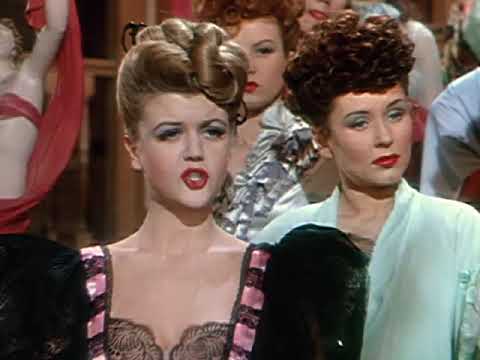
“Oh, You Kid” & “Wait and See” (Angela Lansbury — singing voice: Virginia Rees)
- Where they play:
- In the rival saloon, the glamorous Em (Lansbury) wields torch and tease to keep patrons loyal; reprises taunt the Harvey House across the street.
- Why it matters:
- She’s the foil — these numbers are both lure and declaration of turf.
“In the Valley (Where the Evening Sun Goes Down)” (Judy Garland; later reprise with Kenny Baker)
- Where it plays:
- A gentler porch-and-moonlight interlude that softens the film’s stakes; the reprise turns it into a shared promise.
- Why it matters:
- Heart song — gives the romance thread its glow.
“Swing Your Partner Round and Round” (Ray Bolger, Judy Garland & company)
- Where it plays:
- Square-dance set piece as tensions ease — a swirl of calls, do-si-dos, and reconciliations on the floorboards.
- Why it matters:
- Choreography as diplomacy: the town literally learns to move together.
“The Train Must Be Fed” (company)
- Where it plays:
- Kitchen-and-counter bustle montage: coffee, pies, and clockwork service timed to the timetable.
- Why it matters:
- Work song that makes hospitality heroic — the Harvey House creed.
Notes & Trivia
- Year check: The film is 1946. The much-loved expanded CD arrived in 1996 (Rhino Movie Music), which is why the “1996 musical” date sometimes pops up.
- Hit parade: “Atchison, Topeka and the Santa Fe” topped charts in 1945 in several competing versions and won the 1946 Oscar for Best Original Song.
- Dubbing credits: Angela Lansbury’s vocals were dubbed by Virginia Rees; Cyd Charisse’s lines in “It’s a Great Big World” were sung by Marion Doenges.
- Deleted numbers: Warren/Mercer also wrote “March of the Doagies,” “Hayride,” and “My Intuition” — recorded, with some filmed, then dropped; they appear on restorations/bonus materials and the 1996 CD.
Reception & Quotes
From release to revival screenings, the music’s reputation has remained shiny: a locomotive classic wrapped in Technicolor gloss.
“Mercer’s lyric and Warren’s tune make the railroad sing — literally.” Song histories & Oscar retrospectives
“A production number so buoyant it sells civic planning with a smile.” Classic-film retrospectives
Availability: An expanded soundtrack dropped on CD in 1996 (Rhino Movie Music) and is now streamable; vintage Decca cast recordings (1945) also circulate.
Interesting Facts
- Pre-release blitz: MGM seeded the hit single months before filming wrapped — early transmedia marketing, 1940s-style.
- Brand synergy: The song “sold” the Atchison, Topeka & Santa Fe railroad so well it later echoed in advertising.
- Kay Thompson’s fingerprints: The Decca cast album used MGM-identical arrangements, with Thompson shaping the vocal blend.
- Platform engineering: The train number’s camera blocking turns the platform into a musical conveyor belt.
- Dance diplomacy: The square-dance isn’t filler — it’s the peace treaty.
Technical Info
- Title: The Harvey Girls (Original Motion Picture Soundtrack)
- Film Year: 1946 (MGM)
- Album Milestone: 1996 expanded CD (Rhino Movie Music)
- Type: Film musical — original songs integrated on screen
- Songwriters: Harry Warren (music); Johnny Mercer (lyrics)
- Music direction: Lennie Hayton (conductor/music director)
- Key numbers (selected): “On the Atchison, Topeka and the Santa Fe”; “It’s a Great Big World”; “The Wild, Wild West”; “Oh, You Kid”; “Wait and See”; “In the Valley (Where the Evening Sun Goes Down)”; “Swing Your Partner Round and Round”; “The Train Must Be Fed”
- Awards: Academy Award — Best Original Song (“On the Atchison, Topeka and the Santa Fe”)
- Album availability: 1996 CD & modern streaming; 1945 Decca cast album also extant
Key Contributors
| Entity | Relation | Notes |
|---|---|---|
| Harry Warren | Composer → Songs | Wrote the film’s score with Mercer |
| Johnny Mercer | Lyricist → Songs | Oscar-winning lyric for “Atchison, Topeka and the Santa Fe” |
| Lennie Hayton | Music Director/Conductor → MGM Orchestra | Supervised prerecords & sessions |
| Judy Garland | Lead Vocalist/Performer → Multiple numbers | Leads the train showpiece & ballads |
| Angela Lansbury (voice: Virginia Rees) | Performer → Saloon numbers | “Oh, You Kid,” “Wait and See” |
| Ray Bolger | Performer → Dance features | Square-dance co-lead |
| Kay Thompson | Vocal Arranger (Decca cast album) | Replicated MGM arrangements for disc |
| Rhino Movie Music | Label → 1996 CD expansion | Restored/expanded film tracks & outtakes |
Questions & Answers
- Is it a 1996 musical?
- No — the film premiered in 1946. A popular expanded soundtrack CD was released in 1996, which causes the date mix-up.
- Who wrote the songs?
- Harry Warren (music) and Johnny Mercer (lyrics) — a top-tier Hollywood team.
- Which number won the Oscar?
- “On the Atchison, Topeka and the Santa Fe” — Best Original Song.
- Does Angela Lansbury sing?
- Her numbers are dubbed by Virginia Rees in the film.
- Where can I hear the complete soundtrack?
- The 1996 Rhino CD (and current streaming reissues) collect film tracks, reprises, and several deleted/outtake songs.
Sources: film/song credits & performers; Oscar/song histories; 1996 Rhino CD details; Decca 1945 cast album notes; official trailer & studio clips.
November, 28th 2025
A-Z Lyrics Universe
Cynthia Erivo Popular
Ariana Grande Horsepower
Post Malone Ain't No Love in Oklahoma
Luke Combs Good Riddance (Time of Your Life)
Green Day Bye Bye Bye
*NSYNC You're the One That I Wan
John Travolta & Olivia Newton-John I Always Wanted a Brother
Braelyn Rankins, Theo Somolu, Kelvin Harrison Jr. and Aaron Pierre The Power of Love
Frankie Goes to Hollywood Beyond
Auli’i Cravalho feat. Rachel House MORE ›