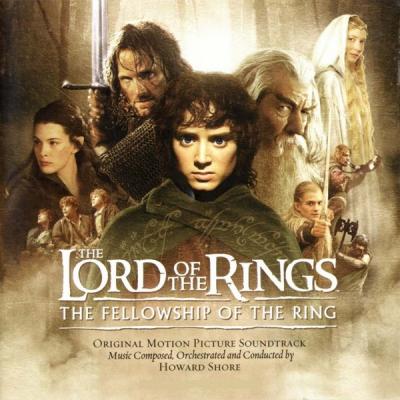
"The Lord of the Rings: The Fellowship of the Ring" Soundtrack Lyrics
Movie • 2001
Track Listing
Howard Shore
(Aniron) Enya
Elizabeth Frazer (Lament for Gandalf)
Edward Ross (In Dreams)
Enya
Howard Shore
J.R.R Tolikien/ Billy Boyd / Dominic Monangan
“The Lord of the Rings: The Fellowship of the Ring (Original Motion Picture Soundtrack)” – Album Guide to Tracks and Key Scenes
Review
How do you score a beginning that already feels ancient? Howard Shore answers with memory first. The 2001 album builds a musical world where pennywhistle and fiddle sketch the Shire, brass carves Gondor’s future, and choirs carry myth like weather. It’s not just pretty; it’s structural — motifs braid geography, history, and choice into a single road.
The record moves like a journey: hearthlight (“Concerning Hobbits”), dread gathering (“The Black Rider”), vaulted awe (“Moria”/“The Bridge of Khazad-dûm”), then the green hush of Lothlórien before fellowship breaks and voices bless the end credits (“May It Be,” “In Dreams”). What’s distinct is the folk → liturgy arc: personal tunes swell into communal ritual without losing their handmade warmth.
Genres & themes in phases: folk-dance timbres (pennywhistle, fiddle) — home and habit; modal choral writing — age and awe; heroic brass — oath and muster; lament aria — grief as compass; pop-adjacent ballad (credits) — benediction for the road.
How It Was Made
Shore composed, orchestrated, and conducted a highlights program drawn from more than three hours of score. Performers include the London Philharmonic Orchestra, New Zealand Symphony Orchestra, London Voices, and the London Oratory School Schola. The album arrived on November 20, 2001 via Reprise Records, with featured vocalists Enya (“Aníron,” “May It Be”), Elizabeth Fraser (the Lórien-set “Lament for Gandalf”), and boy soprano Edward Ross (“In Dreams”). A multi-disc Complete Recordings edition followed in 2005, presenting (nearly) the full film score in narrative order.
Tracks & Scenes
Scene-anchored notes (not a full tracklist). Diegetic = heard by characters on screen.
“Concerning Hobbits”
- Where it plays:
- Early Shire sequences: Bilbo’s birthday bustle, lanes and gardens, the texture of everyday life. Fiddle, low whistle, and the Shire’s “two-step” rhythm paint village time.
- Why it matters:
- Establishes home as a melody — so departures feel like harmonic loss.
“The Black Rider”
- Where it plays:
- Nazgûl hunt the Ringbearer along hedges and lanes; strings saw against pulse, men’s choir grinds like distant iron.
- Why it matters:
- Introduces Mordor’s machinery as sound — fear learned by ear.
“The Council of Elrond (feat. ‘Aníron’ — Enya)”
- Where it plays:
- Rivendell’s council and Arwen–Aragorn moments. Enya’s theme threads the lovers’ vow; harp and voice sit inside Shore’s Rivendell harmony.
- Why it matters:
- Intimacy inside statecraft — a private promise under public oaths.
“A Knife in the Dark” → “Flight to the Ford”
- Where it plays:
- Weathertop attack into the river chase. Cor anglais calls the hobbits; choral clusters harden as waters rise at Bruinen.
- Why it matters:
- First major test — peril motif locks to the Ringbearer’s breath.
“The Bridge of Khazad-dûm”
- Where it plays:
- Moria’s collapse through the Balrog standoff. Low brass and male choir grind to a cliff-edge cadence; after the fall, strings hold vigil.
- Why it matters:
- Tragedy as architecture — the saga’s grief chord is forged here.
“Lothlórien” (feat. “Lament for Gandalf” — Elizabeth Fraser)
- Where it plays:
- In Galadriel’s wood, choral veils and Fraser’s voice hover like light through leaves; mourning becomes memory.
- Why it matters:
- A pause that heals — sorrow turns luminous before the road resumes.
“Amon Hen”
- Where it plays:
- Ambush and breaking: Boromir’s stand; the Fellowship splinters amid horns and drum-line catastrophe.
- Why it matters:
- Heroism with a cost — brass hails and then collapses into elegy.
“The Breaking of the Fellowship” (w/ “In Dreams” — Edward Ross)
- Where it plays:
- Farewells on the shore and the first steps alone; the end-credits segue carries Ross’s vocal over the Shire hymn variant.
- Why it matters:
- A blessing for a smaller road — not triumph, permission to go on.
“May It Be” (Enya) — end credits
- Where it plays:
- First end-credits song; Quenya phrases and a lullaby cadence ease the chapter closed before “In Dreams” returns the Shire theme.
- Why it matters:
- Pop-ballad benediction that still belongs to Middle-earth’s tongue.
Notes & Trivia
- Two endings, one idea: The credits flow from Enya’s “May It Be” into Shore/Walsh’s “In Dreams” sung by boy soprano Edward Ross.
- Love theme guest: Enya’s “Aníron” supplies Aragorn/Arwen’s motif inside “The Council of Elrond.”
- Lórien’s voice: Cocteau Twins’ Elizabeth Fraser performs the album’s “Lament for Gandalf” passage in “Lothlórien.”
- Expanded set: The Complete Recordings (2005) presents (nearly) the full score across 3 CDs + a DVD.
- Ensembles: LPO + NZSO with London Voices and the London Oratory School Schola give the score its combined weight and halo.
Reception & Quotes
Listeners and critics have long treated the album as a rare world-builder: a place you can hear. The later vinyl/CD reissues kept its reputation evergreen.
“A folk tune that grows into liturgy — Shore turns place into theme.” Score retrospectives
“‘Khazad-dûm’ is tragedy engineered: choir as stone.” Fan essays
“Enya’s benediction and the boy soprano close the book like a prayer.” Album coverage
Interesting Facts
- Chart run: The OST hit Platinum in the U.S. and posted Top-10/Top-20 peaks across multiple countries.
- Textbook case: Doug Adams’s The Music of the Lord of the Rings Films dissects how “Shire,” “Fellowship,” and “Mordor” themes evolve across the trilogy.
- Languages: Lyrics and choral phonetics span Sindarin, Quenya, Khuzdul phonemes, and Old English–flavored Rohirric forms (the latter bloom more in Part II, but the palette starts here).
- Credits architecture: The OST’s “Breaking of the Fellowship” contains “In Dreams”; the Complete Recordings retitles the end suite within its longer sequence.
- Rivendell blend: Enya’s distinct production textures were woven into Shore’s orchestral palette, not just layered on top.
Technical Info
- Title: The Lord of the Rings: The Fellowship of the Ring (Original Motion Picture Soundtrack)
- Year: 2001 (OST); 2005 (The Complete Recordings)
- Type: Score album (with end-title songs); expanded archival release
- Composer/Conductor: Howard Shore
- Performers: London Philharmonic Orchestra; New Zealand Symphony Orchestra; London Voices; London Oratory School Schola
- Featured vocals: Enya (“Aníron,” “May It Be”); Elizabeth Fraser (“Lament for Gandalf” excerpt in “Lothlórien”); Edward Ross (“In Dreams”)
- Label: Reprise Records
- Release context: OST released Nov 20, 2001; Complete Recordings issued Dec 13, 2005 (3 CD + DVD)
- Selected notable placements: “Concerning Hobbits” — Shire life; “The Black Rider” — Nazgûl pursuit; “The Council of Elrond/Aníron” — vow and council; “Flight to the Ford” — river rescue; “The Bridge of Khazad-dûm” — Moria/Balrog; “Lothlórien” — mourning in the wood; “Amon Hen” — ambush and scattering; “Breaking of the Fellowship”/“In Dreams” → “May It Be” — end credits.
Questions & Answers
- Who performs the end-credits songs?
- Enya sings “May It Be”; the boy soprano Edward Ross sings “In Dreams,” which extends the Shire theme.
- Is Enya’s love theme part of Shore’s score?
- Yes — “Aníron” (composed/performed by Enya) is woven into “The Council of Elrond” and underscoring for Aragorn/Arwen.
- Where can I hear the Balrog sequence on album?
- “The Bridge of Khazad-dûm” covers the Moria collapse, standoff, and aftermath.
- Does the OST contain everything from the film?
- No — it’s a highlights program. The 2005 Complete Recordings set presents the film’s (near-complete) score in order.
- Which ensembles and choirs are on the album?
- London Philharmonic Orchestra, New Zealand Symphony Orchestra, London Voices, and the London Oratory School Schola.
Key Contributors
| Entity | Relation |
|---|---|
| Howard Shore | Composer, orchestrator, conductor; album producer. |
| London Philharmonic Orchestra; New Zealand Symphony Orchestra | Orchestral performers. |
| London Voices; London Oratory School Schola | Choirs — choral backbone and boys’ choir timbre. |
| Enya (with Roma Ryan) | Composer/performer — “Aníron”; performer — “May It Be.” |
| Elizabeth Fraser | Featured vocalist — “Lament for Gandalf” within “Lothlórien.” |
| Edward Ross | Boy soprano — “In Dreams” (end-credits extension of the Shire theme). |
| Reprise Records | Label — released OST (2001) and later editions; Complete Recordings (2005). |
| New Line Cinema | Studio/distributor; music executive production. |
Sources: official soundtrack pages, label/credits databases, composer notes/interviews, scene guides, and archival trailer.
November, 28th 2025
A-Z Lyrics Universe
Cynthia Erivo Popular
Ariana Grande Horsepower
Post Malone Ain't No Love in Oklahoma
Luke Combs Good Riddance (Time of Your Life)
Green Day Bye Bye Bye
*NSYNC You're the One That I Wan
John Travolta & Olivia Newton-John I Always Wanted a Brother
Braelyn Rankins, Theo Somolu, Kelvin Harrison Jr. and Aaron Pierre The Power of Love
Frankie Goes to Hollywood Beyond
Auli’i Cravalho feat. Rachel House MORE ›