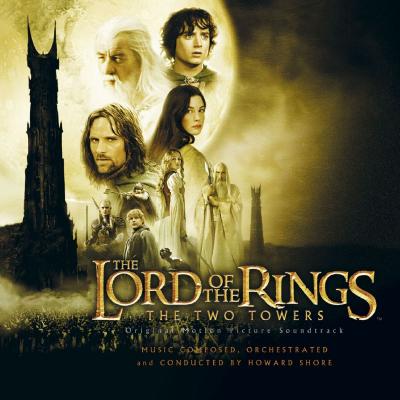
"The Lord of the Rings: The Two Towers" Soundtrack Lyrics
Movie • 2002
Track Listing
Howard Shore
Howard Shore
Isabel Bayrakdarian
Howard Shore
Howard Shore
featuring Sheila Chandra
Howard Shore featuring Ben Del Maestro
featuring Elizabeth Fraser & Ben Del Maestro
performed by Emiliana Torrini
featured in Breath of Life
featured in Isengard Unleashed
featured in Forth Eorlingas
“The Lord of the Rings: The Two Towers (Original Motion Picture Soundtrack)” – Album Guide to Tracks and Key Scenes
Review
How do you make the “middle” feel like destiny? By giving it a new heartbeat. Howard Shore’s Two Towers score raises a standard — the Rohan theme — and lets it lead armies and feelings. A hardanger fiddle sings like weather over grasslands; men’s choir and war-drums grind under Isengard; Gollum’s motif curls in woodwinds until Emilíana Torrini’s end-title vocal finally names the ache.
The album moves from scattered companies to shared purpose. Rohan’s nobility (“The Riders of Rohan,” “The King of the Golden Hall”) meets the claustrophobia of pursuit (“The Black Gate Is Closed,” “The Passage of the Marshes”), then expands into fortress writing for Helm’s Deep (“Helm’s Deep,” “The Hornburg,” “Forth Eorlingas”). In between, the voice-led set pieces do the soul-work: “Evenstar” guards Aragorn and Arwen’s fragile promise; “Breath of Life” lets Éowyn’s inner weather lift above the din; “Gollum’s Song” closes the chapter with a bruise you can hum.
Genres & themes in phases: folk-epic (hardanger fiddle) — lineage and land; choral-industrial — machines and malice; lament aria — private loss; symphonic siege — duty and endurance; pop-lieder end-title — identity split in two.
How It Was Made
Shore composed, orchestrated, and conducted a highlights program drawn from the full film score. Performers include the London Philharmonic Orchestra, London Voices, and the London Oratory School Schola, with notable soloists: Isabel Bayrakdarian (soprano, “Evenstar”), Sheila Chandra (vocals, “Breath of Life”), Dermot Crehan (hardanger fiddle across the Rohan material), and Emilíana Torrini (end-title “Gollum’s Song”). Reprise issued the soundtrack on December 10, 2002; a Target-exclusive limited CD added one extra track. The complete, extended score followed later as The Complete Recordings.
Tracks & Scenes
Scene-anchored notes (not a full tracklist). Diegetic = heard by the characters in-world.
“The Riders of Rohan” (feat. hardanger fiddle)
- Where it plays:
- Wide daylight over the Riddermark as the camera finds mounted patrols and wind-bent grass; later, the motif follows Éomer’s banishment and the mustering of riders. The hardanger fiddle cuts through the orchestral bed with a reedy, ancient edge.
- Why it matters:
- A nation as a melody — noble, wind-scarred, and ready to ride.
“The King of the Golden Hall”
- Where it plays:
- Inside Meduseld as Gandalf frees Théoden from Wormtongue’s blight. Brass lift, then the Rohan tune returns, steadier, as sunlight opens the hall.
- Why it matters:
- Restoration in music — a court breathes again.
“Evenstar” (Isabel Bayrakdarian — soprano feature)
- Where it plays:
- Aragorn/Arwen memory-visions in Rivendell’s cadence; strings and harp hold still while Bayrakdarian’s line traces a vow against time.
- Why it matters:
- Private promise amid public war — love scored as stasis in a storm.
“The Passage of the Marshes” → “The Black Gate Is Closed”
- Where it plays:
- Frodo, Sam, and Gollum creep through dead water and toward Mordor’s wall. Low choir and glassy textures merge with sound design; Gollum’s woodwind curls keep the trio’s moral compass uncertain.
- Why it matters:
- Horror by inches — temptation and pity in one motif.
“Helm’s Deep” → “The Hornburg” → “Forth Eorlingas”
- Where it plays:
- From the rain-beaten ramparts to the gate break, then Gandalf’s dawn cavalry swing with Éomer. The battle writing cycles between trudge, panic, and release; when the Rohirrim crest the ridge, a solo voice and horns cut the night like a banner.
- Why it matters:
- The siege becomes liturgy — endurance, then salvation by daylight.
“Isengard Unleashed”
- Where it plays:
- Ents march and break Saruman’s works; choral-weighted writing turns trees into judgment while water hammers the machinery.
- Why it matters:
- Nature as chorus — a moral argument rendered as percussion and choir.
“Breath of Life” (Sheila Chandra — vocals)
- Where it plays:
- Interwoven through Rohan/Éowyn material: a wordless vocal halo that rises when grief and courage touch.
- Why it matters:
- Gives Éowyn an inner weather — strength heard before it’s seen.
“Gollum’s Song” (Emilíana Torrini) — end credits
- Where it plays:
- Over the credits: a haunted lullaby from the point of view of a split self. The melody carries Gollum’s tenderness and terror without resolving either.
- Why it matters:
- The chapter closes in empathy, not thunder — a daring move for a blockbuster midpoint.
Notes & Trivia
- Release & editions: Standard CD dropped December 10, 2002; a U.S. retail-exclusive CD added one bonus cue; the full extended score arrived later as The Complete Recordings.
- Vocal features: Isabel Bayrakdarian (“Evenstar”), Sheila Chandra (“Breath of Life”), Emilíana Torrini (“Gollum’s Song”).
- Rohan’s instrument: The hardanger fiddle (soloist Dermot Crehan) colors the Riders’ identity across the album.
- Choirs: London Voices and the London Oratory School Schola provide the male-choir rumble and boys’ choir halo.
- Award note: The OST later took home the Grammy for Best Score Soundtrack Album.
Reception & Quotes
Critics praised the new thematic spine (Rohan) and the courage to end with a character ballad. Fans still cite the Helm’s Deep sequence as a modern action-scoring benchmark.
“Rohan’s theme feels carved from wind — the film grows a conscience.” Score reviews
“Torrini’s ‘Gollum’s Song’ turns a monster into a mirror.” Album notes
Availability: Original OST (2002, Reprise) is widely streaming; The Complete Recordings expands to the full extended film score.
Interesting Facts
- Middle-movement magic: The album deepens earlier motives (Fellowship/Shire) while debuting Rohan and fully personifying Gollum.
- Metal vs. wood: Isengard’s choral “machine” sonority contrasts deliberately with Rohan’s woody fiddle and hand percussion.
- Voice of rescue: A treble/solo voice often pierces the Helm’s Deep writing at moments of hope — a tiny light in a black frame.
- Soloist lineage: Bayrakdarian’s classical clarity, Chandra’s gliding timbre, and Torrini’s indie-lilt each stamp a different corner of the story.
- Complete immersion: The multi-disc Complete Recordings set places cues in narrative order and adds extensive liner notes.
Technical Info
- Title: The Lord of the Rings: The Two Towers (Original Motion Picture Soundtrack)
- Year: 2002 (OST); 2006 (The Complete Recordings)
- Type: Score album (with end-title song); expanded archival release
- Composer/Conductor: Howard Shore
- Performers: London Philharmonic Orchestra; London Voices; London Oratory School Schola
- Featured soloists: Isabel Bayrakdarian (soprano — “Evenstar”); Sheila Chandra (vocals — “Breath of Life”); Dermot Crehan (hardanger fiddle — Rohan cues); Emilíana Torrini (vocal — “Gollum’s Song”)
- Label: Reprise Records
- Release details: OST released Dec 10, 2002; U.S. retailer-exclusive limited CD added one bonus cue; complete score issued later as The Complete Recordings
- Selected notable placements: “The Riders of Rohan” — landscape & muster; “The King of the Golden Hall” — Théoden restored; “The Passage of the Marshes”/“Black Gate Is Closed” — Frodo/Sam/Gollum crawl; “Helm’s Deep”→“The Hornburg”→“Forth Eorlingas” — siege to dawn charge; “Isengard Unleashed” — Ents level the forge; “Evenstar” — vow; “Breath of Life” — Éowyn’s inner voice; “Gollum’s Song” — end credits.
Questions & Answers
- When was the OST released — and on what label?
- December 10, 2002, on Reprise Records.
- Who sings on the album?
- Isabel Bayrakdarian (“Evenstar”), Sheila Chandra (“Breath of Life”), and Emilíana Torrini (“Gollum’s Song”).
- What instrument gives Rohan its sound?
- The hardanger fiddle — performed by Dermot Crehan — threads through the Riders’ music.
- Does the album include the Helm’s Deep music?
- Yes — cues like “Helm’s Deep,” “The Hornburg,” and “Forth Eorlingas” cover the siege and dawn charge.
- Is there a longer edition?
- Yes. The Complete Recordings presents the extended cut’s full score in sequence with detailed liner notes.
Key Contributors
| Entity | Relation |
|---|---|
| Howard Shore | Composer, orchestrator, conductor; album producer. |
| London Philharmonic Orchestra | Principal orchestral performer. |
| London Voices; London Oratory School Schola | Choirs — choral foundation (men’s & boys’). |
| Isabel Bayrakdarian | Soprano — featured on “Evenstar.” |
| Sheila Chandra | Vocalist — featured on “Breath of Life.” |
| Dermot Crehan | Featured soloist — hardanger fiddle (Rohan). |
| Emilíana Torrini | Vocalist — “Gollum’s Song” (end credits). |
| Reprise Records | Label — issued OST (2002) and later editions. |
| New Line Cinema | Studio/distributor — film; music executive production. |
Sources: official soundtrack listings, label and database pages, composer/soloist features, instrumentation notes, and archival trailers.
November, 28th 2025
A-Z Lyrics Universe
Cynthia Erivo Popular
Ariana Grande Horsepower
Post Malone Ain't No Love in Oklahoma
Luke Combs Good Riddance (Time of Your Life)
Green Day Bye Bye Bye
*NSYNC You're the One That I Wan
John Travolta & Olivia Newton-John I Always Wanted a Brother
Braelyn Rankins, Theo Somolu, Kelvin Harrison Jr. and Aaron Pierre The Power of Love
Frankie Goes to Hollywood Beyond
Auli’i Cravalho feat. Rachel House MORE ›