
"The Losers" Soundtrack Lyrics
Movie • 2010
Track Listing
Kevin W. Buchholz and Jessie Shapiro
Ram Jam
Skunk Anansie
The Heavy
Papi Brandao & Sus Ejecutivos
The Kills
Street Sweeper Social Club
Amel Larrieux
Journey
Street Sweeper Social Club
Orchestra Lunatica
“The Losers: Original Motion Picture Soundtrack” – Album Guide to Tracks and Key Scenes
Review
Can an action-comedy score grin without getting goofy? John Ottman threads that needle. The Losers balances a slick, guitar-led title theme with stealthy, percussion-forward caper cues. It’s less cape-and-brass superhero, more “crew-on-a-mission” swagger — quick motifs, crunchy rhythm guitars, and short, punchy cues cut to stunts, jokes, and double-crosses.
The songs department does heavy lifting too: crate-digger rock (Ram Jam), punky alt (Skunk Anansie), indie-cool (The Kills), funk-snap (The Heavy), and a drop-dead classic (“Don’t Stop Believin’”) used for comedy as much as catharsis. Together, songs + score set a breezy, cocky tone: the team’s moral code is complicated; their vibes are not.
Genres & themes in phases: guitar-driven score — competence and camaraderie; garage/alt bangers — trouble with a smirk; Latin oldies — local color; funk-rock — muscle; arena classic — meta-joke; end-credits indie uplift — afterglow.
How It Was Made
Director Sylvain White tapped John Ottman for the score; the official album dropped digitally in May 2010. Ottman’s program plays like a compact heist suite: a title idea introduced on smooth guitars (“Dead Men”), hardened in “Not Soldiers Anymore,” then intercut with tighter action cuts (“Miami Heist,” “Port Break-In,” “Shoot Out”). Songs were licensed around the globe-trotting plot — Bolivia to Miami — and placed as energetic scene-stamps.
Tracks & Scenes
Below: screen-anchored highlights and why they matter (not a full album tracklist).
“Champion of the Blind” (Kevin W. Buchholz & Jessie Shapiro)
- Where it plays:
- Opening titles around 0:01 — card table introductions, freeze-frames, quick bio beats. It’s the movie’s cocky handshake.
- Why it matters:
- Announces the tone: graphic-novel cool over military grit.
“Black Betty” (Ram Jam)
- Where it plays:
- ~0:02 as the team trucks into the Bolivia op. The famous stomp riffs under convoy shots and mission banter.
- Why it matters:
- Old-school swagger sets a lawless, blue-collar mood.
“Tear the Place Up” (Skunk Anansie)
- Where it plays:
- ~0:05 during the compound raid and school-bus extraction. The song’s shout-along title becomes the set-piece’s thesis.
- Why it matters:
- Gives the rescue a punk edge and a punchy tempo for cuts.
“Big Bad Wolf” (The Heavy)
- Where it plays:
- ~0:12 while the stranded crew cobbles a life in Bolivia — a cockfight and car tinkering montage.
- Why it matters:
- Dirty-blues strut that says: even broke, they’re still dangerous.
“Bilongo” (Papi Brandao y Sus Ejecutivos)
- Where it plays:
- ~0:13: street-food stroll and bar scene where Clay first meets Aisha. Warm source cue as flirtation bait.
- Why it matters:
- Local color softens the frame before the sparks fly.
“U.R.A. Fever” (The Kills)
- Where it plays:
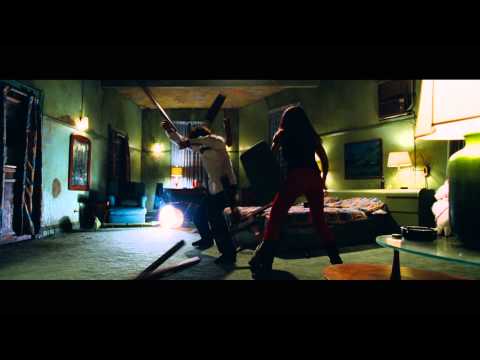
- ~0:18 (hotel-room fight) and again ~0:47 (trailer love scene). The chorus lands like a taunt.
- Why it matters:
- Turns Clay/Aisha’s chemistry into a sly, minimal pulse.
“Clap for the Killers” (Street Sweeper Social Club)
- Where it plays:
- ~0:21: Jensen’s ride to the cemetery, revving the plot back to the States.
- Why it matters:
- Anthemic sneer for a team that refuses to stay dead.
“Sweet Misery” (Amel Larrieux)
- Where it plays:
- ~0:49: the morning after Clay/Aisha, a brief, soft-grained tag.
- Why it matters:
- One drop of tenderness before plans go sideways again.
“Don’t Stop Believin’” (Journey) — Jensen’s gag & end-credits reprise
- Where it plays:
- ~0:50: Jensen lip-syncs through a corporate lobby (headphones on), later chased by security. Reappears over the soccer stinger in credits (~1:31).
- Why it matters:
- Perfect needle-drop joke — weaponized optimism.
“The Oath” (Street Sweeper Social Club) — first credits song
- Where it plays:
- ~1:29 as credits roll; punctuates the final freeze-frames.
- Why it matters:
- A hard, declarative exit after the last twist.
“Through Tears of Joy” (Orchestra Lunatica) — end-credits closer
- Where it plays:
- ~1:33: third song in credits, a slow-build instrumental that carries the “we made it” glow.
- Why it matters:
- Surprisingly earnest coda — a pulse of triumph after the jokes.
Score spine (John Ottman) — highlights
- Where they play:
- “Dead Men,” “Not Soldiers Anymore,” “Miami Heist,” “Port Break-In,” “Shoot Out,” “Double Crossed,” “The Losers” — short, motif-driven cues that lock to planning, betrayals, and firefights.
- Why they matter:
- They stitch the mixtape together — theme, plan, punchline.

Notes & Trivia
- The end-credits run three distinct vibes: agit-prop rock (“The Oath”), an in-joke reprise (“Don’t Stop Believin’”), then an instrumental glow (“Through Tears of Joy”).
- “U.R.A. Fever” became the film’s stealth romance motif — it scores both a brawl and a love scene.
- Ottman’s album was initially a compact, download-first program before wider storefront/streaming availability.
- Yes, that’s real Ram Jam — “Black Betty” is the second cue in the film and sets the outlaw tone early.
Reception & Quotes
Reviews pegged the movie as breezy and disposable; the music — less so. Fans file the album as “Ottman in caper mode,” tight and replayable.
“A slick title theme, a lot of fun, and cut-to-fit action cues — perfect for this crew’s attitude.” Score review capsules
“The mixtape needle-drops are the secret sauce.” Fan chatter & blogs
Availability: Digital/streaming (2010); end-credits songs are available separately from their respective artists.

Interesting Facts
- Gag-as-needle-drop: Jensen’s iPod sing-along turns a stadium anthem into a stealth-exit tactic.
- Latin vinyl: “Bilongo” threads location flavor through the Clay–Aisha meet-cute.
- Double life cue: “U.R.A. Fever” scores both combat and romance without changing clothes.
- Short-cue design: Many score cuts are under three minutes — built for montage and quip timing.
- Credit climber: “Through Tears of Joy” closes the show with a slow, emotional build — unusual after an action-comedy blowout.
Technical Info
- Title: The Losers: Original Motion Picture Soundtrack
- Year: 2010
- Type: Score album (with prominent licensed songs in-film)
- Composer: John Ottman
- Music supervision: Lior Rosner (film credits)
- Label/rights note: ℗ 2010 Pale Blue Ltd (album listing)
- Release context: Digital release May 2010; film opened April 2010
- Selected notable placements: “Champion of the Blind” — open (0:01); “Black Betty” — Bolivia drive (0:02); “Tear the Place Up” — bus rescue (0:05); “U.R.A. Fever” — fight & love scenes (~0:18 / ~0:47); “Don’t Stop Believin’” — lobby lip-sync & credits gag (~0:50 / 1:31); “Through Tears of Joy” — end-credits closer (~1:33).
Questions & Answers
- Who wrote the score?
- John Ottman — a compact, guitar-forward caper score built from short motifs.
- Is there an official score album?
- Yes. A 16-track digital release in 2010 collects Ottman’s cues.
- Which songs are the big crowd-pleasers on screen?
- Ram Jam’s “Black Betty,” Skunk Anansie’s “Tear the Place Up,” The Kills’ “U.R.A. Fever,” Journey’s “Don’t Stop Believin’.”
- What’s that instrumental that closes the credits?
- “Through Tears of Joy” by Orchestra Lunatica — a slow-build, uplifting piece.
- Who handled the movie’s music supervision?
- Lior Rosner is credited as music supervisor.
Key Contributors
| Entity | Relation |
|---|---|
| John Ottman | Composer — score; album artist for the 2010 release. |
| Lior Rosner | Music Supervisor — film credits. |
| Sylvain White | Director — tone + music brief guiding caper/crew vibe. |
| Warner Bros. Pictures | Distributor — U.S. release. |
| Pale Blue Ltd | Rights holder — ℗ credit on the score album. |
| Ram Jam; Skunk Anansie; The Heavy; Papi Brandao y Sus Ejecutivos; The Kills; Street Sweeper Social Club; Journey; Amel Larrieux; Orchestra Lunatica | Featured artists — film needle-drops and end-credits cues. |
| Dark Castle Entertainment / Vertigo (DC) | Producers/rights — film production entities. |
Sources: official film and album credits; soundtrack scene guides; album store/streaming listings; score reviews; archival trailers.
November, 28th 2025
A-Z Lyrics Universe
Cynthia Erivo Popular
Ariana Grande Horsepower
Post Malone Ain't No Love in Oklahoma
Luke Combs Good Riddance (Time of Your Life)
Green Day Bye Bye Bye
*NSYNC You're the One That I Wan
John Travolta & Olivia Newton-John I Always Wanted a Brother
Braelyn Rankins, Theo Somolu, Kelvin Harrison Jr. and Aaron Pierre The Power of Love
Frankie Goes to Hollywood Beyond
Auli’i Cravalho feat. Rachel House MORE ›