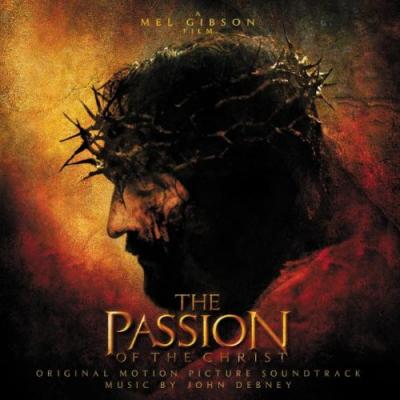
"The Passion of the Christ" Soundtrack Lyrics
Movie • 2004
Track Listing
Holly Williams
Leon Russell and the Shelter People
Ricky Skaggs
Jessi Colter & Shooter Jennings
Dolores O'Riordan
Lee Ryan
Nick Cave & The Bad Seeds
Elvis Presley
The Ghost Who Walks
Leonard Cohen
The Blind Boys Of Alabama
Bob Dylan
"The Passion of the Christ (Original Motion Picture Soundtrack)" – Album Guide to Tracks and Key Scenes
Review
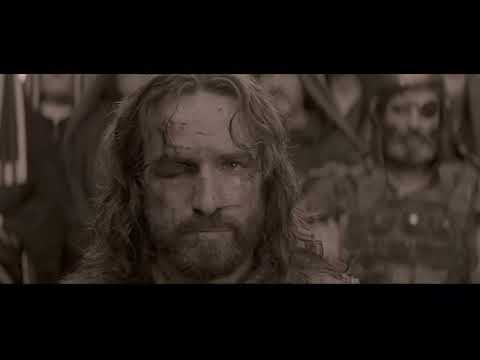
How do you score a story everybody thinks they already “hear”? John Debney’s music answers with breath and dust — ancient timbres, low choirs, keening solos — a sound that feels carved rather than written. The soundtrack doesn’t decorate brutality; it interprets it, giving the film’s near-silent stretches a living pulse. When dialogue fades to Aramaic whispers and glances, the music becomes the narrator.
Debney fuses traditional orchestral writing with world instruments and voices: duduk and bansuri against tremolo strings, a double-violin singing like metal under stress, a woman’s lament cutting through the crowd. The arc is deliberate — Gethsemane’s tight dread, the scourging’s ritual thunder, a Stations-of-the-Cross procession that feels like breathwork, and finally a hushed, luminous coda. It’s austere, yes, but also tender; the score keeps returning to Mary and to dignity.
Genres & themes in phases: liturgical minimalism — reverence and dread; Middle Eastern folk colors — historical texture and human scale; choral lament — communal grief; orchestral transfiguration — release and renewal. The album listens like a passion play: movement to movement, wound to wound, silence to light.
How It Was Made
Composer & production: Debney wrote roughly 80–90 minutes of music, recorded the orchestra in London (AIR Lyndhurst), and the choir at Abbey Road. Nick Ingman conducted, with additional music by Jack Lenz. The palette blends orchestra, London Voices, and the Transylvania State Philharmonic Choir with featured soloists on world winds and strings. Sony/Integrity issued the album in February 2004, with Sony Classical editions circulating globally.
Featured artists & textures: world-winds virtuoso Pedro Eustache headlines the ethnic woodwinds (including duduk & flutes); L. Shankar and Gingger Shankar contribute distinctive double-violin/vocal colors; vocalist/lyricist Lisbeth Scott crafts and sings Mary’s Aramaic lines; Mel Gibson provides brief chant on one cue. The writing leans into “ancient” timbre without period cosplay — a modern, mystic blend designed for image and ritual.
Tracks & Scenes
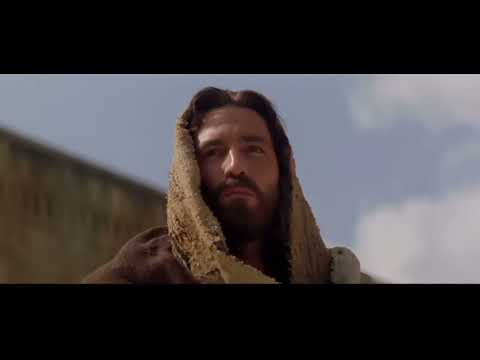
“The Olive Garden” (John Debney)
- Where it plays:
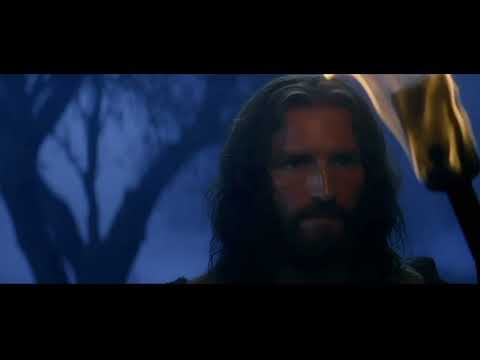
- Gethsemane: wind through olives, disciples drifting to sleep, Jesus alone in prayer. Low drones gather under whispered pleas; the camera tightens, the pulse slows. Early minutes, pre-arrest — non-diegetic score.
- Why it matters:
- Sets the sonic theology: breath, earth, and restraint. The world-wind timbres place us in a specific night, not an abstract myth.
“Jesus Arrested” → “Peter Denies Jesus”
- Where it plays:
- Torchlight erupts; blades flash; a kiss becomes catastrophe. The rhythm turns percussive and irregular as the mob closes in, then pares back to anxious strings and voice for Peter’s courtyard betrayal. First act — non-diegetic.
- Why it matters:
- Two linked character beats: public violence, private failure. The score lets shock collapse into shame.
“Flagellation / Dark Choir / Disciples”
- Where it plays:
- At the pillar, drums land like law. Voices don’t “comment”; they embody witnesses. The cue alternates ritualized thunder with choral shadow as Mary listens from the crowd. Mid-film — non-diegetic with choral focus.
- Why it matters:
- Debney writes endurance. Repetition becomes empathy; the choir stands in for a world that cannot look away.
“Mary Goes to Jesus” (feat. Lisbeth Scott)
- Where it plays:
- Along the Via Dolorosa, Mary pushes through the crowd to meet her son. Strings step carefully; a woman’s voice (Aramaic lyric) enters like a hand on a shoulder. Late mid-film — non-diegetic with solo vocal.
- Why it matters:
- Maternally focused writing: melody as touch. The cue reframes the pageant as a family moment in public.
“Bearing the Cross” → “Procession”
- Where it plays:
- The climb, the falls, Simon pressed into service. Percussion keeps the gait; winds cry in counterpoint. The city becomes a drum; the hill becomes breath. Late second act — non-diegetic.
- Why it matters:
- Motion as meaning. The ostinato is the labor of each step; the melody is resolve.
“Crucifixion” → “Raising the Cross” → “It Is Done”
- Where it plays:
- Nails, wood, sky darkening. Brass is nearly absent; voices and strings carry the weight. The lift to the vertical is written in the harmony — then silence, then a final, terrible cadence. Final act — non-diegetic.
- Why it matters:
- Refuses triumphal bombast; chooses witness. The music lets grief be unadorned, then accepts the stillness.
“Resurrection”
- Where it plays:
- Stone rolls, light breathes. Harmony warms, choral color thins to radiance; the cue ends not with fireworks but with openness. Final minutes — non-diegetic.
- Why it matters:
- A release, not a reversal. The sound moves from body to spirit without losing the body.
Also notable (album/editions & in-film color):
- Erhu figures associated with Satan — a timbral signature used sparingly in temptations and taunts.
- Brief chant by director Mel Gibson layered into a track; choral forces recorded at Abbey Road.
- Later expanded releases add alternates and trailer music (e.g., extended “Bearing the Cross”).
Notes & Trivia
- Debney cites Peter Gabriel’s Passion (The Last Temptation of Christ) as an influence on the score’s hybrid approach.
- Pedro Eustache served as principal world-winds soloist; his palette (duduk, bansuri, more) is central to the film’s voice.
- L. Shankar & Gingger Shankar’s double-violin textures and vocals add an other-worldly sheen in climactic cues.
- Lisbeth Scott wrote/sang Aramaic lines for Mary — most prominently in “Mary Goes to Jesus.”
- The album received an Oscar nomination (Best Original Score) and won a Dove Award (Instrumental Album of the Year).
Reception & Quotes
Film-music press praised the craft and emotional intensity; fan communities adopted pieces like “Bearing the Cross” and “Resurrection” as concert staples (Debney later arranged an oratorio version for live performance).
“A powerful blend of traditional writing with ethnic and contemporary textures.” — Filmtracks review
“Debney’s choral writing moves from lament to benediction without melodramatics.” — Movie-Wave
“One of the most significant religious scores of the era.” — MovieMusicUK
Availability: Original album issued February 2004 (Sony/Integrity; Sony Classical in several territories). Expanded editions/regionals exist; streaming editions mirror the core program.
Interesting Facts
- Abbey Road choir, AIR orchestra: Choir and orchestra recorded at London’s marquee rooms to capture scale and clarity.
- Director’s voice: Mel Gibson’s chant appears within a cue — a rare director cameo in a score track.
- Instrument as character: Erhu colors are linked with Satan; the association is a subtle psychological tag.
- Concert life: Debney’s music later became a full Passion Oratorio for live performance, with Scott’s texts up front.
- Parallel album: A separate “Songs Inspired By” compilation exists, distinct from Debney’s score album.
Technical Info
- Title: The Passion of the Christ — Original Motion Picture Soundtrack (score)
- Year: 2004 (album released Feb 24, 2004)
- Type: Film score (orchestral/choral with world instruments)
- Composer: John Debney — conductor: Nick Ingman; additional music: Jack Lenz
- Key performers: Pedro Eustache (world winds); L. Shankar & Gingger Shankar (double violin/vocals); Lisbeth Scott (lyrics/vocal solos)
- Recording: Orchestra — AIR Lyndhurst; Choir — Abbey Road; mixed at O’Henry Sound Studios
- Label/album status: Sony Music/Integrity (with Sony Classical territorial issues); later expanded/territorial pressings
- Awards: Academy Award nomination (Best Original Score); GMA Dove Award (Instrumental Album of the Year)
Key Contributors
| Entity | Relation |
|---|---|
| John Debney | Composed the score; produced soundtrack; led hybrid-timbre concept |
| Jack Lenz | Additional music; musical research |
| Nick Ingman | Conductor of the London sessions |
| Pedro Eustache | Principal world-winds soloist (duduk/flutes) |
| L. Shankar; Gingger Shankar | Double-violin/vocal soloists; additional music contributors |
| Lisbeth Scott | Lyrics/vocal solos (Aramaic); vocal coach; “Mary Goes to Jesus” feature |
| London Voices; Transylvania State Philharmonic Choir | Choral performance |
| Icon Productions; Newmarket Films | Studio / Distributor |
| AIR Lyndhurst; Abbey Road Studios | Recording venues (orchestra/choir) |
Questions & Answers
- Who composed the score?
- John Debney composed the original score; Nick Ingman conducted; Jack Lenz contributed additional music.
- Is this the same as the “Songs” album?
- No. Debney’s album is the score; a separate “Songs Inspired By” compilation was released alongside it.
- What instruments give the soundtrack its unique color?
- Duduk and other world winds (Pedro Eustache), double-violin and vocals (L. Shankar, Gingger Shankar), plus choir and low strings.
- Where were the London sessions recorded?
- Orchestra at AIR Lyndhurst; choir at Abbey Road. The mix was completed at O’Henry Sound Studios in L.A.
- Does the film use character-linked timbres?
- Yes — for example, erhu colors often shadow Satan, while Mary’s moments feature Lisbeth Scott’s Aramaic vocal.
Sources: Wikipedia (film & soundtrack entries); Discogs releases/credits; MovieMusicUK review; Filmtracks review; Movie-Wave review; AllMusic notes; Metacritic credits; MusicBrainz release; artist bios (Eustache, Scott); official trailer listing.
November, 29th 2025
A-Z Lyrics Universe
Cynthia Erivo Popular
Ariana Grande Horsepower
Post Malone Ain't No Love in Oklahoma
Luke Combs Good Riddance (Time of Your Life)
Green Day Bye Bye Bye
*NSYNC You're the One That I Wan
John Travolta & Olivia Newton-John I Always Wanted a Brother
Braelyn Rankins, Theo Somolu, Kelvin Harrison Jr. and Aaron Pierre The Power of Love
Frankie Goes to Hollywood Beyond
Auli’i Cravalho feat. Rachel House MORE ›