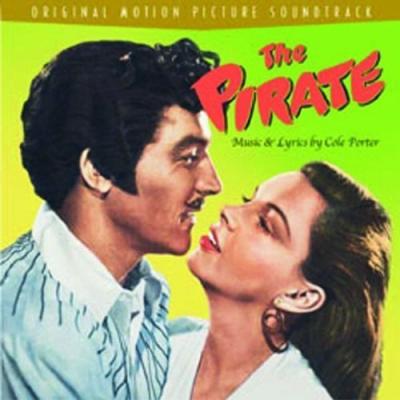
"The Pirate" Soundtrack Lyrics
Musical • 1948
Track Listing
"The Pirate (Original Motion Picture Soundtrack — Cole Porter)" – Album Guide to Tracks and Key Scenes
Review
How do you bottle swashbuckling fantasy and backstage satire in the same songbook? The Pirate does it the MGM way: Cole Porter’s urbane wit sails alongside Vincente Minnelli’s candy-colored dream logic. The soundtrack lives between two poles — Judy Garland’s torchy sparkle and Gene Kelly’s athletic bravado — with Lennie Hayton’s studio orchestra polishing every horn stab and harp gliss.
Porter’s tunes jump from plaza serenade to meta-vaudeville clowning. “Nina” struts; “Mack the Black” boasts; “You Can Do No Wrong” purrs; and “Be a Clown” turns into a tap-rocket when the Nicholas Brothers join Kelly. Minnelli keeps flipping diegesis: numbers begin as onstage “acts,” then bloom into fantasies. The album (from 78s to later restorations) preserves that sleight of hand — plush, witty, and a little wicked.
Genres & themes in phases: operetta gloss — public romance and pomp; Latin-tinged pastiche — plaza theater and swagger; vaudeville jazz — irony and self-myth; ballet-influenced underscore — Minnelli’s fever-dreams. It’s a Freed Unit confection that still crackles when the taps hit.
How It Was Made
Song & score: Music and lyrics by Cole Porter; musical direction by Lennie Hayton (Oscar nomination for Scoring of a Musical Picture). Vincente Minnelli directs, Arthur Freed produces. The original 1948 MGM Records album appeared as a set of 78-rpm discs with Garland and Kelly’s vocals; decades later, Rhino Handmade/TCM issued a complete, remastered CD with outtakes, rehearsal demos (including Roger Edens acetates), and the notorious deleted “Voodoo.”
Choreography & performance: Gene Kelly stages athletic showpieces, including a plaza spectacle for “Nina” and two barnstorming takes of “Be a Clown,” the first with the Nicholas Brothers and the finale with Garland. Minnelli’s “Pirate Ballet” pushes stylized fantasy; the studio orchestra under Hayton sells the sweep.
Tracks & Scenes
“Nina” (Gene Kelly)
- Where it plays:
- In the town square at Calvados, the showman Serafin (Kelly) whips up a carnival-serenade, leaping benches and flirting with the crowd as the camera glides through a purpose-built plaza set. Non-diegetic musical performance within the story’s showworld.
- Why it matters:
- Introduces Serafin’s swagger and Kelly’s choreography vocabulary — athletic, teasing, communal.
“Mack the Black” (Judy Garland)
- Where it plays:
- Manuela (Garland) unfurls a mock-ballad of the dreaded pirate, the orchestra swelling as fantasy bleeds into staged spectacle. Later reprises bookend the pirate-myth gag. Mostly onstage/diegetic, with Minnelli stylization.
- Why it matters:
- Porter’s joking “pirate legend” becomes plot fuel — and Garland’s bravura showpiece.
“You Can Do No Wrong” (Judy Garland)
- Where it plays:
- A silky, coaxing number aimed at Serafin — staged like a rehearsal-turned-seduction with camera close-ups and velvet strings. Diegetic performance in rehearsal space.
- Why it matters:
- Shows Garland’s control at a lower flame; Porteresque flattery with an amused eyebrow.
“Pirate Ballet” (Orchestra / Ensemble)
- Where it plays:
- A stylized fantasy set-piece: tableaux of swordplay and swoons, Minnelli painting with bodies and fog as the orchestra quotes and develops the pirate motifs. Non-diegetic ballet-within-film.
- Why it matters:
- Minnelli’s dream-grammar — dance as narrative, orchestration as watercolor.
“Be a Clown” — first rendition (Gene Kelly & The Nicholas Brothers)
- Where it plays:
- A vaudeville explosion: Kelly, Harold and Fayard Nicholas swap taps, flips, and call-and-response breaks, topping each other with acrobatic wit. Diegetic show number.
- Why it matters:
- One of MGM’s great dance showstoppers — joyous, interracial virtuosity (tragically cut from some Southern prints at the time).
“Love of My Life” — reprise (Company)
- Where it plays:
- The main ballad’s full solo setting was cut; the reprise surfaces later as a brief, glowing button tying Serafin’s bravado back to Manuela’s dream. Non-diegetic reprise.
- Why it matters:
- Proof of the score’s reshuffle in postproduction — the melody survives because the story needs its tenderness.
“Be a Clown” — finale (Judy Garland & Gene Kelly)
- Where it plays:
- Big-top energy spills across the set as Garland and Kelly volley verses, the ensemble piling in, cymbals crashing. Diegetic grand-finale staging.
- Why it matters:
- Porter punchline + Minnelli parade — the film signs off with unbuttoned joy.
Notes & Trivia
- Oscar nod: Lennie Hayton was nominated for Best Scoring of a Musical Picture (21st Academy Awards); Easter Parade won.
- Deleted “Voodoo”: Garland and Kelly filmed a sultry duet; studio chief Louis B. Mayer reportedly ordered the footage destroyed. The prerecord survives and appears on archival releases.
- Nicholas Brothers reality: The first “Be a Clown” — with Harold & Fayard Nicholas — was sometimes removed from Southern prints, a stark reminder of exhibition-era racism.
- Soundtrack history: MGM issued a 78-rpm album in 1948; Rhino Handmade/TCM’s 2002 CD restored the complete, Oscar-nominated score with demos and interviews.
- Echoes in film lore: Porter’s “Be a Clown” is frequently cited as the template for “Make ’Em Laugh” in Singin’ in the Rain.
Reception & Quotes
Period reviews admired polish and star power while mixed on the songs; modern viewers prize Minnelli’s visuals and the dance fireworks (especially the Nicholas Brothers tandem with Kelly).
“Top two… ‘Be a Clown’ and ‘Nina’ — gaily preposterous.” — The New Yorker, 1948
“Garland, Kelly, and a capable ork under Hayton… reproduction fine, score less scintillating.” — Billboard, Apr 10, 1948
Availability: 1948 MGM 78-rpm album; 2002 Rhino Handmade/TCM complete CD (remastered with outtakes/demos); later digital issues and highlights EPs exist.
Interesting Facts
- Plaza on a soundstage: The “Nina” square was purpose-built, cobblestones and all, for Kelly’s footwork and Minnelli’s crane shots.
- Freed Unit sheen: Porter’s urbane bite meets Arthur Freed’s plush production playbook — a quintessential MGM cocktail.
- Archival extras: The Rhino/TCM CD adds Roger Edens’ demo acetates and vintage Garland/Kelly promo interviews.
- Dance lineage: The Nicholas Brothers’ acrobatic taps here sit alongside their legendary turns in Stormy Weather and others — peerless syncopation.
- Rearranged balladry: “Love of My Life” was largely dropped in final cut; only its reprise remains in the film proper.
Technical Info
- Title: The Pirate — Original Motion Picture Soundtrack
- Year: 1948 (film & original MGM album)
- Type: Film musical (MGM) — soundtrack (songs by Cole Porter) + studio orchestra
- Composer/Lyricist: Cole Porter
- Musical director / Scoring: Lennie Hayton (Academy Award nominee)
- Label/editions: MGM Records 78-rpm album (1948); Rhino Handmade/TCM complete CD (2002); later digital highlight releases
- Selected placements: “Nina”; “Mack the Black”; “You Can Do No Wrong”; “Pirate Ballet”; “Be a Clown” (feat. Nicholas Brothers; finale with Garland)
- Production: Director Vincente Minnelli; Producer Arthur Freed (MGM Freed Unit)
Key Contributors
| Entity | Relation |
|---|---|
| Vincente Minnelli | Director — stylized musical staging |
| Arthur Freed | Producer — MGM Freed Unit |
| Cole Porter | Composer–lyricist — all songs |
| Lennie Hayton | Musical director / score (Oscar nomination) |
| Judy Garland; Gene Kelly | Lead performers — Manuela; Serafin |
| Nicholas Brothers (Harold & Fayard) | Featured dancers — first “Be a Clown” |
| Roger Edens | Vocal/arrangement demos (archival); Freed Unit lieutenant |
| MGM Records; Rhino Handmade / TCM Music | Original 78-rpm album; complete CD reissue |
Questions & Answers
- Was the score Oscar-nominated?
- Yes — Lennie Hayton was nominated for Best Scoring of a Musical Picture at the 21st Academy Awards (films of 1948).
- Do any deleted numbers survive?
- The filmed “Voodoo” sequence does not; its prerecord survives on archival releases (and circulates in audio form).
- Which number features the Nicholas Brothers?
- The first rendition of “Be a Clown” teams Gene Kelly with Harold and Fayard Nicholas in a blazing tap trio.
- Is there a comprehensive soundtrack release?
- Yes — Rhino Handmade/TCM’s 2002 CD restores the complete score with outtakes, demos, and interviews.
- What’s on the original 1948 album?
- MGM’s 78-rpm set featured selections sung by Garland and Kelly with the studio orchestra — a compact highlights program.
Sources: IMDb Soundtracks/Awards; Wikipedia film & soundtrack entries; Oscars.org (21st Academy Awards); TCM database; Discogs (MGM 78s & Rhino/TCM CD); The Judy Room (discography & production notes); New Yorker 1948 review; Warner Archive/official clips; assorted label/retail listings for later digital highlights.
November, 29th 2025
A-Z Lyrics Universe
Cynthia Erivo Popular
Ariana Grande Horsepower
Post Malone Ain't No Love in Oklahoma
Luke Combs Good Riddance (Time of Your Life)
Green Day Bye Bye Bye
*NSYNC You're the One That I Wan
John Travolta & Olivia Newton-John I Always Wanted a Brother
Braelyn Rankins, Theo Somolu, Kelvin Harrison Jr. and Aaron Pierre The Power of Love
Frankie Goes to Hollywood Beyond
Auli’i Cravalho feat. Rachel House MORE ›