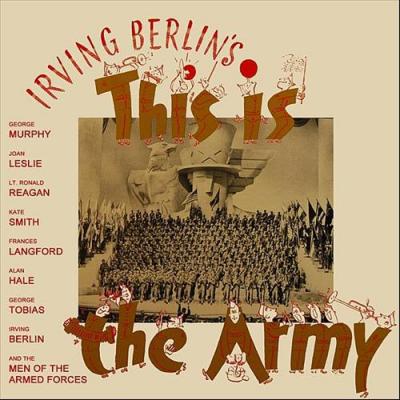
"This is the Army" Soundtrack Lyrics
Musical • 1942
Track Listing
“This Is the Army — Original 1942 All-Soldier Cast Recording (Broadway Revue)” – Album Guide to Tracks and Key Scenes

Review
What does a country at war sound like on opening night? Irving Berlin’s This Is the Army answers with a marching-band heart and Broadway legs — a revue that sells morale with melody. The original 1942 cast album (shellac sides gathered from the stage material) captures the show’s central paradox: serious purpose delivered with comic bravado.
On stage, a 300-soldier company sings, drills, and jokes through wartime life. On record, the highlights still tell the story: service-branch salutes, barracks blues, Harlem couture satire, and Berlin himself stepping forward with a timeless reveille complaint. The arc moves from enlistment jitters to united chorus — not naïve, just necessary.
Genres & themes in phases — military march & patriotic song: duty and discipline; Tin Pan Alley balladry: longing and home-front romance; jazz and Harlem swing: pride, style, and inclusion; comic patter: resilience through laughter.
How It Was Made
The U.S. Army produced the 1942 Broadway run to raise funds for Army Emergency Relief, with Irving Berlin providing music and lyrics and appearing in the show. Sgt. Ezra Stone directed; Milton Rosenstock led the pit. Choreography came from soldiers Nelson Barclift and Robert Sidney, designs from John Koenig, and additional staging from Joshua Logan. The production opened at the Broadway Theatre on July 4, 1942, and became a sensation; a national and then overseas tour followed. Period cast recordings were issued on 78-rpm discs, with later reissues gathering the material for modern release.

Tracks & Scenes
“This Is the Army, Mr. Jones” (Company; music & lyrics: Irving Berlin)
- Where it plays:
- Opening salvo of Act I. A chorus of recruits in khaki addresses a hapless civilian (“Mr. Jones”), turning audience laughter into marching rhythm. Rifles, roll call, and tight chorus lines create a revue-as-drill tableau. Diegetic stage number within the show’s “soldier show” frame.
- Why it matters:
- Sets the revue’s tone — friendly ribbing, strict time, big harmonies — and declares the evening’s mission: entertain while recruiting national spirit.
“That’s What the Well-Dressed Man in Harlem Will Wear” (James Cross, Billy Yates & Company)
- Where it plays:
- Mid-show fashion parade that swaps runway for revue line. Silk gloves, swagger, and call-and-response riffs sketch a Black New York style manifesto, backed by a swinging pit. Staged with integrated dance pairings and spotlight breaks.
- Why it matters:
- Style as strength. The number asserts cultural pride and — unusually for the Army then — reflects the company’s onstage integration.
“I Left My Heart at the Stage Door Canteen” (Soloist & Chorus)
- Where it plays:
- Act I romance vignette at the famed USO canteen. A soldier sings about a brief dance and a longer ache; slow foxtrot steps vignette across a dim set with projected canteen signage.
- Why it matters:
- Human scale amid spectacle — it carries the home-front heartbeat into the barracks.
“I’m Getting Tired So I Can Sleep” (Soloist)
- Where it plays:
- Late-night barracks tableau. Boots pile neatly; lights out; a single bunk light and muted reeds accompany a lullaby for the anxious.
- Why it matters:
- Berlin’s gift for plainspoken feeling — soldierly stoicism softened by melody.
“How About a Cheer for the Navy” → “With My Head in the Clouds (for the Air Corps)” (Company)
- Where it plays:
- Service-salute suite: nautical banter yields to aviation daydreams. Signal flags morph into flight-line semaphore; chorus formations redraw like maps.
- Why it matters:
- Branch pride without rivalry — the revue spreads applause across the services.
“American Eagles” (Company)
- Where it plays:
- Act II march-song with brass flourishes and tap overlays; projected eagles and star fields back a precision company drill.
- Why it matters:
- Patriotic uplift — a picture-postcard chorus that still lands as theatre craft.
“Oh! How I Hate to Get Up in the Morning” (Irving Berlin)
- Where it plays:
- Berlin steps to the apron in uniform, deadpan and irresistible. Drummer teases a sunrise cadence; the audience supplies knowing laughs at every “reveille” gag.
- Why it matters:
- The songwriter becomes star. A 1918 gripe song reborn as World War II release valve — and a signature moment of the evening.

Notes & Trivia
- Opened on Broadway (The Broadway Theatre) July 4, 1942; ran 113 performances before touring the U.S. and U.K.
- Proceeds supported Army Emergency Relief; the show raised millions (wartime dollars) through tours.
- The all-soldier company was uniquely integrated on stage for World War II Army units.
- Director Ezra Stone was just 24; future Broadway/film notable Joshua Logan provided additional staging.
- Several numbers trace back to Berlin’s WWI soldier show Yip! Yip! Yaphank, freshly re-contextualized for WWII.
Reception & Quotes
Opening night was a bona fide Broadway event: record grosses, banner headlines, and instant word-of-mouth. Reviews praised the spirit and scale, while acknowledging the revue format’s sketch-to-sketch unevenness. The album preserves the standout tunes — a sonic snapshot of that July surge.
“A world-record opening night gross and a citywide ticket scramble.” New York press reports, July 1942
“Morale with melody — Mr. Berlin’s soldier show marches smartly.” Contemporary notices
“The laughs land; the lump in the throat does, too.” Later retrospectives

Interesting Facts
- All-soldier pit: The orchestra and chorus were uniformed servicemen; musical director Milton Rosenstock kept tempos military-crisp.
- Harlem couture: “Well-Dressed Man in Harlem” doubled as fashion critique and celebration of Black style.
- Berlin on mic: The songwriter’s own comic delivery was a box-office lure — and a perfect closer for Act II.
- Army to Hollywood: The hit 1943 film version preserved and expanded key numbers for the screen.
- From 78s to streams: Original 1942 cast sides were later compiled for LP/CD and digital reissues.
Technical Info
- Type: Broadway musical revue (all-soldier cast) — original cast recording drawn from stage material
- Title: This Is the Army — Original 1942 All-Soldier Cast Recording
- Year: 1942 (Broadway); historic recordings issued on 78-rpm, later reissued
- Composer/Lyricist: Irving Berlin
- Director (stage): Sgt. Ezra Stone; Additional staging: Joshua Logan
- Choreography: Cpl. Nelson Barclift; Sgt. Robert Sidney
- Music Director: Milton Rosenstock
- Design: John Koenig (sets & costumes)
- Label (original cast discs): Decca (1942 shellac sides; later reissues on various labels)
- Availability: Archival reissues on CD/streaming (various editions); original 78-rpm sets exist in collector markets
- Benefit: Proceeds for Army Emergency Relief; touring unit continued fundraising through 1945
Questions & Answers
- Was the 1942 Broadway company really all soldiers?
- Yes. The cast, chorus, and pit were servicemen assembled by the U.S. Army for a morale-boosting, fundraising revue.
- Did Irving Berlin perform in the show?
- He did — stepping out to sing “Oh! How I Hate to Get Up in the Morning,” a signature turn late in the evening.
- Is there an official cast album?
- Period 78-rpm sides were issued (not a single LP at the time). Later reissues compile the original performances for modern formats.
- How does the 1943 film relate to the stage score?
- It adapts and expands stage numbers for the screen — preserving the revue’s tone while adding cinematic shorts and military pageantry.
- Was the unit integrated?
- On stage, yes — unusually for the era, the company presented integrated performances during World War II.
Key Contributors
| Subject | Relation | Object |
|---|---|---|
| Irving Berlin | wrote music & lyrics for | This Is the Army (1942 revue) |
| Irving Berlin | performed | “Oh! How I Hate to Get Up in the Morning” |
| Sgt. Ezra Stone | directed | This Is the Army (Broadway, 1942) |
| Joshua Logan | provided additional staging for | This Is the Army |
| Milton Rosenstock | music directed | Broadway production (1942) |
| Cpl. Nelson Barclift; Sgt. Robert Sidney | choreographed | stage numbers |
| U.S. Army (Special Services) | produced | all-soldier revue; proceeds to Army Emergency Relief |
| John Koenig | designed | sets and costumes |
| James Cross & Billy Yates | featured in | “That’s What the Well-Dressed Man in Harlem Will Wear” |
| Decca Records | issued | original 1942 cast 78-rpm sides |
Sources: IBDB; National Archives (NARA); Playbill; Apple Music; Discogs; CastAlbums; Warfare History Network feature; Wikipedia (context & production); Warner Bros. trailer (for figures).
November, 29th 2025
A-Z Lyrics Universe
Cynthia Erivo Popular
Ariana Grande Horsepower
Post Malone Ain't No Love in Oklahoma
Luke Combs Good Riddance (Time of Your Life)
Green Day Bye Bye Bye
*NSYNC You're the One That I Wan
John Travolta & Olivia Newton-John I Always Wanted a Brother
Braelyn Rankins, Theo Somolu, Kelvin Harrison Jr. and Aaron Pierre The Power of Love
Frankie Goes to Hollywood Beyond
Auli’i Cravalho feat. Rachel House MORE ›