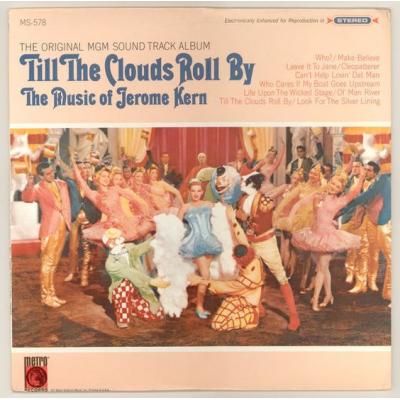
"Till the Clouds Roll By" Soundtrack Lyrics
Musical • 2000
Track Listing
"Till the Clouds Roll By (Original Motion Picture Soundtrack)" – Album Guide to Tracks and Key Scenes
Review
What happens when a Hollywood biopic tosses out strict truth to worship the music? You get an MGM pageant where Jerome Kern’s songs do the talking — and the soundtrack becomes the real story.
“Till the Clouds Roll By” is framed as Kern’s life story, but its soundtrack is the beating heart: an all-star procession (Judy Garland, Lena Horne, Frank Sinatra, Kathryn Grayson, Tony Martin, Dinah Shore, Angela Lansbury and more) delivering studio-gloss renditions of Kern standards. Narrative takes a polite backseat while the music sketches an arc from riverboat Americana to sophisticated Broadway romance. Snippets of backstage melodrama tie numbers together, yet the album plays like a deluxe revue of Kern’s catalogue — a mixtape curated by MGM’s golden-age machine.
The mood moves in phases: early-show optimism (choral prologue and riverboat tableaux) gives way to café-lit torch songs and polished ballroom grace. Stylistically, operetta sheen signals dreamy aspiration; blues-tinged spirituals ground the Mississippi mythos; dance-band swing telegraphs forward momentum; ballad elegance caps it with star aura. The soundtrack’s distinctiveness lies in those crystalline, close-miked MGM arrangements — big orchestra, immaculate choirs, and a camera’s ear for star phrasing.
How It Was Made
Produced by Arthur Freed’s MGM musical unit and directed on paper by Richard Whorf (with sequences staged by Vincente Minnelli, Busby Berkeley, George Sidney and others), the film montages Kern’s hits into grand set pieces. Lennie Hayton supervised and conducted; the studio chorus and orchestra provide the signature Metro gloss. Kern was involved early on, but died during production; the film ultimately serves as a memorial showcase anchored by Show Boat material. The soundtrack album — issued by MGM Records — was among Hollywood’s first commercially packaged “original soundtrack albums,” pressed as a four-disc 78-rpm set shortly after the film’s release.
Tracks & Scenes
Below are key musical moments (including several not always collected on earlier LP highlights). Timestamps are approximate scene windows; performances are staged, i.e., non-diegetic unless noted.
“Cotton Blossom / Show Boat Prologue” (Company)
- Where it plays:
- Opening riverfront montage (≈ 0:00–12:00). Chorus rows and dockhands move in tableau as the camera cranes across a painted Mississippi. The number layers choral calls with processional movement to set the Show Boat frame.
- Why it matters:
- Introduces Kern’s Americana mythos and establishes the revue-within-biopic structure — music as memory.
“Make Believe” (Kathryn Grayson & Tony Martin)
- Where it plays:
- Early Show Boat segment (≈ 10–15 min). Romantic two-shot on a river landing, then a graceful pan to chorus reaction; classic studio backlot idyll.
- Why it matters:
- Shows Kern’s knack for duet architecture — melody as courtship ritual.
“Life Upon the Wicked Stage” (Virginia O’Brien & Chorus Girls)
- Where it plays:
- Backstage burlesque within the Show Boat montage (≈ mid-teens). O’Brien deadpans through a kickline as wings and ropes frame the satire.
- Why it matters:
- Meta-showbiz wink that balances the film’s earnestness with MGM’s sly humor.
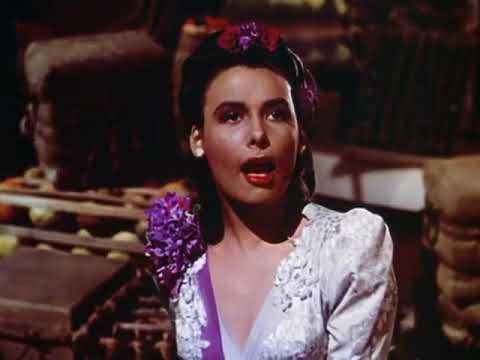
“Can’t Help Lovin’ Dat Man” (Lena Horne)
- Where it plays:
- Cabin-front vignette (≈ 15–20 min). Horne sings in a contained set, camera locked close to let the vocal carry; light stream filters through shutters.
- Why it matters:
- Silken phrasing + restrained arrangement = definitive MGM torch reading of a Kern/Hammerstein staple.
“Ol’ Man River” (Caleb Peterson & Chorus)
- Where it plays:
- Riverbank tableau (≈ 20–24 min). Low-angle framing and rolling choral responses create call-and-answer gravitas.
- Why it matters:
- Anchors the Show Boat block with spiritual weight before the film leaves the river.
“How’d You Like to Spoon with Me” (Angela Lansbury)
- Where it plays:
- London music-hall interlude (≈ 30–35 min). Lansbury, in feathers and gaslight, teases a waltz-time patter with chorus refrains; diegetic stage performance.
- Why it matters:
- Quick, witty reminder of Kern’s pre-Broadway period and of MGM’s comic timing.
“They Didn’t Believe Me” (Dinah Shore)
- Where it plays:
- Radio-style studio setting (≈ 40s). Shore stands at a microphone; soft strings, intimate camera.
- Why it matters:
- Sells the ballad as a crooner classic, bridging stage origins and mid-century pop.
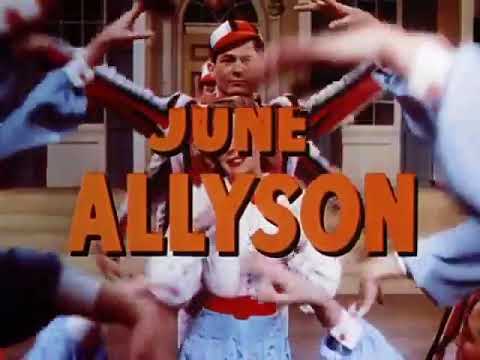
“Till the Clouds Roll By / Leave It to Jane Medley” (June Allyson & Ray McDonald, Company)
- Where it plays:
- Campus-set frolic (≈ late 40s). Pep-rally choreography and collegiate pennants; diegetic show-within-show staging.
- Why it matters:
- Title hook and pep motif; a micro-musical inside the memorial revue.
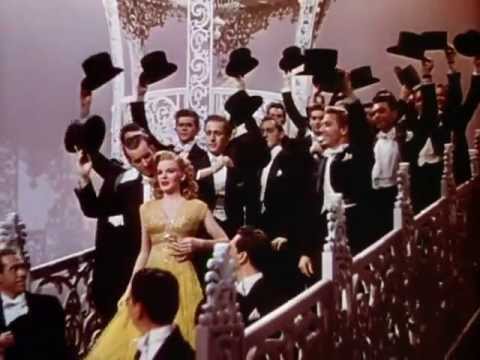
“Look for the Silver Lining” (Judy Garland)
- Where it plays:
- Marilyn Miller tribute set (≈ 60–65 min). Garland in gleaming satin on a stylized proscenium; camera circles at the key modulation.
- Why it matters:
- Signature Garland optimism; emotional apex of the mid-film arc.
“Who?” (Judy Garland)
- Where it plays:
- The Sunny sequence (≈ late 60s). Broadway-bright palette, precision chorus lines; diegetic show number.
- Why it matters:
- Garland’s rhythmic snap spotlights Kern’s melodic buoyancy.
“All the Things You Are” (Tony Martin)
- Where it plays:
- Concert-style spotlight (≈ 80s). Soloist at center, strings in lush blanket, restrained camera dolly.
- Why it matters:
- MGM polish meets one of Kern’s most sophisticated harmonic arcs.
“A Fine Romance” (Virginia O’Brien)
- Where it plays:
- Playful studio-set skit (≈ 80s). O’Brien’s trademark deadpan lands every internal rhyme.
- Why it matters:
- Shows Kern’s comic bite and wordplay chemistry with lyricists.
“The Last Time I Saw Paris” (Dinah Shore)
- Where it plays:
- Melancholy montage (≈ 90s). Spotlight, soft gauze filter, gentle strings — wartime nostalgia distilled.
- Why it matters:
- One-take sincerity; a pop smash in its own right in the film’s wake.
“Ol’ Man River (Reprise / Finale)” (Frank Sinatra)
- Where it plays:
- Finale on a bare stage (≈ 120–end). Sinatra in white, orchestra arrayed behind; the film strips everything to voice + melody.
- Why it matters:
- Star aura + anthem; a curtain call for Kern and MGM’s orchestra.
About the trailer & non-album items
The theatrical trailer largely spotlights Garland, Horne and Sinatra moments and re-cuts the Show Boat block; some trailer snippets are abridged or edited differently than album cuts.
Notes & Trivia
- The film opens with an extended Show Boat suite, then hopscotches Kern’s career via staged “greatest hits.”
- Multiple directors handled individual numbers; Garland’s sequences were staged by Vincente Minnelli.
- Because of public-domain status for the picture, later home-video prints vary; audio mastering on reissues can differ from the 1947 album pressings.
- The official soundtrack’s early release was a landmark for MGM Records and for the concept of an “original soundtrack album.”
Reception & Quotes
Contemporary critics split: some bristled at the sugar-coated biographical thread, many praised the wall-to-wall numbers and the all-star casting. Retrospectives treasure it as a Technicolor time capsule and a Kern showcase.
“Why quibble about the story? … it’s a lavish showcase for Kern’s music and Metro’s stars.” Variety
“A dazzling revue — the studio orchestra and chorus at full burn, capped by Sinatra’s ‘Ol’ Man River.’” TCM overview
“Phoney yarn? Maybe. But the songs are lovely.” NYT summary of Bosley Crowther’s review
Availability: Original MGM 78-rpm album (1947); later LP/cassette reissues and multiple digital compilations (region availability varies); numerous PD video editions of the film; a fully restored DVD arrived mid-2000s. Digital highlights are available on major platforms.
Interesting Facts
- Prototype OST: MGM marketed the film’s music as one of the first true “original soundtrack albums.”
- Star relay: At least four major directors handled segments — a relay race of MGM styles.
- PD circulation: Lapsed copyright drove a flood of budget video releases, complicating audio consistency across prints.
- Garland-as-Marilyn: Garland plays Broadway icon Marilyn Miller for two of the film’s most-shared numbers.
- Two “Ol’ Man Rivers”: Caleb Peterson leads the Show Boat block; Sinatra delivers the reprise/finale on a bare stage.
Technical Info
- Title: Till the Clouds Roll By (Original Motion Picture Soundtrack)
- Year: 2000 context — widely circulated home-video/compilation era; original film 1946; first album issue 1947.
- Type: Musical film soundtrack (various artists; Jerome Kern compositions)
- Composers/Lyricists: Jerome Kern (music); lyrics across numbers by Oscar Hammerstein II, P. G. Wodehouse, Dorothy Fields, Ira Gershwin and others (per song)
- Music direction/orchestration: Lennie Hayton & MGM Studio Orchestra/Chorus
- Music supervision (studio role): MGM musical unit under Arthur Freed
- Selected notable placements: “Look for the Silver Lining” (Garland); “Can’t Help Lovin’ Dat Man” (Horne); “All the Things You Are” (Martin); “Ol’ Man River” (Peterson; finale reprise by Sinatra)
- Release context: Film premiered late 1946; soundtrack album issued 1947 on MGM Records (4×78-rpm set); subsequent LP/digital anthologies exist
- Label/album status: MGM Records (original 78s); later reissues by various rights holders/compilers; multiple digital storefronts host highlight sets
- Availability notes: Film widely available due to PD status; restored DVD release mid-2000s; soundtrack highlights on Apple Music/Spotify
Questions & Answers
- Is this truly an “original soundtrack album” and not re-recorded covers?
- Yes — it collects on-film performances captured by MGM, originally issued on 78-rpm discs in 1947.
- Why do some releases have different track counts or audio quality?
- Public-domain video circulation and later highlights compilations mean edits and mastering vary across labels/regions.
- Who sings “Ol’ Man River” in the movie — and on the album?
- In the early Show Boat block, Caleb Peterson leads; Sinatra performs the finale reprise. Album selections mirror that split.
- Are all featured numbers actually Jerome Kern compositions?
- Yes — the film is a Kern showcase; lyricists vary (Hammerstein, Wodehouse, Fields, Gershwin, et al.).
- Where should a new listener start?
- Spin “Look for the Silver Lining,” “Can’t Help Lovin’ Dat Man,” “All the Things You Are,” and the finale “Ol’ Man River.”
Key Contributors
| Entity | Relation (S–V–O) |
|---|---|
| Jerome Kern | Composer — wrote the music performed throughout the soundtrack. |
| Arthur Freed (MGM) | Producer — oversaw the film’s musical unit and album pipeline. |
| Lennie Hayton | Music director — conducted the MGM Studio Orchestra and chorus. |
| Richard Whorf | Director — credited film director. |
| Vincente Minnelli | Director — staged Judy Garland’s sequences. |
| Busby Berkeley | Director — staged select large-scale numbers. |
| George Sidney | Director — staged finale elements. |
| Judy Garland | Performer — sings “Look for the Silver Lining,” “Who?” |
| Lena Horne | Performer — sings “Can’t Help Lovin’ Dat Man” and “Why Was I Born?” |
| Frank Sinatra | Performer — finale rendition of “Ol’ Man River.” |
| Kathryn Grayson & Tony Martin | Performers — “Make Believe,” “All the Things You Are.” |
| Dinah Shore | Performer — “They Didn’t Believe Me,” “The Last Time I Saw Paris.” |
| Metro-Goldwyn-Mayer | Studio — produced the film and its recordings. |
| MGM Records | Label — issued the 1947 78-rpm soundtrack album. |
Sources: IMDb (film & soundtrack pages); Wikipedia (film & soundtrack entries); TCM (overview & trailer); Variety (contemporary review); Soundtrack.net (album highlights); SoundtrackCollector (track details/issue data); The Judy Room (discography/history); Apple Music & Spotify (digital highlights).
November, 29th 2025
A-Z Lyrics Universe
Cynthia Erivo Popular
Ariana Grande Horsepower
Post Malone Ain't No Love in Oklahoma
Luke Combs Good Riddance (Time of Your Life)
Green Day Bye Bye Bye
*NSYNC You're the One That I Wan
John Travolta & Olivia Newton-John I Always Wanted a Brother
Braelyn Rankins, Theo Somolu, Kelvin Harrison Jr. and Aaron Pierre The Power of Love
Frankie Goes to Hollywood Beyond
Auli’i Cravalho feat. Rachel House MORE ›