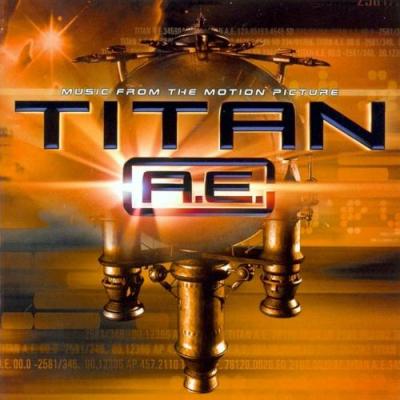
"Titan A.E." Soundtrack Lyrics
Movie • 2000
Track Listing
Lit
Powerman 5000
Electrasy
Fun Lovin' Criminals
The Urge
Texas
Bliss
Jamiroquai
Splashdown
Wailing Souls
Luscious Jackson
Vertical Horizon
Lunatic Calm
Creed
"Titan A.E. (Music From the Motion Picture)" – Album Guide to Tracks and Key Scenes
Review
Can a space opera wear radio-rock sneakers and still feel mythic? Titan A.E. tries — and often succeeds — by gluing slick, turn-of-the-millennium alt/AAA cuts to Graeme Revell’s widescreen orchestral/choral score. The songs sell motion and youth; the score sells scale and extinction.
The plot is pulp-elegiac: Earth is annihilated, and a scavenger kid holds a map to humanity’s do-over. On album, Lit, Powerman 5000, Electrasy, Jamiroquai and company provide the propulsion: guitar-forward choruses, breakbeats, and neon sheen. On screen, Revell’s cues handle the existential weight — the Drej attack’s choral sting, the ice-field chase’s glassy suspense, the Titan awakening’s awe. The blend is unmistakably 2000 — which is part of the charm.
In phases: alt-rock adrenalines — flight, salvage, swagger; trip-hop/funk-pop — world-building texture; score chorales & low brass — loss, scale, rebirth. The collage feels like a mixtape stuffed into a starship console — imperfect, energetic, memorable.
How It Was Made
20th Century Fox/Capitol released a 11-track songs album timed to the film’s June 2000 bow, while composer Graeme Revell’s full underscore arrived years later as a 32-track limited edition CD (La-La Land Records; 1,500 copies). Marketing leaned hard on a rock-first identity — even cutting trailers to Creed’s “Higher” — but the movie’s finished mix balances source songs with an original score recorded in Los Angeles with large orchestra and choir.
Tracks & Scenes
Where the big cues land. Scene beats are described for clarity (home releases/edits vary).
“Cosmic Castaway” (Electrasy)
- Where it plays:
- Early montage as older Cale lives the drifter/salvager grind at Tau 14 — arc welders, scrap hauls, and a chip on the shoulder before he’s recruited.
- Why it matters:
- Lyrics (“cosmic castaway”) literalize the refugee premise and plant the film’s loner-to-leader arc.
“Over My Head” (Lit)
- Where it plays:
- Prominently used in tie-in music video and on the official album; the DVD includes the video as a bonus. In some TV spots/featurettes it underscores Cale/Akima flight clips.
- Why it matters:
- Era-defining single that helped market the film’s youthful tone, even when not foregrounded in narrative scenes.
“The End Is Over” (Powerman 5000)
- Where it plays:
- Action connective tissue around Valkyrie skirmishes and station escapes — quick cuts, shouted orders, engine roar.
- Why it matters:
- Industrial swagger that sells the film’s scrappy hardware.
“It’s My Turn to Fly” (The Urge)
- Where it plays:
- First real piloting rush for Cale — a hard-tilt dogleg through debris and tight canyons as he proves he’s more than a welder.
- Why it matters:
- On-the-nose title, earned vibe: the song doubles as a character beat.
“Everybody’s Going to the Moon” (Jamiroquai)
- Where it plays:
- Light-spirited interlude between heavier beats — docking, market crowds, the sense of a bigger, stranger economy.
- Why it matters:
- Funk-pop shimmer that refreshes the ear — a left-field color on a rock-heavy set.
“Karma Slave” (Splashdown)
- Where it plays:
- Tech-and-trade montage in the drifter quarter; sly, rhythmic undercurrent while plans are drawn and loyalties are weighed.
- Why it matters:
- Trip-hop edges mirror the film’s “don’t trust anyone” middle act.
“Renegade Survivor” (Wailing Souls)
- Where it plays:
- Refugee enclave ambience and bar-life crossfades; voices and radio bleed as deals are made.
- Why it matters:
- Reggae pulse reframes the human diaspora as culture that adapts rather than breaks.
“Down to Earth” (Luscious Jackson)
- Where it plays:
- Low-key transit/market glide with Akima and Cale; a breathing space before the next scramble.
- Why it matters:
- Cool-down that gives the romance thread a groove.
“Not Quite Paradise” (Bliss 66)
- Where it plays:
- Main end-credits song after the Titan sequence resolves and a new world dawns.
- Why it matters:
- Earns the movie’s thesis: hope, but with dings and burn marks.
Score highlights (Graeme Revell)
- “Prologue / Drej Attack”
- Choral-metallic blast as Earth is destroyed; the franchise’s most searing sound-image.
- “Hydrogen Forest Chase”
- Glass-and-echo textures for the ice-field gauntlet; percussion snaps like cracking crystal.
- “Earth Is Never Lost / Mother Drej” → “Creation”
- From confrontation to rebirth — brooding low brass giving way to luminous choir as Titan does its impossible work.
Notes & Trivia
- The commercial songs album (Capitol/EMI) dropped June 6, 2000 — ten days before the U.S. theatrical release.
- Creed’s “Higher” powered theatrical trailers but is not in the film or on the album.
- Revell’s score wasn’t issued until 2014, when La-La Land Records released a 32-track limited CD (1,500 units) with liner notes by Jeff Bond.
- The DVD includes a music video for Lit’s “Over My Head.”
- Jamiroquai’s “Everybody’s Going to the Moon” was recorded for the soundtrack and later pressed in limited physical formats.
Reception & Quotes
Reviewers split on the pop veneer but praised the muscular score and a few bravura set-pieces. Fans still cite the album as a time-capsule of turn-of-the-millennium alt-rock.
“Rock-first marketing, orchestral heart — an oddly effective mix.” album capsules
“Revell’s ‘Creation’ cue earns the goosebumps.” film-music coverage
“The soundtrack is so hella ’90s it was dated before home video — which is exactly why I love it.” fan discussion
Interesting Facts
- Firsts: The film was part of early end-to-end digital cinema demonstrations in June 2000.
- Two-album reality: 2000 songs compilation now; the complete Revell score only arrived in 2014.
- Mixtape DNA: Contributors range from Powerman 5000 to Jamiroquai — a deliberate, eclectic brief.
- Music video tie-in: Lit’s “Over My Head” video integrates film imagery and was included on the DVD.
- Trailer swap: Creed’s “Higher” sold the vibe but never appears in the movie.
Technical Info
- Title: Titan A.E. — Music From the Motion Picture
- Year: 2000 (songs album); 2014 (complete score release)
- Type: Film soundtrack (various artists) + original score
- Composer: Graeme Revell
- Label(s): Capitol/EMI (songs album); La-La Land Records (score; LLLCD 1320)
- Selected notable placements: “Cosmic Castaway” (Electrasy) — early Cale/Tau-14 life; “It’s My Turn to Fly” (The Urge) — first big piloting rush; “Not Quite Paradise” (Bliss 66) — end credits; Jamiroquai’s “Everybody’s Going to the Moon” — mid-film interlude.
- Release context: Songs album streeted June 6, 2000; score CD issued Oct. 2014 (limited to 1,500).
- Availability: Songs widely stream; the La-La Land score is out-of-print but track info/pages remain online.
Questions & Answers
- Who composed the score?
- Graeme Revell. His orchestral/choral writing anchors the Drej attack, the ice-field chase, and the Titan “creation” sequence.
- What song plays over the end credits?
- “Not Quite Paradise” by Bliss 66.
- Was the score ever officially released?
- Yes — La-La Land Records issued a 32-track limited edition CD in 2014 (1,500 copies).
- Why do people mention Creed when talking about the soundtrack?
- Because “Higher” headlined theatrical trailers; it’s not in the film or on the album.
- Where should I start on the album?
- Try “Cosmic Castaway,” “The End Is Over,” and “It’s My Turn to Fly,” then pair with Revell’s “Prologue/Drej Attack” and “Creation” from the score.
Key Contributors
| Entity | Relation (S–V–O) |
|---|---|
| Graeme Revell | Composer — wrote and produced the original score. |
| Don Bluth; Gary Goldman | Directors — shaped placement and tone for songs and score. |
| Capitol / EMI | Label — released the 2000 songs compilation. |
| La-La Land Records | Label — issued the 2014 limited score CD (1,500 units). |
| Electrasy | Artist — performed “Cosmic Castaway.” |
| Lit | Artist — performed “Over My Head” (featured in DVD music video and on album). |
| Powerman 5000 | Artist — performed “The End Is Over.” |
| The Urge | Artist — performed “It’s My Turn to Fly.” |
| Bliss 66 | Artist — performed end-credits track “Not Quite Paradise.” |
| Jamiroquai | Artist — contributed “Everybody’s Going to the Moon.” |
Sources: Wikipedia (film page: music/score & DVD note); AllMusic (album date/duration); IMDb Soundtracks (song credits); Discogs (album & score release data); La-La Land Records (score details); Film Music Reporter (2014 score announcement); Titan A.E. Wiki (track roster); Spotify/YouTube playlists for reference; DVD/press coverage noting trailer use of “Higher.”
November, 29th 2025
A-Z Lyrics Universe
Cynthia Erivo Popular
Ariana Grande Horsepower
Post Malone Ain't No Love in Oklahoma
Luke Combs Good Riddance (Time of Your Life)
Green Day Bye Bye Bye
*NSYNC You're the One That I Wan
John Travolta & Olivia Newton-John I Always Wanted a Brother
Braelyn Rankins, Theo Somolu, Kelvin Harrison Jr. and Aaron Pierre The Power of Love
Frankie Goes to Hollywood Beyond
Auli’i Cravalho feat. Rachel House MORE ›