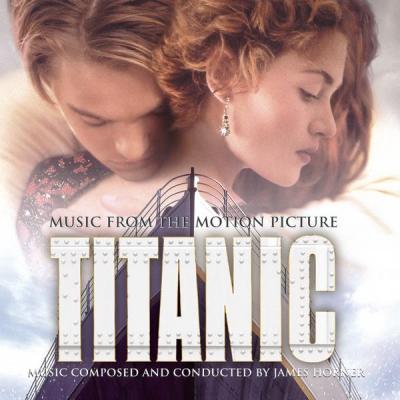
"Titanic" Soundtrack Lyrics
Movie • 1997
Track Listing
Celine Dion
"Titanic (Music from the Motion Picture)" – Album Guide to Tracks and Key Scenes
Review
How do you write music that’s intimate enough for two people on a railing — and big enough for the North Atlantic? James Horner splits the atom: a hushed, wordless vocal over uilleann pipes and synth choir for memory and loss; a clean, ascending love theme that dares to be simple; and, yes, one of the most famous end-credit songs ever recorded.
The album is two machines meshing — orchestral elegy and radio pop. On screen, “Southampton,” “Take Her to Sea, Mr. Murdoch,” “A Building Panic,” “Unable to Stay, Unwilling to Leave,” “The Sinking,” “Hymn to the Sea” carry the film’s weight: departure splendor, procedural tension, triage dread, and the long goodbye. Around the edges, period diegetics (salon waltzes, ragtime, jigs) anchor the ship’s social world. In credits, “My Heart Will Go On” reframes the film as a recollected life — a pop epilogue that still hits.
In phases: pipes + synth-choir — history as haunt; string chorales — human scale against steel; dancehall/ragtime/jigs — class textures; end-credit ballad — memory that survives the cold.
How It Was Made
James Cameron first temped the cut with Enya; after she declined, he returned to Horner, who wrote a score that keeps church out and ocean in — replacing traditional choir with a blended, electronic choral pad to avoid liturgical color. Norwegian vocalist Sissel Kyrkjebø supplies the breathy, wordless voice; Eric Rigler’s uilleann pipes and whistle carve the Celtic timbre that became the film’s signature. Sony Classical released the soundtrack on November 18, 1997; a second album, Back to Titanic (1998), expanded source music and key set-pieces, later folded into 2012/2017 anniversary sets.
Tracks & Scenes
Diegetic songs + score placements. Timestamps vary by edition; beats are described precisely.
“Southampton” (James Horner)
- Where it plays:
- Embarkation and sail-away. Brass and snare salute the ship; synth choir glows under deck-by-deck reveals as Titanic clears the harbor.
- Why it matters:
- Announces the film’s two hearts: pride in engineering; foreknowledge of loss.
“An Irish Party in Third Class (John Ryan’s Polka / The Blarney Pilgrim)” (Gaelic Storm)
- Where it plays:
- Steerage dance. Fiddles blaze while Jack spins Rose; arm-wrestles thud; pipes cut through stomps and laughter. Camera drops to sweat and floorboards — the ship feels alive.
- Why it matters:
- Class collision rendered as joy; Rose chooses heat over etiquette.
“Alexander’s Ragtime Band” (I Salonisti)
- Where it plays:
- First-class reception music; later, fragments recur as the band tries to steady nerves. Polite sparkle over tightening dread.
- Why it matters:
- Surface gaiety — a mask the night will peel away.
“The Portrait” (James Horner)
- Where it plays:
- Piano setting for the drawing scene in Cal’s suite. Solo statement of the love theme as graphite sketches skin and light.
- Why it matters:
- Not just romance — an assertion of seeing and being seen.
“A Building Panic” → “Unable to Stay, Unwilling to Leave” (score)
- Where it plays:
- After impact: bulkhead doors slam; crew triage; boats load. Strings drive, then thin to aching sustain as Jack and Rose part at a boat — and refuse it.
- Why it matters:
- Procedural rhythm becomes heartbreak — music as pulse and pause.
“Nearer, My God, to Thee” (I Salonisti — arrangement)
- Where it plays:
- Band’s final hymn on the Grand Staircase landing, using the “Bethany” tune. Lamps dim; water rises; players nod, keep bowing.
- Why it matters:
- Legend and cinema agree here: grace under doom, framed by a Victorian hymn.
“The Sinking” → “Death of Titanic” (score)
- Where it plays:
- Breakup and plunge: angles steepen, lights fail, screams bleed into score. Wordless soprano traces the horizon as steel tears.
- Why it matters:
- Horner finds the line between awe and horror without sensationalism.
“Come Josephine, In My Flying Machine” (1910 song; fragments sung on screen)
- Where it plays:
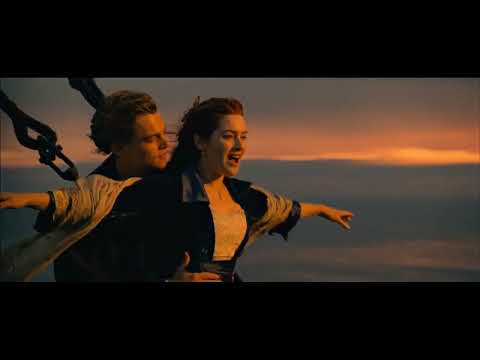
- Jack hums it at the bow during the “I’m flying” embrace; Rose later sings a fragile echo while adrift on the door, waiting for rescue. A deleted scene shows them singing it after the steerage party — context the final cut implies.
- Why it matters:
- A private refrain turns motif: flight imagined, then remembered, then survived.
“Hymn to the Sea” (score) → “My Heart Will Go On” (Céline Dion)
- Where it plays:
- Epilogue and credits. Pipes and voice carry the names; the pop single enters over black — memory set to meter.
- Why it matters:
- Grief gives way to recollection; the melody you heard all film finally speaks.
Notes & Trivia
- The commercial soundtrack (Sony Classical) arrived Nov 18, 1997; Back to Titanic (1998) added I Salonisti and Gaelic Storm highlights plus new suites.
- Gaelic Storm’s jig set (“John Ryan’s Polka,” “The Blarney Pilgrim,” etc.) was compiled on album as “An Irish Party in Third Class.”
- “Nearer, My God, to Thee” in the film uses the Bethany tune; historians debate which tune the real band played.
- Horner’s choral color is largely synthesized — a deliberate choice to avoid a church sound.
- Wordless soprano throughout the score is Sissel Kyrkjebø; the pipes you hear so often are Eric Rigler’s.
Reception & Quotes
Titanic became the highest-selling primarily orchestral soundtrack ever. Horner won two Oscars (score; song with Will Jennings); the single dominated charts and the Grammys. Critics still cite the restraint of the score against the film’s scale.
“A human elegy inside an industrial tragedy.” film-music commentary
“The pop song shouldn’t work — but as epilogue, it does.” album notes & retrospectives
“Pipes, synth choir, and memory — the sound of 1997, somehow timeless.” press roundups
Interesting Facts
- Temp to triumph: Cameron temped with Enya; Horner wrote with that timbre in mind, then made it his own.
- Private refrain: “Come Josephine” is never a full needle-drop — just a character memory you can hum.
- Band as character: I Salonisti recorded new period arrangements and acted the ship’s musicians on screen.
- Two-album arc: 1997 core score; 1998’s sequel album adds source cues and longer suites; later anniversary boxes fold everything together.
- Chart behemoth: the soundtrack sold north of 27M copies worldwide.
Technical Info
- Title: Titanic — Music from the Motion Picture (+ follow-up: Back to Titanic)
- Year: 1997 (primary album); 1998 (companion); 2012/2017 (anniversary sets)
- Type: Film score + period source music; end-credit song
- Composer: James Horner; lyrics for “My Heart Will Go On” by Will Jennings
- Key soloists: Sissel Kyrkjebø (vocalise), Eric Rigler (uilleann pipes/whistles)
- Music supervisor: Randy Gerston
- Label: Sony Classical / Sony Music Soundtrax
- Selected notable placements: “An Irish Party in Third Class” (steerage dance); “Alexander’s Ragtime Band” (salon); “The Portrait” (drawing scene); “Nearer, My God, to Thee” (band’s last hymn); “My Heart Will Go On” (end credits)
- Awards: Academy Awards — Best Original Dramatic Score; Best Original Song; multiple Grammys & Golden Globes for the song
- Availability: Widely streaming; expanded editions available; physical editions plentiful
Questions & Answers
- Who sings on the score (not the pop song)?
- Norwegian vocalist Sissel Kyrkjebø — the breathy, wordless voice woven through the cues.
- What’s the jig in the steerage party?
- A medley led by “John Ryan’s Polka” and “The Blarney Pilgrim,” performed on screen by Gaelic Storm.
- Which hymn does the band play as the ship goes down?
- In the film: “Nearer, My God, to Thee” to the tune “Bethany.” (Historically debated.)
- What song closes the film?
- Céline Dion’s “My Heart Will Go On” plays over the main credits.
- Is “Come Josephine, In My Flying Machine” actually in the movie?
- Yes — characters sing fragments on screen; a fuller version appears on the companion album.
Key Contributors
| Entity | Relation (S–V–O) |
|---|---|
| James Horner | Composer — wrote, orchestrated, and conducted the score; co-produced the soundtrack. |
| James Cameron | Director — approved the late addition of the end-credit song. |
| Sissel Kyrkjebø | Vocalist — performed wordless soprano lines across key cues. |
| Eric Rigler | Instrumentalist — uilleann pipes/whistles that define the score’s timbre. |
| Gaelic Storm | Band — performed the third-class dance set on screen. |
| I Salonisti | Ensemble — portrayed the ship’s band; recorded salon pieces and the hymn. |
| Randy Gerston | Music Supervisor — oversaw source music/licensing and placements. |
| Céline Dion & Will Jennings | Performer/Lyricist — delivered the end-credit song “My Heart Will Go On.” |
| Sony Classical / Sony Music Soundtrax | Label — released the soundtrack and reissues. |
Sources: Sony Classical/Apple Music album pages; Discogs credits; Wikipedia (album & film pages); MusicBrainz credits; Filmtracks & Movie Music UK retrospectives; Spotify/official streams for I Salonisti & Gaelic Storm; JamesHorner-Filmmusic (anniversary set notes); The Session discussion on jig set; articles on “Come Josephine” usage; Oscars.gov awards database; official trailers on YouTube.
November, 29th 2025
A-Z Lyrics Universe
Cynthia Erivo Popular
Ariana Grande Horsepower
Post Malone Ain't No Love in Oklahoma
Luke Combs Good Riddance (Time of Your Life)
Green Day Bye Bye Bye
*NSYNC You're the One That I Wan
John Travolta & Olivia Newton-John I Always Wanted a Brother
Braelyn Rankins, Theo Somolu, Kelvin Harrison Jr. and Aaron Pierre The Power of Love
Frankie Goes to Hollywood Beyond
Auli’i Cravalho feat. Rachel House MORE ›