
"Trainspotting" Soundtrack Lyrics
Movie • 1996
Track Listing
Iggy Pop
Brian Eno
Primal Scream
Sleeper
New Order
Iggy Pop & David Bowie
Blur
Lou Reed
Pulp
Bedrock f/ KYO
Elastica
Leftfield
Underworld
Damon Albarn
"Trainspotting — Music From the Motion Picture (1996)" – Album Guide to Tracks and Key Scenes
Review
What happens when a film makes pop music feel like destiny? Trainspotting fuses Britpop, proto-punk, and club euphoria into a pulse that carries the story as much as any character. The album isn’t a souvenir; it’s the film’s bloodstream — opening on Iggy Pop’s sprinting snare, closing on Underworld’s neon heartbeat, with Lou Reed’s bittersweet ballad bending the middle into tragedy.
Danny Boyle’s needle-drops behave like edits: a timelapse of 90s scenes — charity shops, clubs, squat flats, hospital corridors — all cut to songs that do plot work. The sequencing on the 1996 album (and the 1997 second volume) mirrors that arc: swagger, seduction, oblivion, resolve. Heard front-to-back, you get a tour of UK youth culture on the brink of morning.
Genres & themes, in phases: punk/glam punch — appetite and bravado; ambient pop — fantasy and denial; synth-techno — night momentum, bad decisions at 140 BPM; Britpop melancholy — consequence; classic singer-songwriter — the bill comes due.
How It Was Made
Director Danny Boyle is famously hands-on with music — he has said he doesn’t typically use a traditional music supervisor and selects tracks himself. That taste anchors a soundtrack that bridged scenes and subcultures: Iggy Pop and Lou Reed sit beside New Order and Pulp; Underworld and Leftfield shoulder the film’s rave energy. The commercial album arrived via EMI/Capitol in 1996; overwhelming demand led to Trainspotting #2 (1997), mopping up additional film cues and era-adjacent inspirations.

Tracks & Scenes
“Lust for Life” (Iggy Pop)
- Where it plays:
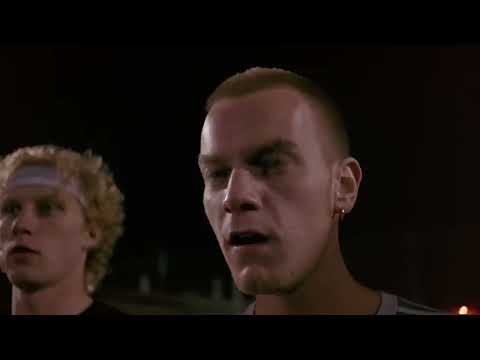
- Right out of the gate — Renton and Spud sprint through Edinburgh; Renton’s “Choose life” monologue bites between drum hits. Non-diegetic, mixed like an adrenaline IV.
- Why it matters:
- The film’s swaggering thesis: appetite as propulsion, irony as armor.
“Deep Blue Day” (Brian Eno)
- Where it plays:
- “Worst Toilet in Scotland.” As Renton dives after lost suppositories, the world turns dream-blue and calm. Non-diegetic, a serene hallucination over filth.
- Why it matters:
- Beauty as denial — an ethereal joke that lands like poetry.
“Temptation” (Heaven 17) → “Atomic” (Sleeper, Blondie cover)
- Where it plays:
- Nightclub sequence. Renton tries sobriety, eyes Diane; the cut glides from Heaven 17’s synth-seduction into Sleeper’s glittering “Atomic” as the chase turns romantic. Non-diegetic, mixed to the strobe.
- Why it matters:
- A perfect on-floor crossfade — desire as relapse engine.
“Sing” (Blur)
- Where it plays:
- After the devastating baby scene — the film exhales into a hollow, organ-like drone. Non-diegetic, holding the room in suspended grief.
- Why it matters:
- Mourning without words — Britpop turned to liturgy.
“Perfect Day” (Lou Reed)
- Where it plays:
- Renton’s overdose — he “sinks” through the carpet and into an ambulance as Reed croons. Non-diegetic, but cut to picture like a fatal lullaby.
- Why it matters:
- The film’s cruelest irony; one lyric — “You’re gonna reap just what you sow” — becomes a verdict.
“Dark and Long (Dark Train)” (Underworld)
- Where it plays:
- Cold-turkey sequence — parents lock Renton in his room; fever dreams pound against the bassline. Non-diegetic, relentless.
- Why it matters:
- Withdrawal as techno — the body turns into a metronome of panic.
“Mile End” (Pulp)
- Where it plays:
- Derelict flat life — cracked walls, thin mattresses, black humor. Non-diegetic with diegetic bleed from tinny speakers.
- Why it matters:
- Kitchen-sink pop for squat-flat realism — shabby, catchy, weirdly proud.
“For What You Dream Of (Full On Renaissance Mix)” (Bedrock feat. KYO)
- Where it plays:
- Club rush sequences — bodies in motion, shots and strobes, schemes brewing. Non-diegetic big-room propulsion.
- Why it matters:
- Signature progressive-house surge — the night has its own plot.
“A Final Hit” (Leftfield)
- Where it plays:
- Pre-deal “just one more” spiral — Renton rationalizes a test run before the big score. Non-diegetic, clinical and dark.
- Why it matters:
- Self-deception with sub-bass — the title says it all.
“Statuesque” (Sleeper)
- Where it plays:
- After the heroin deal — a buoyant, bittersweet glide before the last turn. Non-diegetic; feels like victory music.
- Why it matters:
- False dawn, gorgeously lit.
“Born Slippy .NUXX” (Underworld)
- Where it plays:
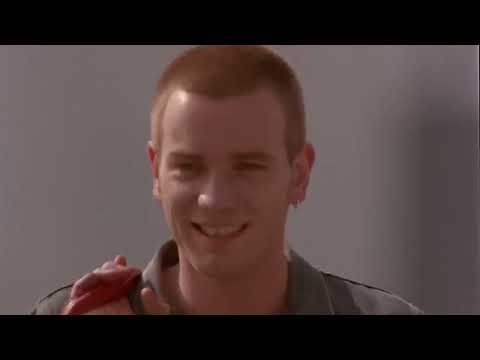
- Finale/credits — Renton chooses a new life, runs toward daylight, and the synth arpeggio becomes a promise. Non-diegetic; end-title surge.
- Why it matters:
- The defining outro of 90s cinema — euphoria with a hangover.
Notes & Trivia
- Two commercial albums exist: the 1996 original and Trainspotting #2 (1997), which adds cues and inspirations not on Vol. 1.
- Underworld’s “Dark and Long (Dark Train)” wasn’t on the first album — it surfaced on the second volume after fan demand.
- “Atomic” in the club is a Sleeper cover of Blondie, cut to feel era-specific but timeless on the dancefloor.
- “Born Slippy .NUXX” became a UK #2 single after the film; Boyle has called it the movie’s “heartbeat.”
- Rankings love it: Vanity Fair (Top 10) and Entertainment Weekly (Top 20) list the OST among the best ever.
Reception & Quotes
The soundtrack is widely credited with canonizing 90s UK pop and bringing electronic music to mainstream filmgoers — a mixtape that doubled as cultural export.
“From ‘Lust for Life’ to ‘Born Slippy’, the music is the movie’s pulse.” — GQ UK
“‘Perfect Day’ turns a relapse into an epitaph — unforgettable.” — Consequence
“A snapshot of 1996 that still feels immediate.” — Soundtrack retrospectives
Interesting Facts
- Hands-on director: Boyle has said he picks songs himself rather than rely on a conventional supervisor.
- Blur deep cut: “Sing” was an early Blur track rarely used elsewhere; the film revived it for a generation.
- Club archaeology: Bedrock’s 1993 prog-house anthem found new life here, years after release.
- Volume two saves: Fan-favorite cues like “Dark Train” and “Statuesque” got proper album slots on the 1997 follow-up.
- Legacy ripple: The sequel (T2) intentionally echoed this soundtrack with new takes from Underworld and Iggy Pop.
Technical Info
- type: Film soundtrack (various artists)
- title: Trainspotting — Music From the Motion Picture
- year: 1996 (Vol. 2 in 1997)
- curation: Danny Boyle (director-driven song selection)
- labels: EMI (UK); Capitol (US)
- selected notable placements: “Lust for Life” — opening chase; “Deep Blue Day” — toilet dive; “Temptation”→“Atomic” — nightclub meet-cute; “Sing” — aftermath of the baby scene; “Perfect Day” — overdose; “Dark and Long (Dark Train)” — cold-turkey; “Mile End” — squat life; “For What You Dream Of” — club rush; “Statuesque” — post-deal glow; “Born Slippy .NUXX” — finale
- recognition: Regularly ranked among greatest soundtracks; significant UK/US certifications over time
Questions & Answers
- Is “Born Slippy .NUXX” the end-credits track?
- Yes — it scores Renton’s final decision and runs into the credits.
- Which song plays during the overdose?
- Lou Reed’s “Perfect Day,” cut tightly to Renton’s collapse and rescue.
- What’s the serene music in the toilet scene?
- Brian Eno’s “Deep Blue Day.” The calm is the joke — and the point.
- Who picked all these songs?
- Danny Boyle is known for personally selecting tracks rather than using a traditional music supervisor.
- Why are there two albums?
- Volume 1 (1996) covered core cues; demand led to a 1997 follow-up with additional tracks used in (or inspiring) the film.
Key Contributors
| Subject | Relation | Object |
|---|---|---|
| Danny Boyle | directed; curated songs | Trainspotting (1996) |
| Iggy Pop | performed | “Lust for Life” (opening) |
| Lou Reed | performed | “Perfect Day” (overdose) |
| Underworld | performed | “Dark and Long (Dark Train)”; “Born Slippy .NUXX” (finale) |
| Blur | performed | “Sing” (post-tragedy interlude) |
| Sleeper | performed | “Atomic” (Blondie cover, club); “Statuesque” (post-deal) |
| Pulp | performed | “Mile End” (squat flat) |
| Bedrock feat. KYO | performed | “For What You Dream Of” (club) |
| EMI / Capitol | released | Trainspotting — Music From the Motion Picture (1996) |
Sources: album pages and label credits; critical retrospectives; scene-placement features; official trailers and notable clips.
The budget was covered 32 times in this movie, where the biggest star is Ewan McGregor, who in 1996 was almost unknown person. Sometimes there are films that make actors rise the next morning after the premiere to know they became stars. It was the thing with Danny Boyle after this work. Actually, it was one of many his great works, after which followed fabulous horror movies ‘28 Days Later’, ‘28 Weeks Later’, and inimitable social drama revealing the dark Mumbai’s side ‘Slumdog Millionaire’, which raised several stars and USD 377 millions vs. USD 15 budget, ‘Steve Jobs’, which barely overcame its budget in the box office and he also plans Trainspotting 2 in 2017. This film is about drug addiction and poverty that are occurring at the background of economic recession in 1980s in the UK. We see here many people suffering from their morphinism and, of course, the beholder will see some deaths connected with abuse of the forbidden substances. Don’t wait too colorful themes from this film. Iggy Pop & David Bowie made a collaborative song (Night Clubbing, telling of the place of time spending of the main characters) and Iggy Pop did a separate single (Lust for Life), which tells in aggressive lyrics of desire to life in the rock way, and should suit the main hero, but it doesn’t fit him on a 100%. Underworld is pretty tranquil, as rock only can be. It even may be of a new wave era, but the same could be the garage indie rock, as its sound and lyrics are slightly immature. The opposition in style is Mile End of 4.5 minutes long. It is British-style pop, carefree and denying dying out of all things, somewhat similar to The Beatles. Well, you know, every British band looks 40% like The Beatles, it is obvious from any side.November, 29th 2025
A-Z Lyrics Universe
Cynthia Erivo Popular
Ariana Grande Horsepower
Post Malone Ain't No Love in Oklahoma
Luke Combs Good Riddance (Time of Your Life)
Green Day Bye Bye Bye
*NSYNC You're the One That I Wan
John Travolta & Olivia Newton-John I Always Wanted a Brother
Braelyn Rankins, Theo Somolu, Kelvin Harrison Jr. and Aaron Pierre The Power of Love
Frankie Goes to Hollywood Beyond
Auli’i Cravalho feat. Rachel House MORE ›