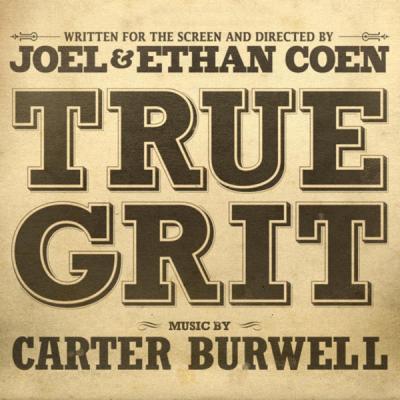
"True Grit" Soundtrack Lyrics
Movie • 2010
Track Listing
Carter Burwell
Carter Burwell
Carter Burwell
Carter Burwell
Carter Burwell
Carter Burwell
Carter Burwell
Carter Burwell
Carter Burwell
Carter Burwell
Carter Burwell
Carter Burwell
Carter Burwell
Carter Burwell
Carter Burwell
Carter Burwell
Carter Burwell
Carter Burwell
Iris DeMent
J. S. Torbett
Johnny Cash
“True Grit: Original Motion Picture Soundtrack” – Album Guide to Tracks and Key Scenes
Review
If revenge is a straight line, what does it sound like? In the Coens’ True Grit, Carter Burwell answers with discipline: austere orchestration carved from 19th-century Protestant hymns. Where many Westerns swell, this one holds its breath — drums are rare, brass restrained, and the melody often a lone, stubborn line. It fits Mattie Ross: unsentimental, devout, unstoppable.
The album carries a liturgy-like arc. “Leaning on the Everlasting Arms” becomes Mattie’s spine — whispered by solo instruments, then braided into fuller textures as her quest hardens. Elsewhere, cue titles follow story beats like chapter heads (“The Hanging Man,” “The Snake Pit,” “Ride to Death”). The mood shifts in phases — ledger & law (spare strings, parlor tempos) → frontier ordeal (cold air in the harmony, lower registers) → reckoning (themes stripped to chant) → afterimage (piano and silence). It’s devotional music doing character work — stern, beautiful, and exact.
How It Was Made
Burwell and the Coens chose to base the score on period hymns — most centrally “Leaning on the Everlasting Arms,” also heard famously in The Night of the Hunter. Burwell canvassed Presbyterian hymnals, adapting tunes like “What a Friend We Have in Jesus,” “Hold to God’s Unchanging Hand,” and “The Glory-Land Way” into a modern chamber palette. Nonesuch released the album December 21, 2010; Iris DeMent’s recording of “Leaning on the Everlasting Arms” closes the film (and appears as a digital bonus track on some editions). The trailer, meanwhile, fronted Johnny Cash’s “God’s Gonna Cut You Down,” never heard in-film.
Production favors clarity: close-miked strings, winds, and piano, little reverb, and arrangements that keep the hymn tunes audible even as harmony darkens. It’s a design choice — the music feels hand-hewn and “of the people,” not Hollywood-grand.
Tracks & Scenes
Approximate scene contexts for key cues and songs. “Diegetic” means heard by characters on screen.
“The Wicked Flee” (Carter Burwell)
- Where it plays:
- Opening movement over Mattie’s narration and first images (~00:01). Solo lines outline a stern hymn cadence; the world is introduced without romance (non-diegetic).
- Why it matters:
- States the film’s moral frame — scripture as structure — and introduces the cold, unsentimental sound.
“The Hanging Man”
- Where it plays:
- The public hanging early in the film (~00:18). Fiddle and low strings sit still as the crowd watches, emotion withheld (non-diegetic under sparse diegetic ambience).
- Why it matters:
- Shows the score’s restraint — the music refuses spectacle, matching Mattie’s steady gaze.
“La Boeuf Takes Leave”
- Where it plays:
- After LaBoeuf’s first clash with Mattie and Rooster (~00:40). A drier, slightly comic gait as alliances wobble (non-diegetic).
- Why it matters:
- Uses hymn fragments as character counterpoint — pride pricks, melody demurs.
“River Crossing” → “Little Blackie”
- Where it plays:
- Mattie forces Little Blackie across the water to rejoin Rooster (~00:47). The cue tightens the “Everlasting Arms” motive into a stubborn ostinato (non-diegetic).
- Why it matters:
- Mattie’s theme literally moves her — a musical act of will.
“Your Headstrong Ways”
- Where it plays:
- Campfire disputes and negotiating tactics (~00:55). Muted harmony under sharp dialogue (non-diegetic).
- Why it matters:
- Title-as-character study — melody holds its line against pressure.
“Talk About Suffering” (traditional hymn, adapted)
- Where it plays:
- Woven through midfilm travel and hardship beats (non-diegetic); the tune also appears in end-credits listings.
- Why it matters:
- A literal lyric turned instrumental lament — community grief distilled to strings.
“The Snake Pit”
- Where it plays:
- After the cave fall and bite (~01:45). Harmony thins; a single line holds as the world narrows (non-diegetic).
- Why it matters:
- The score’s starkest moment — faith pressed into pain.
“Ride to Death” → “I Will Carry You”
- Where it plays:
- Rooster’s desperate ride through the night with Mattie in his arms (~01:50–01:56). Theme fragments surge, then subside into aching cadence (non-diegetic).
- Why it matters:
- Hymn tune, now elegy — moral grit becomes mortal cost.
“The Grave”
- Where it plays:
- Epigraph-like coda in the adult-Mattie epilogue (~end). Spare piano articulates finality (non-diegetic).
- Why it matters:
- Closes the circle with humility — no fanfare, only memory.
End song — “Leaning on the Everlasting Arms” (Iris DeMent)
- Where it plays:
- End credits, full vocal performance. In some album editions it appears as a bonus track; not part of the main score program.
- Why it matters:
- Gives the film’s private prayer a voice — plain, unwavering, resolute.
Trailer song — “God’s Gonna Cut You Down” (Johnny Cash)
- Where it plays:
- Marketing only (theatrical trailer). Not in the film or the official score album.
- Why it matters:
- Sets a marketing mood — frontier judgment — while the film itself stays with hymns.
Notes & Trivia
- Burwell’s score draws heavily from 19th-century hymns; the Coens specifically referenced “Leaning on the Everlasting Arms.”
- The Academy ruled the score ineligible for Best Original Score due to reliance on pre-existing hymn material.
- Nonesuch issued the album; the digital edition in some territories adds Iris DeMent’s end-credits performance as a bonus track.
- Hymns referenced in cue credits include “What a Friend We Have in Jesus,” “Hold to God’s Unchanging Hand,” and “The Glory-Land Way.”
- Johnny Cash’s “God’s Gonna Cut You Down” powered the trailer only — a notable non-album/non-film placement.
Reception & Quotes
Critics praised the discipline and thematic unity. The film earned 10 Oscar nominations; coverage repeatedly called the score’s ineligibility an unfortunate technicality, not a judgment of quality.
“Hymns revoiced into a stern, beautiful chamber Western.” Movie Music UK (review)
“Ineligible on a technicality — a shame, as Burwell’s work here is among his grandest.” Nonesuch round-up quoting Los Angeles Times
“Academy nixes four contenders… ‘True Grit’ among scores diluted by pre-existing themes.” Variety
Interesting Facts
- Mattie’s motif: Roughly a quarter of the score derives from “Leaning on the Everlasting Arms.”
- Trailer ≠ film: Johnny Cash in marketing; Iris DeMent in the movie credits; neither is on the core CD program.
- Sound of austerity: The recording favors close, dry mic’ing — intimacy over epic reverb.
- Hymnal homework: Burwell spent months combing Presbyterian hymnals to find tunes that fit call-and-response structures.
- Label fit: Nonesuch’s art-music lean suits the album’s chamber scale and serious tone.
Technical Info
- Title: True Grit: Original Motion Picture Soundtrack
- Year: 2010
- Type: Original score (album) with end-credits song
- Composer/Producer: Carter Burwell
- Label/Release: Nonesuch Records — December 21, 2010
- Key thematic source: “Leaning on the Everlasting Arms” (Elisha A. Hoffman & A.J. Showalter)
- Other hymn sources (adapted): “What a Friend We Have in Jesus”; “Hold to God’s Unchanging Hand”; “The Glory-Land Way”; “Talk About Suffering”
- Trailer song (not in film/OST): Johnny Cash — “God’s Gonna Cut You Down”
- Album highlights: “The Wicked Flee”; “River Crossing”; “The Hanging Man”; “The Snake Pit”; “Ride to Death”; “The Grave”
- Awards note: Film received 10 Oscar nominations; score ruled ineligible for Best Original Score
Questions & Answers
- Why does the score sound like hymns?
- Burwell and the Coens based it on 19th-century Protestant hymnody to mirror Mattie’s faith and the story’s moral starkness.
- What’s the main recurring theme?
- “Leaning on the Everlasting Arms” — it shadows Mattie and recurs in several cues.
- What song plays over the end credits?
- Iris DeMent’s rendition of “Leaning on the Everlasting Arms.” On some editions it’s a digital bonus track.
- Why wasn’t the score Oscar-eligible?
- The Academy ruled it relied too heavily on pre-existing hymn material to qualify as “original.”
- Was Johnny Cash in the movie?
- No — his “God’s Gonna Cut You Down” was used in the trailer only.
Key Contributors
| Entity | Relation (S–V–O) |
|---|---|
| Joel Coen; Ethan Coen | Directors/Writers → set hymn-based musical brief |
| Carter Burwell | Composer/Producer → adapted 19th-century hymns into original score |
| Nonesuch Records | Label → released the official soundtrack album |
| Iris DeMent | Vocalist → performed end-credits “Leaning on the Everlasting Arms” |
| Johnny Cash | Artist → “God’s Gonna Cut You Down” featured in the trailer (marketing only) |
| Elisha A. Hoffman; A.J. Showalter | Hymnwriters → “Leaning on the Everlasting Arms” (source theme) |
| Joseph Scriven; Charles C. Converse | Hymnwriters → “What a Friend We Have in Jesus” (source) |
| Franklin L. Eiland | Hymnwriter → “Hold to God’s Unchanging Hand” (source) |
| J.S. (Glory-Land Way) | Hymnwriter → credited source for “The Glory-Land Way” adaptations |
| Paramount Pictures | Studio → released the film (2010) |
Sources: Nonesuch album page; Carter Burwell project notes; Wikipedia soundtrack entry; Discogs release; IMDb soundtrack list; Variety & EW on Oscar ineligibility; Apple Music & Spotify listings; Movie Music UK review; theatrical trailer.
November, 29th 2025
A-Z Lyrics Universe
Cynthia Erivo Popular
Ariana Grande Horsepower
Post Malone Ain't No Love in Oklahoma
Luke Combs Good Riddance (Time of Your Life)
Green Day Bye Bye Bye
*NSYNC You're the One That I Wan
John Travolta & Olivia Newton-John I Always Wanted a Brother
Braelyn Rankins, Theo Somolu, Kelvin Harrison Jr. and Aaron Pierre The Power of Love
Frankie Goes to Hollywood Beyond
Auli’i Cravalho feat. Rachel House MORE ›