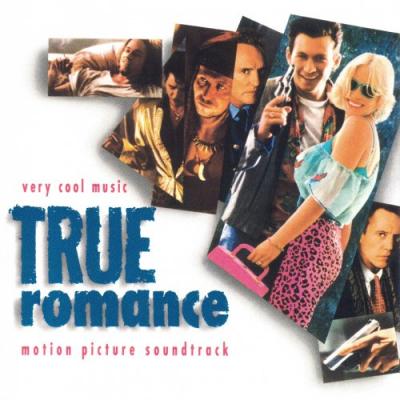
"True Romance" Soundtrack Lyrics
Movie • 1993
Track Listing
Hans Zimmer
Charlie Sexton
John Waite
Charles & Eddie
Nymphomania
Hans Zimmer
Shelby Lynne
Howard Blake
Robert Palmer
Soundgarden
Hans Zimmer
Chris Isaak
“True Romance (Original Motion Picture Soundtrack)” – Album Guide to Tracks and Key Scenes
Review
How do you score a lovers-on-the-run fairy tale that keeps walking into gunfights? With a lullaby that refuses to flinch. Hans Zimmer’s theme — the famous marimba pattern from “You’re So Cool” — turns the film’s chaos into a bright, chiming mantra. It’s candy over razor blades: a music-box pulse leading two dreamers through very bad nights.
Tony Scott layers that motif with jukebox color — Detroit bar rock, lounge oldies, West Coast alt-metal — so the soundtrack swings between myth and mess. The album moves in phases: infatuation (marimba ostinato; Charlie Sexton’s swagger) → blood & bravado (Aerosmith on car radio; Elvis on the conscience) → heat (Soundgarden and sirens) → afterglow (Chris Isaak for the credits). The trick is tone: Zimmer keeps the lovers’ POV naive and hopeful while the needle-drops keep reminding us where they are — America, loud and armed.
How It Was Made
Zimmer’s score anchors the official album (Morgan Creek, 1993), with select songs folded around it. The theme consciously echoes the Carl Orff/Gunild Keetman Schulwerk piece “Gassenhauer,” a nod to Terrence Malick’s Badlands — another story of youthful romance on a collision course. Tony Scott and editor Christian Wagner let the chiming pattern recur as a narrative glue, while the licensed tracks supply character texture (Elvis, Burl Ives, Aerosmith, Soundgarden).
Later, a 25th-anniversary vinyl program reassembled the cues and key songs across “Side Clarence” and “Side Alabama,” bringing the soundtrack back to shelves for new listeners and collectors.

Tracks & Scenes
Song placements with descriptive context (U.S. theatrical timing is approximate). “Diegetic” = the characters hear it.
“You’re So Cool” (Hans Zimmer)
- Where it plays:
- Main theme recurring throughout, first over opening and early Detroit sequences; reprises over travel interludes and the lovers’ quiet beats (non-diegetic).
- Why it matters:
- Childlike marimba heartbeat — a fairy-tale shell around a violent world.
“Graceland” (Charlie Sexton)
- Where it plays:
- ~00:00 — Opening credits; Clarence riffs in a bar about Elvis, all nerves and charm (diegetic bleed into non-diegetic).
- Why it matters:
- Sets the Elvis-haunted fantasy that keeps whispering to Clarence.
“In Dreams” (John Waite & Bekka Bramlett)
- Where it plays:
- ~00:08 — All-night diner after the movie; pie, flirting, destiny (diegetic room play-through).
- Why it matters:
- Soft-focus pop to sell the meet-cute as fate.
“Wounded Bird” (Charles & Eddie)
- Where it plays:
- ~00:10 — Comic-shop tenderness and first love scene; then the morning-after on the stoop (diegetic then score-like bleed).
- Why it matters:
- Turns pulp-romance into sincerity; the film needs that.
“White Wedding” (Billy Idol)
- Where it plays:
- ~00:17 — Tattoo parlor scene as Alabama and Clarence talk Drexl and commitment (diegetic).
- Why it matters:
- Camp-ironic bell that says: this whirlwind is real to them.
“Skinny (They Can’t Get Enough)” (The Skinny Boys)
- Where it plays:
- ~00:18 — Drexl’s den as he deals dope and menace (diegetic).
- Why it matters:
- 90s street texture for a very 70s kind of villain.
“Heartbreak Hotel” (Elvis Presley)
- Where it plays:
- ~00:20 & ~01:42 — Clarence’s bathroom pep-talks with his Elvis apparition (non-diegetic in-world fantasy/needle-drop on the mind).
- Why it matters:
- Elvis as conscience and swagger coach — the film’s private joke.
“I Want Your Body” (Nymphomania)
- Where it plays:
- ~00:24 — Clarence confronts Drexl; the room throbs until the scene explodes (diegetic).
- Why it matters:
- Weaponized sleaze — amps up the squalor before the shootout.
“Little Bitty Tear” (Burl Ives)
- Where it plays:
- ~00:33 — Clifford (Clarence’s dad) hums along in the car, heading home (diegetic/car radio).
- Why it matters:
- Dad’s ordinary world before Walken’s Sicilian story blows it apart.
“Chantilly Lace” (The Big Bopper)
- Where it plays:
- ~00:43 — Pay-phone call with Dick; the couple’s kiss inside the booth (diegetic).
- Why it matters:
- Oldies radio makes the whole thing feel like a drive-in fantasy.
“The Other Side” (Aerosmith)
- Where it plays:
- ~00:56 — L.A. arrival drive; radio on, stomachs empty, hearts full (diegetic).
- Why it matters:
- Big-shouldered radio rock to announce a new act: Hollywood.
“(Love Is) The Tender Trap” (Robert Palmer)
- Where it plays:
- ~01:20 — Elliot gets pulled over; smarm meets blue lights (diegetic).
- Why it matters:
- Rat-pack wink over a very un-cool moment.
“Outshined” (Soundgarden)
- Where it plays:
- ~01:33 — Brad Pitt’s couch-stoner Floyd… and then armed visitors (diegetic in apartment).
- Why it matters:
- Grunge lethargy, then panic — an all-timer comic beat.
End-credits — “Two Hearts” (Chris Isaak)
- Where it plays:
- ~01:52 — Roll-out after the smoke clears (non-diegetic).
- Why it matters:
- Dusty romance after a hard-won sunrise.
Notes & Trivia
- Zimmer’s theme is an homage to the Orff/Keetman Schulwerk piece “Gassenhauer,” channeling Malick’s Badlands motif into a new love-on-the-run context.
- The official album centers the score but folds in key songs (e.g., Sexton, Palmer, Soundgarden, Isaak); several other on-screen tracks never made the original CD.
- Elvis functions as Clarence’s inner voice; “Heartbreak Hotel” punctuates two of those mirror-talk scenes.
- A 25th-anniversary vinyl reissue (2017) split the program into “Side Clarence” and “Side Alabama,” adding packaging extras for collectors.
Reception & Quotes
From first release to modern reissues, critics have praised the theme’s disarming naiveté and the soundtrack’s pop-myth energy.
“Theme music… with the jingling sound of a Christmas carol — yet all the music feels exactly right.” The New York Times
“A beloved Zimmer theme — explicitly riffing on Orff/Keetman — that turns pulp into fable.” Album notes & retrospectives
Availability: Streaming on major platforms; original CD on Morgan Creek; anniversary vinyl editions via Real Gone/Wargod.
Interesting Facts
- Voiceover mirror: Alabama’s closing narration over “You’re So Cool” mirrors Sissy Spacek’s Badlands voiceover — same narrative device, different moral temperature.
- Elvis twice: “Heartbreak Hotel” shadows Clarence’s choices like a saint’s candle in a bad church.
- Credits contrast: The film ends with Isaak’s dust-soft croon after a finale that’s all muzzle flash.
- Mixtape America: From Burl Ives to Soundgarden — the span is the point. It’s a love story stapled to a country’s record collection.
- Vinyl story: The 2017 box reissue bundled sunglasses, mugshots, and ephemera — soundtrack as fan-fiction prop set.
Technical Info
- Title: True Romance (Original Motion Picture Soundtrack)
- Year: 1993
- Type: Score-led soundtrack with selected songs
- Composer/Producer: Hans Zimmer
- Label/Release: Morgan Creek — September 7, 1993
- Notable songs (in film): “Graceland” (Charlie Sexton); “In Dreams” (John Waite & Bekka Bramlett); “White Wedding” (Billy Idol); “The Other Side” (Aerosmith); “Outshined” (Soundgarden); “Two Hearts” (Chris Isaak)
- Thematic source: Orff/Keetman “Gassenhauer” (from Schulwerk), via Badlands homage
- Reissues: 25th-anniversary vinyl editions (Real Gone/Wargod), expanded packaging
Questions & Answers
- What’s the “music-box” theme called?
- “You’re So Cool” — Zimmer’s marimba-led motif that recurs throughout the film.
- Is the theme borrowed from Badlands?
- It’s an homage to the Orff/Keetman Schulwerk piece “Gassenhauer,” famously used in Badlands; Zimmer crafted a new variant for this film.
- Which big songs show up beyond the score?
- Charlie Sexton’s “Graceland,” Robert Palmer’s “(Love Is) The Tender Trap,” Soundgarden’s “Outshined,” and Chris Isaak’s “Two Hearts,” among others.
- Where can I stream the album?
- On major platforms (Apple Music/Spotify). Vinyl reissues are also available from specialty labels.
- What plays over the end credits?
- Chris Isaak’s “Two Hearts.” The Zimmer theme reprises elsewhere during the coda.
Key Contributors
| Entity | Relation (S–V–O) |
|---|---|
| Tony Scott | Director → shaped tone and spotting around Zimmer’s refrain |
| Quentin Tarantino | Writer → story spine that invites a fairy-tale theme over pulp |
| Hans Zimmer | Composer/Producer → built “You’re So Cool” on a Schulwerk echo |
| Morgan Creek | Label/Producer → released the 1993 album |
| Charlie Sexton; John Waite & Bekka Bramlett; Robert Palmer; Soundgarden; Chris Isaak | Artists → key licensed songs used in memorable scenes |
| Real Gone Music / Wargod | Labels → 25th-anniversary vinyl reissues and box set |
| Warner Bros. | Studio → distributed the film (album art often uses WB imagery) |
Sources: Apple Music/Spotify album listings; Wikipedia (album & development); SoundtrackRadar (scene timestamps/placements); Pitchfork (25th-anniversary vinyl); trailer (YouTube).
November, 29th 2025
'True Romance' is an American crime film with elements of black comedy and romance, directed by Tony Scott and written by Quentin Tarantino. Get more info: Wikipedia, IMDbA-Z Lyrics Universe
Cynthia Erivo Popular
Ariana Grande Horsepower
Post Malone Ain't No Love in Oklahoma
Luke Combs Good Riddance (Time of Your Life)
Green Day Bye Bye Bye
*NSYNC You're the One That I Wan
John Travolta & Olivia Newton-John I Always Wanted a Brother
Braelyn Rankins, Theo Somolu, Kelvin Harrison Jr. and Aaron Pierre The Power of Love
Frankie Goes to Hollywood Beyond
Auli’i Cravalho feat. Rachel House MORE ›