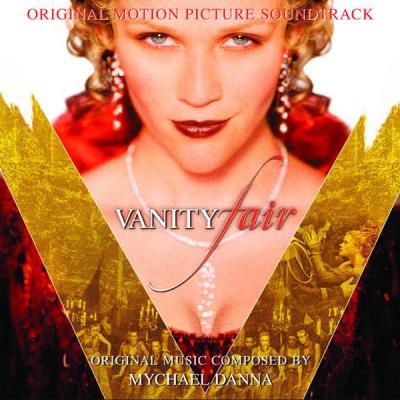
"Vanity Fair" Soundtrack Lyrics
Movie • 2004
Track Listing
Sissel / Mychael Danna
Custer LaRue
Custer LaRue
Hakim
Shankar Mahadevan/Richa Sharma
"Vanity Fair (Original Motion Picture Soundtrack)" – Album Guide to Tracks and Key Scenes
Overview
How do you score a social climber who refuses to stay inside the frame? Vanity Fair answers with a Regency sound-world — chamber strings, salon dances, drawing-room airs — that keeps slipping its corset to flirt with empire and spectacle.
Composer Mychael Danna builds a graceful, period-grounded score (recorded with the Philharmonia Orchestra) that pivots between parlor intimacy and ballroom pomp. Literary settings (Byron’s “She Walks in Beauty,” Tennyson’s “Now Sleeps the Crimson Petal”) and courtly dances (Hummel polonaise, stately waltzes) sketch Becky’s public mask; tender woodwinds and harp track the private operator underneath. Then, in an inspired Mira Nair touch, the final reel blooms into a desi coda — “Gori Re (O Fair One)” — composed by Shankar–Ehsaan–Loy and sung by Shankar Mahadevan and Richa Sharma. The effect is bold: a British period piece that tips its hat to India at the curtain call.
Phases & meanings: Drawing-room airs — manners and masks; ballroom set-pieces — status games in 3/4 time; tender strings/harp — Becky’s private calculus; Indian finale song — empire flows back into the music, bright and unabashed.
How It Was Made
Score & players: Danna’s score was recorded in London (Henry Wood Hall) with the Philharmonia; Nicholas Dodd handled conducting/orchestrations. The album presents 25 cues, running ~45 minutes, released by Universal Classics/Decca in late August 2004.
Song commission: Director Mira Nair commissioned Shankar–Ehsaan–Loy late in post to craft an original, acoustic Indian number (“Gori Re”) for the film’s last sequences — no synths, tabla-forward, lyric by Javed Akhtar — as a joyful cultural wink at the story’s Anglo–Indian currents.
Tracks & Scenes
“She Walks in Beauty” (Sissel; music by Mychael Danna)
- Where it plays:
- Album opener and early-film palette-setter: Byron’s text set for voice and orchestra, introducing Becky’s world of appearances — lamplight, silk, and side-eyed appraisals. Non-diegetic.
- Why it matters:
- Signals a literate, curated sound — poetry-as-overture for a heroine who performs perfection while plotting survival.
“Now Sleeps the Crimson Petal” (Custer LaRue; music by Mychael Danna)
- Where it plays:
- A parlor performance frame — hushed voices and glances over teacups. The Tennyson setting floats under candlelight as Becky calculates her next move. Semi-diegetic performance into score.
- Why it matters:
- Turns a drawing room into theater. The lyric’s dreamy stillness contrasts Becky’s restless ambition.
“The Great Adventurer” (featuring Custer LaRue)
- Where it plays:
- Early montage of military flirtations and colonial tales — songs and gossip mingling at Miss Crawley’s. Non-diegetic song used like lively source.
- Why it matters:
- Winks at empire bragging while Becky learns to steer rooms with charm and timing.
“Becky Arrives at Queen’s Crawley” / “No Lights After Eleven”
- Where it plays:
- Arrival and house-rules sequence: courtly strings, prim woodwinds, and a clipped cadence as Becky tests boundaries. Non-diegetic score.
- Why it matters:
- Establishes the film’s comic-regency gait — manners as constraint, music as sly narrator.
“Becky and Rawdon Kiss”
- Where it plays:
- Garden shadows and stolen breath before the war news. Low strings warm, then retreat as reality intrudes. Non-diegetic.
- Why it matters:
- Shows Danna’s light touch with romance — private, unsyrupy, alert to consequences.
“Piano for Amelia / Announcement of Battle”
- Where it plays:
- Parlor calm fractures when Waterloo looms. A gentle keyboard figure yields to martial brass and snare. Non-diegetic into source blend.
- Why it matters:
- One cue, two worlds: domestic ritual vs. public history slamming through the door.
Ballroom source cues — “The Polonaise” (Hummel) & “The Waltz”
- Where it plays:
- Gilded salons, introductions, and status tests. Camera rides the floor as Becky outmaneuvers rivals with smiles. Diegetic dance-band feel.
- Why it matters:
- Authentic period dance language that sells the choreography of class.
“Sir Pitt’s Marriage Proposal” / “I Owe You Nothing”
- Where it plays:
- Proposal farce and Becky’s cool refusal. The orchestra tightens into comic staccato, then exhales with a tart cadence. Non-diegetic.
- Why it matters:
- Character writing in miniature: Becky’s agency gets a musical grin.
Showpiece dance — “Ballet Zirnana” (on-screen performance)
- Where it plays:
- Becky’s exotic court dance before the King: silk veils, hand-drums, and audience gasps as etiquette meets spectacle. Semi-diegetic performance.
- Why it matters:
- Mira Nair’s taste for theatrical pageant peeks through the Regency surface — foreshadowing the film’s Indian-colored finale.
“Gori Re (O Fair One)” — Shankar–Ehsaan–Loy feat. Shankar Mahadevan & Richa Sharma
- Where it plays:
- Final sequences into credits: a radiant acoustic duet with tabla and dholak, no synths, recorded specifically for the film’s last passages. Non-diegetic song, culturally foregrounded.
- Why it matters:
- A joyful coda that reframes a British classic through Nair’s Indian lens — and it sticks to the ear long after the curtain.
Notes & Trivia
- The 25-track commercial album was issued by Universal Classics/Decca in August 2004 and runs about 45 minutes; Spotify/Apple Music mirror this sequence.
- Vocal features include Norwegian soprano Sissel (Byron setting) and early-music stylist Custer LaRue (parlor airs).
- The recording credits the Philharmonia Orchestra with Nicholas Dodd conducting/orchestrating.
- IMDB’s soundtrack roll lists authentic period sources used in the ballroom scenes (e.g., Hummel polonaise, waltz cues).
- “Gori Re” was commissioned late; Mira Nair requested acoustic Indian instrumentation only — tabla forward, no synths.
Reception & Quotes
Reviews of Danna’s score highlighted its poise and quiet wit, while the Indian finale song drew notice as an unexpected, charming flourish in a Regency drama.
“Danna… emulates Becky’s personality — classical structure with a playful pace.” Filmtracks
“The upbeat vocal number ‘Gori Re’ is enjoyable… for those who relish Indian styles.” Soundtrack coverage cited in film notes
Interesting Facts
- Poets in the parlor: Byron and Tennyson texts are set for voice — a literary thread you can hear.
- Dance as social math: Authentic polonaises and waltzes make the ball scenes feel like strategy sessions with chandeliers.
- Empire echoes: The Indian finale is diegetic-feeling joy, not just end-credits wallpaper.
- Recording pedigree: Henry Wood Hall sessions, Philharmonia players — polished but nimble.
- Cue titles map plot: From “Becky and Amelia Leave School” to “Sir Pitt’s Marriage Proposal,” the album lets you follow the story without pictures.
Technical Info
- Title: Vanity Fair (Original Motion Picture Soundtrack)
- Year: 2004 (album released late August 2004; film released September 2004 in the U.S.)
- Type: Film soundtrack — orchestral score with select vocal/period pieces; original song for finale
- Composer: Mychael Danna (score)
- Orchestrations/Conductor: Nicholas Dodd; performed by the Philharmonia Orchestra
- Finale song: “Gori Re (O Fair One)” by Shankar–Ehsaan–Loy; vocals by Shankar Mahadevan & Richa Sharma; lyrics by Javed Akhtar
- Label: Universal Classics / Decca (25 tracks; ~45:25)
- Selected notable placements: Parlor performances — “She Walks in Beauty,” “Now Sleeps the Crimson Petal”; Ballroom — Hummel polonaise & waltzes; War news — “Piano for Amelia / Announcement of Battle”; Romance interludes — “Becky & Rawdon Kiss”; Finale/credits — “Gori Re”.
Questions & Answers
- Who composed the score?
- Mychael Danna, recorded with the Philharmonia Orchestra and conducted/orchestrated by Nicholas Dodd.
- Is the finale song really Indian?
- Yes. “Gori Re (O Fair One)” was commissioned by Mira Nair from Shankar–Ehsaan–Loy with lyrics by Javed Akhtar and acoustic Indian instrumentation.
- Are the ballroom pieces authentic period music?
- Yes — you’ll hear polonaises and waltzes (e.g., Hummel) functioning as diegetic dance cues.
- Does the album include the parlor vocals?
- It does: Sissel sings Byron’s “She Walks in Beauty,” and Custer LaRue appears on multiple airs including “Now Sleeps the Crimson Petal.”
- Where can I stream the soundtrack?
- On Apple Music and Spotify under Vanity Fair (Original Motion Picture Soundtrack) (25 tracks, ~45 minutes).
Key Contributors
| Subject | Relation | Object |
|---|---|---|
| Mychael Danna | composed | Original score for Vanity Fair (2004) |
| Nicholas Dodd | conducted / orchestrated | Philharmonia Orchestra sessions; album recordings |
| Philharmonia Orchestra | performed | Score recording (Henry Wood Hall, London) |
| Sissel | performed | “She Walks in Beauty” (Byron setting) |
| Custer LaRue | performed | Parlor airs incl. “Now Sleeps the Crimson Petal” |
| Shankar–Ehsaan–Loy | composed | “Gori Re (O Fair One)” — finale/credits song |
| Shankar Mahadevan & Richa Sharma | sang | “Gori Re (O Fair One)” |
| Javed Akhtar | wrote lyrics | “Gori Re (O Fair One)” |
| Mira Nair | directed | Feature film; commissioned Indian finale song |
| Universal Classics / Decca | released | Commercial soundtrack album (Aug 2004) |
Sources: Discogs & retailer track lists; Apple Music & Spotify album pages; IMDb Soundtracks; Wikipedia soundtrack notes; Filmtracks review; press features on “Gori Re”.
November, 20th 2025
A-Z Lyrics Universe
Cynthia Erivo Popular
Ariana Grande Horsepower
Post Malone Ain't No Love in Oklahoma
Luke Combs Good Riddance (Time of Your Life)
Green Day Bye Bye Bye
*NSYNC You're the One That I Wan
John Travolta & Olivia Newton-John I Always Wanted a Brother
Braelyn Rankins, Theo Somolu, Kelvin Harrison Jr. and Aaron Pierre The Power of Love
Frankie Goes to Hollywood Beyond
Auli’i Cravalho feat. Rachel House MORE ›