Soundtracks:  A B C D E F G H I J K L M N O P Q R S T U V W X Y Z #


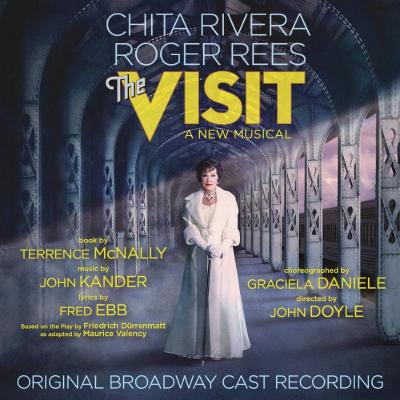
Visit Album Cover

"Visit" Soundtrack Lyrics

Musical • 2015

Track Listing


"The Visit (Original Broadway Cast Recording)" – Album Guide to Tracks and Key Scenes

2015 teaser frame: Chita Rivera as Claire Zachanassian steps from her train into the ghosted gold of Güllen
Book musical as gothic parable — Kander & Ebb’s final collaboration, 2015

Overview

How do you write a torch song for vengeance? The Visit answers by letting a love theme curdle and glow. The album captures the 2015 one-act Broadway edition of John Kander and Fred Ebb’s late, dark valediction — book by Terrence McNally — with Chita Rivera as Claire Zachanassian, the richest woman on earth, returning to bankrupt Güllen with an unholy bargain. It’s a score of waltzes with knives; tango as indictment; lullabies that refuse to forgive.

On record the textures pop: reed-and-strings noir, funeral brass that smiles, a little cabaret poison in the woodwinds. Numbers pivot from stage-set irony (“A Happy Ending”) to private confession (“Love and Love Alone”). The cast album preserves a production that plays like a living etching — stark, elegant, and quietly cruel.

Style map: Weimar-flavored waltz & tango — civility as threat; choral hymn — groupthink with pretty vowels; torch ballad — memory that won’t heal; satiric patter — officials tidying up morality.

How It Was Made

From workshop to Broadway. After Chicago (2001) and Signature Theatre/DC (2008), a revised one-act version bowed on Broadway (Lyceum Theatre) in spring 2015, directed by John Doyle, choreography by Graciela Daniele, with Rivera and Roger Rees (in his final stage role) as Claire and Anton. The run opened April 23 and closed June 14, 2015.

Cast recording. The Original Broadway Cast Recording arrived that summer via Broadway Records in partnership with Yellow Sound Label, produced by Michael Croiter. Digital and CD editions contain 22 tracks — a compact map of the one-act order from “Prelude” to the choral “Finale.”

Teaser still: Claire poised with cane; the town behind her like a verdict
One act, no exit — the Broadway edition streamlined the story and song stack

Tracks & Scenes

“Out of the Darkness” (Townspeople)

Where it plays:
Opening tableau as the townsfolk of Güllen gather at the decayed station, waiting for the benefactor who might save them. Choral procession; the world creaks awake.
Why it matters:
Establishes the communal voice that will later become a mob — pretty harmony as moral drift.

“At Last” (Claire, Townspeople)

Where it plays:
Claire steps off the train — entourages, coffins, panthers, and all. She greets the town like a queen receiving tribute; time freezes around her.
Why it matters:
Entrance aria with a smile full of teeth; the score’s glamour arrives with its threat.

“I Walk Away” (Claire, Louis Perch, Jacob Chicken, Rudi)

Where it plays:
Claire recounts being abandoned and exiled; her grotesque entourage chimes in with facts the town forgot. Onstage confession, ritual calm.
Why it matters:
Lays out the debt — not money, but justice — and hints at the price she expects.

“I Know Claire” (Anton)

Where it plays:
Alone, Anton insists he understands the girl Claire was. A private memory turns brittle as he senses what’s coming.
Why it matters:
The first crack in denial; Kander’s melody softens, then won’t resolve.

“A Happy Ending” (Mayor, Priest, Doctor, Police Chief, Schoolmaster, Townspeople)

Where it plays:
The town elders rehearse a civic fairy tale—how this will all look in the papers—while carefully ignoring Claire’s condition.
Why it matters:
Satire in a brisk two minutes; decorum as cover story.

“You, You, You” (Anton, Claire)

Where it plays:
Night walk duet: the former lovers trace old routes through town, shadowed by their younger selves.
Why it matters:
Glacial tenderness — we believe the love, which makes the bargain worse.

“Look at Me” (Claire, Anton, Young Claire, Young Anton)

Where it plays:
A mirrored memory: past and present couples share the stage as Claire insists the town see who she became.
Why it matters:
The production’s time-fold trick captured on record — romance reframed as evidence.

“Eunuchs’ Testimony” (Jacob Chicken, Louis Perch)

Where it plays:
The bought witnesses (now Claire’s eunuchs) sing their original perjury and present the truth as a mordant cabaret act.
Why it matters:
A courtroom turned music-hall; justice arrives in grotesque harmony.

“Winter” (Claire)

Where it plays:
Claire alone with her seasons — rage cooled into ritual. A spare, icy lullaby.
Why it matters:
Rivera’s signature cut: stillness with a pulse; the aria of a woman past pleading.

“Yellow Shoes” (Doctor, Townspeople)

Where it plays:
Montage number as Güllen quietly upgrades — shoes, suits, credit accounts. Everyone swears nothing’s changed.
Why it matters:
The bright consumer refrain is the tell; the mob is already forming.

“I Would Never Leave You” (Rudi, Louis Perch, Jacob Chicken, Claire)

Where it plays:
Claire’s attendants pledge fealty with comic menace; Claire accepts as if it were a love song.
Why it matters:
Deadpan devotion that doubles as threat — the show’s black humor at full shine.

“The Only One” (Schoolmaster)

Where it plays:
The Schoolmaster — last conscience in town — begs them not to do it. His lyric is a plea into wind.
Why it matters:
A moral center, briefly; the chorus will drown him out.

“Fear” / “A Car Ride” (Anton; Company)

Where it plays:
Anton senses the vote before it happens; later, a ride with his family that feels like goodbye.
Why it matters:
Two steps to acceptance — panic, then grace.

“Love and Love Alone” (Claire)

Where it plays:
Claire’s credo, delivered with near-whisper poise. She confesses that love became something monstrous — but love all the same.
Why it matters:
The thesis stated plainly; the ballad nobody else in musical theatre could sell like Rivera.

“In the Forest Again” / “Finale” (Claire, Anton, Young Doubles, Townspeople)

Where it plays:
Last meeting in a ghosted wood; the town votes; headlines write themselves. The chorus pronounces a beautiful lie.
Why it matters:
Elegy and indictment in one curtain — a hymn that damns the singers.
Teaser montage: the town in vespers, a pair of yellow shoes in close-up, and Claire’s cane tapping time
Choral prettiness, private poison — how the score stages complicity

Notes & Trivia

  • One-act edition: Broadway used a tightened version (vs. earlier two-act runs), re-sequencing songs like “A Confession” and “Eunuchs’ Testimony.”
  • Final Kander & Ebb premiere: Developed after Ebb’s passing, the show stands as the team’s last new musical to reach Broadway.
  • Yellow shoes, bright guilt: The town’s footwear becomes a visual chorus — a symbol of consumer complicity that the album immortalizes in a jaunty refrain.
  • Roger Rees’s farewell: Rees originated Anton on Broadway before illness forced him to step away late in the run.

Reception & Quotes

Reviews praised Rivera’s command and the score’s satin menace; some found the museum-cool staging deliberate by design. The cast performed a compressed medley on the Tony telecast, underlining the show’s hymn-to-mob spine.

“At its best, the music has the flavor of darkest chocolate.” Major-paper review
“A choral lullaby for a town learning to lie to itself.” Cast-album coverage

Availability: The 22-track cast album streams widely and remains in print on CD.

Teaser shot: Claire framed like a saint and a shark as the ensemble forms behind her
Why the album works: beauty first — then the shiver

Interesting Facts

  • Hearing the doubles: You can hear the staging’s time-split in tracks like “Look at Me” and “In the Forest Again.”
  • Satire by arrangement: The “officials” songs use prim orchestration — bassoons, tidy snare — to parody civic decorum.
  • March that smiles: “A Happy Ending” is practically a polka for PR — whistling past the graveyard.
  • Chita in stillness: Rivera’s “Winter” is almost motionless on stage; the album preserves that hush.
  • Chorus as verdict: The Finale disguises a killing as community pride — a moral shock delivered in perfect blend.

Technical Info

  • Title: The Visit (Original Broadway Cast Recording)
  • Year: 2015 (album issued summer 2015)
  • Type: Musical cast recording — one-act Broadway edition
  • Music / Lyrics / Book: John Kander / Fred Ebb / Terrence McNally
  • Key performers: Chita Rivera (Claire), Roger Rees (Anton) and Broadway company
  • Label: Broadway Records in partnership with Yellow Sound Label
  • Notable numbers: “At Last,” “I Walk Away,” “You, You, You,” “Winter,” “Yellow Shoes,” “Love and Love Alone,” “In the Forest Again,” “Finale”
  • Broadway run: Lyceum Theatre — opened April 23, 2015; one-act production directed by John Doyle

Questions & Answers

Is the Broadway album the two-act version?
No — it documents the 2015 one-act edition, with ordering and titles reflecting that revision.
Who released the cast recording?
Broadway Records with Yellow Sound Label; Michael Croiter produced the session.
How many tracks are on the album?
Twenty-two, from “Prelude” through “Finale,” capturing the full arc without dialogue.
What’s the deal with the “yellow shoes”?
A jaunty town number about new purchases — a symbol of creeping complicity baked into the score.
Where can I see the show’s tone in one clip?
The 2015 Tony Awards medley shows the choral menace and Rivera’s ice-calm presence in one shot.

Key Contributors

SubjectRelationObject
John KandercomposedThe Visit score
Fred EbbwroteLyrics
Terrence McNallywroteBook
Chita RiveraperformedClaire Zachanassian (Original Broadway cast)
Roger ReesperformedAnton Schell (Original Broadway cast)
John Doyledirected2015 Broadway production
Graciela Danielechoreographed2015 Broadway production
Broadway Records; Yellow Sound LabelreleasedOriginal Broadway Cast Recording (2015)
Lyceum TheatrepresentedBroadway run (opened April 23, 2015)

Sources: album listings (label/date/track count); production histories and song orders; press announcements; performance clips (teaser & Tonys); plot/song synopses and symbol notes.

This musical played about 3 months on Broadway, at the Lyceum Theatre. From the critics he received mostly positive reviews. The plot is all about the same – love and the obstacles to the achievement of perfect harmony. It is strange that the soundtrack has really so little music – a total of 8 songs. Then one of two things are here – either it is not complete, or the rest of the performed music is just not included in its official publication. Whatever it was, it includes quite diverse genres: rap (Stand Tall), pop (The Three Wisemen), yodeling, jazz, opera, romance. Opera execution is represented by two wonderful songs by Enrico Caruso, who peremptorily mesmerizing us with his strong voice. We want to thank Fiona Apple for the fact that this wonderful smiling girl gave us a light mood and sound that gladdens the hearts, like the swelling buds on spring trees. Song Generation is a wonderful jazz, which sets the main vector of seriousness and solidity in the sound collection. The entire collection of incredibly talented and wonderfully inlays to this musical, which, we hope, more than once will delight all others on Broadway. Maybe it will move to the big screen someday.

November, 20th 2025

More info on IMDb and Wikipedia
A-Z Lyrics Universe

Lyrics / song texts are property and copyright of their owners and provided for educational purposes only.