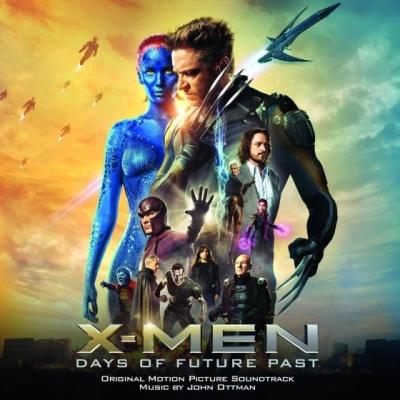
"X-Men - Days of Future Past" Soundtrack Lyrics
Movie • 2014
Track Listing
Roberta Flack
Robert Israel
Alice Cooper
Quincy Jones
Jim Croce
Claude Francois
Eartha Kitt
Alexander Courage
Harry Bluestone
James Sanderson
Francis Scott Key (Arranged by John Cacavas)
Little Feat
“X-Men: Days of Future Past (Original Motion Picture Soundtrack)” – Album Guide to Tracks and Key Scenes
Overview
What does a franchise sound like when the past and future collide? In X-Men: Days of Future Past, composer–editor John Ottman brings back his X2 main theme — a rare act of thematic continuity in the series — then welds it to a darker, hybrid palette: strings and choir for fate, analog synths and bass for 1973 grit, and low-end percussion for ticking doom. It’s a score about resetting timelines without losing identity.
Ottman’s album moves like the film: a grim future overture, a bruised middle full of moral detours, and a defiant end title that reasserts the team’s DNA. Around the orchestral spine sit era-anchoring needle-drops: Roberta Flack on a clock radio, Alice Cooper on a teenage rebel’s hi-fi, Jim Croce swirling through Quicksilver’s time-bent mischief.
Genres & phases: orchestral action and ostinati — mission and sacrifice; choral haze — destiny and loss; 1970s analog keys/guitars — the past as texture; classic pop needle-drops — irony, memory, and proof of time travel.
How It Was Made
Ottman returned to the franchise with Bryan Singer, uniquely doubling as both editor and composer. He revived the X2 title theme (first time a prior X-score theme was reused in the series) and blended it with 1973-flavored colors — analog synths, electric piano and bass — inside a straight-orchestral frame. Sony Classical/Fox Music released the album digitally on May 26, 2014, with CD and vinyl following that summer. A longer “Rogue Cut” edition expanded the program in 2015.
Tracks & Scenes
Below, signature cues and songs with vivid, scene-level context. Time markers are approximate and may vary by cut; we avoid the full tracklist.
“The Future – Main Titles” (John Ottman)
- Where it plays:
- Cold open into a decimated 2023 — Sentinels hunting, final-stand montage. The updated X2 theme punches in over the titles, announcing continuity even as timelines fracture.
- Why it matters:
- Reclaims a franchise identity. The old motif returns with harsher edges — hope refusing to die.
“Hope (Xavier’s Theme)” (John Ottman)
- Where it plays:
- Interlaces Charles’ 1973 crisis (serum, self-doubt) with his future self’s resolve. Quiet strings and choir hold space for belief to regrow.
- Why it matters:
- A human heartbeat inside a machine war — the cue that sells the film’s emotional reset.
“Paris Pandemonium” (John Ottman)
- Where it plays:
- Hotel ballroom chaos during the Paris summit; Raven’s intervention, Magneto’s escalation, cameras flashing as history bends.
- Why it matters:
- Ottman’s cross-cutting chops show — rhythm keeps political theater and mutant spectacle in the same breath.
“Time in a Bottle” (Jim Croce) — Quicksilver’s kitchen run
- Where it plays:
- Inside the Pentagon kitchen breakout: Quicksilver slips on headphones, the world slows to syrup, and he rearranges bullets, fists and soup mid-air. Non-diegetic to us, diegetic to him (through the cans).
- Why it matters:
- Perfect needle-drop irony — a gentle 1973 hit scoring slapstick genius and life-saving improvisation.
“Hello Hooray” (Alice Cooper) — recruiting Quicksilver
- Where it plays:
- On Peter’s stereo during his first appearance: a suburban basement of tinkering, TV glare and cocky speedster attitude while Logan and Charles ask for help.
- Why it matters:
- 1973 swagger that nails his show-off vibe before he even moves.
“The First Time Ever I Saw Your Face” (Roberta Flack) — Logan’s déjà vu radio
- Where it plays:
- On a clock radio when Logan wakes in 1973… and again when he wakes in the reset future. Same song, different world — instant proof the timeline changed.
- Why it matters:
- A tender ballad as temporal anchor. The softest sound cues the biggest sci-fi swing.
French source cue: “Stop! (Au nom de l’amour)” (Claude François)
- Where it plays:
- Heard as period source during the Paris section (diegetic ambience). It paints the location with contemporary pop sheen amid espionage maneuvers.
- Why it matters:
- Local color that contrasts the looming assassination stakes — pop glamour vs. political dread.
Notes & Trivia
- Label: Sony Classical / Fox Music. Digital release May 26, 2014; CD June 30; vinyl August 4.
- Ottman is the first composer to score more than one mainline X-Men film — and the first to re-use a prior film’s theme.
- The album charted at No. 176 on the Billboard 200 and No. 34 on the UK Official Soundtrack Albums list.
- An expanded 2015 album (“The Rogue Cut”) adds cues for restored sequences like “Finding Rogue.”
- Trailer campaign used multiple official cuts; the core theatrical trailer is a fan-memorized marker for the theme’s return.
Music–Story Links
- Reintroducing the X2 theme in the main titles primes the film’s thesis: the past can save the future without erasing who we were.
- “Hope (Xavier’s Theme)” shadows Charles’ relapse and recovery — music as rehabilitation arc.
- Quicksilver’s cues lean on contrast: delicate Croce against comic-book physics reframes violence as ingenuity, not bloodshed.
- Pop radio (Roberta Flack) bookends Logan’s journey — the same song proves the world is different.
Reception & Quotes
Critics split on the album but praised the thematic through-line and the bold reuse of the X2 motif; others felt the long program dulled impact. The film clips made the Quicksilver sequence an instant music-cinema classic.
“Blends the classical with the futuristic… a thrilling work that revitalizes the franchise.” AllMusic
“At least we finally have thematic continuity in the franchise.” Filmtracks
“Roberta Flack on the clock radio… Groundhog Day-style.” MovieMusicUK
Interesting Facts
- The 1970s flavor in the score comes from analog synths, electric piano and bass layered into orchestral writing.
- The soundtrack’s end title (“Welcome Back/End Titles”) brings the X2 theme home after the reset.
- The album includes the two big needle-drops — Croce and Flack — as bonus tracks.
- The Rogue Cut album runs ~1h52m, adding restored scenes and alternate assemblies.
- Ottman discussed juggling editing and scoring — he was literally cutting picture while imagining cues.
Technical Info
- Title: X-Men: Days of Future Past (Original Motion Picture Soundtrack)
- Year: 2014 (film & soundtrack)
- Type: Feature film score (with select source songs)
- Composer/Producer: John Ottman
- Label: Sony Classical / Fox Music
- Key cues: “The Future – Main Titles”; “Hope (Xavier’s Theme)”; “Paris Pandemonium”; “Welcome Back/End Titles”
- Notable songs in film: “Time in a Bottle” (Jim Croce); “Hello Hooray” (Alice Cooper); “The First Time Ever I Saw Your Face” (Roberta Flack); French source heard in Paris (“Stop! (Au nom de l’amour)”).
- Release notes: Digital May 26, 2014; CD June 30, 2014; vinyl August 4, 2014. Expanded “Rogue Cut” album released July 10, 2015.
- Charts: US Billboard 200 No. 176; UK Official Soundtrack Albums No. 34.
- Availability: Widely streaming; original CD/vinyl in print runs via Sony Classical.
Questions & Answers
- Is this the same theme as X2?
- Yes. Ottman brought back and updated his X2 main theme — the first time an X-Men movie reused a prior film’s theme.
- Which song plays in Quicksilver’s slow-mo scene?
- Jim Croce’s “Time in a Bottle,” heard via his headphones while he rescues the team in the Pentagon kitchen.
- What’s the song on Logan’s radio in 1973 (and again at the end)?
- Roberta Flack’s “The First Time Ever I Saw Your Face.” It bookends his time-jump.
- Did the album get an expanded edition?
- Yes — The Rogue Cut (2015) adds and reshuffles music for the longer home-video version.
- How did the 1970s setting affect the score?
- Ottman folded analog synths, electric piano and bass into the orchestral writing to tint 1973 scenes.
Key Contributors
| Entity | Relation |
|---|---|
| John Ottman | Composer & Editor — returned from X2; revived main theme |
| Sony Classical / Fox Music | Labels — released the soundtrack (digital/CD/vinyl) |
| Jim Croce | Artist — “Time in a Bottle” (Quicksilver kitchen) |
| Alice Cooper | Artist — “Hello Hooray” (Quicksilver’s intro) |
| Roberta Flack | Artist — “The First Time Ever I Saw Your Face” (Logan’s radio cue) |
| Claude François | Artist — “Stop! (Au nom de l’amour)” (Paris-set source cue) |
| Jasper Randall Choir; American Federation of Musicians | Performers — credited on score recordings |
| Bryan Singer | Director/Producer — long-time Ottman collaborator shaping music’s role |
Sources: Wikipedia (album basics, development, charts); Discogs (release formatting/editions); Apple Music/Spotify (program details); MovieMusicUK & AllMusic (reviews/scene notes); Wired (Quicksilver behind-the-scenes); IMDb soundtrack listings; X-Men Movies Wiki (expanded/Rogue Cut track info); official trailers on YouTube.
This film in a series about X-Men is the most monumental one. There is a huge variety of special effects, brand new X-Men and their antagonists. And also there is a person who manages the time and, contrary to the laws of physics, has sent the Wolverine back in the past on the screen. As we can see, the audience like everything connected with the time travel, especially if consequences of this logically linked together. Except of the original fact that the move back in time is closed in our universe. The exception is perhaps only the individually paired tachyons, but their strange behavior is likely explained by the transition to a state of antimatter than the time travel. Okay, Hugh Jackman in this film played Wolverine for the last time in his life, as he repeatedly said on his Facebook page. No more we may wait to see him in this franchise. We also thought that Mystique dies in this film, but she declared to participate in the next one, which will be released on screens in 2016. So the stories are intertwined as the producers want. Of course! With a budget of USD 1.02 billion at 7 films, they have collected more than 3 B. Such a lucrative franchise cannot be missed! Music in the film is very different – both instrumental, and one that is listened every day. And such, about the existence of which you learn only from this soundtrack. Alice Cooper presents an example of a hard and true sounding. It differs from a romantic ballad Stop Au No De L’Amour by Claude Francois. C’est Si Bon is full of passion, and played at very low notes, most of which come from the voice. Star Spangled Banner is an anthem. Majestic and menacing, but at the same time, humane and open. The best-known anthem in the history of Humankind.November, 19th 2025
Find more about 'X-Men - Days of Future Past': IMDb, WikipediaA-Z Lyrics Universe
Cynthia Erivo Popular
Ariana Grande Horsepower
Post Malone Ain't No Love in Oklahoma
Luke Combs Good Riddance (Time of Your Life)
Green Day Bye Bye Bye
*NSYNC You're the One That I Wan
John Travolta & Olivia Newton-John I Always Wanted a Brother
Braelyn Rankins, Theo Somolu, Kelvin Harrison Jr. and Aaron Pierre The Power of Love
Frankie Goes to Hollywood Beyond
Auli’i Cravalho feat. Rachel House MORE ›