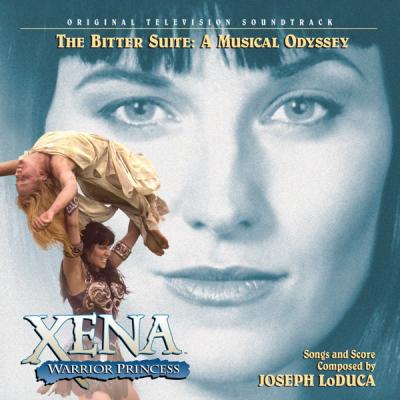
"Xena: Warrior Princess: The Bitter Suite" Soundtrack Lyrics
TV • 1998
Track Listing
“Xena: Warrior Princess — The Bitter Suite: A Musical Odyssey (Original Television Soundtrack)” – Album Guide to Tracks and Key Scenes
Overview
How do you fix a friendship broken by grief — swordfight or duet? The Bitter Suite (aired February 2, 1998) answers with the series’ audacious musical: Xena and Gabrielle are pulled into Illusia, a dream-realm that turns blame into ballads and confession into counterpoint. The companion album, The Bitter Suite: A Musical Odyssey, preserves the episode as a through-composed journey: recitatives, set-pieces, and reprises that move like a stage show in under 45 minutes.
Composer Joseph LoDuca threads folk-modal harmony, tango, cabaret, and choral writing through character-driven songs. The music doesn’t pause the story — it is the story, mapping their rupture (Solan/Hope fallout) to a healing arc: accusation → trial → truth → mercy. Two centerpiece numbers (“Hearts Are Hurting” and “The Love of Your Love”) do the heavy lifting, with Illusia’s guides — Callisto, Ares, and Joxer — nudging the revelations along.
Genres & phases: cabaret & waltz — temptation and misdirection; liturgical/choral touches — judgment and absolution; tango — desire entangled with power; folk ballad — grief laid bare; orchestral finale — reconciliation as destiny regained.
How It Was Made
Written by Chris Manheim and Steven L. Sears and directed by Oley Sassone, the musical episode was shot in November 1997 for Season 3. LoDuca composed new songs and score; vocals were a hybrid: Lucy Lawless (Xena) sang her own lines, while Hudson Leick (Callisto) was largely dubbed by Broadway star Michelle Nicastro and Renée O’Connor (Gabrielle) by singer Susan Wood. The Bitter Suite soundtrack arrived in 1998 via Varèse Sarabande as the show’s “Volume Three” album.
Tracks & Scenes
Key numbers below (not a full tracklist), with scene-level context and why each matters to the arc.
“Song of the Fool” (Ensemble)
- Where it plays:
- After Xena attacks Gabrielle on the cliff and both plunge into the sea, Illusia awakens. Joxer-as-fool introduces the rules of this sing-first reality, nudging Xena toward self-reckoning.
- Why it matters:
- Signals that logic won’t win here — only music will. It frames Illusia as a corrective theater.
“Song of Illusia / What’s Still Unwritten” (Callisto; Ensemble)
- Where it plays:
- Callisto ushers Xena through a carnival of symbols — fate’s wheel, masked jurors, shifting sets. The lyrics warn that truth and lies will trade masks in this realm.
- Why it matters:
- Temptation disguised as guidance; Callisto pushes Xena to confront cost and complicity.
“War and Peace” (Company)
- Where it plays:
- Amid Amazon ritual echoes and soldier chants, the chorus stages a mock trial of vengeance versus mercy. Visuals flicker between battlefield tableaux and tribunal.
- Why it matters:
- Turns the season’s moral argument into a crowd anthem — Xena’s wrath vs. Gabrielle’s pacifism.
“Melt Into Me / Let Go” (Callisto → Xena; then Xena)
- Where it plays:
- A tango of seduction where Callisto urges fusion (“come melt into me”), then flips into Xena’s plea to release the corrosive anger (“let go”). The staging mirrors a push-pull duet with knives sheathed.
- Why it matters:
- Back-to-back temptations — one toward oblivion, one toward surrender — clarifying the choice ahead.
“Hearts Are Hurting (Part I & II)” (Xena & Gabrielle)
- Where it plays:
- In a hall of echoes, they finally sing their accusations: Solan’s death, Hope’s lies, the betrayal that curdled love. The second part pivots from blame to admission and shared ache.
- Why it matters:
- The emotional engine of the episode — the fight becomes a duet, then a fragile truce. One of the show’s Emmy-nominated songs.
“Hate Is the Star” (Ares & Company)
- Where it plays:
- Ares steps in, trying to crown hatred as fate’s guiding light; the chorus fans flames while the set turns iron and red.
- Why it matters:
- Antagonist thesis: pain wants permanence. The number tests their progress.
“The Love of Your Love” (Xena)
- Where it plays:
- Solo confession — Xena admits the true center of her bond with Gabrielle. The melody rises over harp and strings as Illusia peels away its masks.
- Why it matters:
- The second Emmy-nominated song. It closes the circle from rage to radical tenderness.

Notes & Trivia
- Aired as Season 3, Episode 12 on February 2, 1998; often cited as TV’s template for later musical episodes.
- LoDuca’s songs earned two Emmy nominations: “Hearts Are Hurting” and “The Love of Your Love.”
- Hudson Leick’s singing was largely dubbed by Michelle Nicastro; Renée O’Connor’s by Susan Wood; Lucy Lawless, Kevin Smith, and Ted Raimi sang their own parts.
- Illusia’s imagery borrows tarot motifs (e.g., Wheel of Fortune) and occult text quotations woven into narration.
- The official album is the series’ “Soundtrack Volume Three” — a concise, story-order presentation rather than a cues dump.
Music–Story Links
- When Callisto sings “Song of Illusia,” guidance arrives as misdirection — Xena’s nemesis weaponizes melody to lure her off course.
- “Hearts Are Hurting” stages accountability: verse = accusation, chorus = empathy. The form models the reconciliation.
- “Melt Into Me / Let Go” pairs seduction with surrender — two doors out of trauma, only one leads home.
- “The Love of Your Love” reframes victory as vulnerability. The battle ends when Xena names love as motive, not weakness.
Reception & Quotes
The episode quickly became a cult favorite and a go-to example of how a non-musical series can use songs to deepen canon. The album remains the definitive way to revisit the Illusia arc on its own terms.
“A landmark detour — grief processed as operetta and it works.” Retrospective feature
“Climax of a long game storyline; the music earns the reconciliation.” TV essay
Interesting Facts
- The Varèse CD (VSD-5918) shipped in late March 1998; streaming editions present a tight nine-track program (~42 minutes).
- Filmed November 5–19, 1997 in New Zealand — slotted between two pivotal dramatic episodes to complete the arc.
- Kevin Smith (Ares) rehearsed tango sequences amid reports of a temporary on-set injury to Lucy Lawless’s knee; the number made it in.
- Illusia’s “fool” device lets Joxer steer tone from satire to sincerity without breaking diegesis.
- The episode’s success helped normalize the one-off musical in genre TV lineups thereafter.
Technical Info
- Title: Xena: Warrior Princess — The Bitter Suite: A Musical Odyssey (Original Television Soundtrack)
- Year: 1998 (episode airdate Feb 2; album 1998)
- Type: Television soundtrack (through-composed songs & score)
- Composer/Lyricist: Joseph LoDuca (songs & score); additional lyrics in places by Dennis Spiegel (credited on nominated songs)
- Label/Catalog: Varèse Sarabande — VSD-5918 (CD); later digital availability
- Key numbers referenced: “Song of the Fool”; “Song of Illusia / What’s Still Unwritten”; “War and Peace”; “Melt Into Me / Let Go”; “Hearts Are Hurting (I & II)”; “Hate Is the Star”; “The Love of Your Love.”
- Episode creatives: Writers Chris Manheim & Steven L. Sears; Director Oley Sassone
- Availability: CD (1998); streaming on major platforms
Questions & Answers
- Is this the same musical as “Lyre, Lyre, Hearts on Fire”?
- No. The Bitter Suite (1998) is an original, through-composed episode; Lyre, Lyre (2000) is a covers-heavy, comic battle-of-the-bands.
- Who actually sings on the episode/album?
- Lucy Lawless, Kevin Smith and Ted Raimi sing their roles; Hudson Leick is largely dubbed by Michelle Nicastro; Renée O’Connor by Susan Wood.
- Why do the lyrics mention tarot-like imagery?
- Illusia’s staging borrows tarot symbols (e.g., Fate’s wheel) and esoteric text fragments to literalize inner judgment.
- What awards did the music receive?
- Emmy nominations for Outstanding Music and Lyrics for “Hearts Are Hurting” and “The Love of Your Love.”
- Is the album a full cue dump?
- No — it’s sequenced like a short cast album, tracking the story beats in order rather than listing every underscore fragment.
Key Contributors
| Entity | Relation |
|---|---|
| Joseph LoDuca | Composer/Lyricist — wrote songs & score; album assembly |
| Dennis Spiegel | Lyricist — credited collaborator on nominated songs |
| Lucy Lawless | Performer — Xena; lead vocals on “The Love of Your Love” & others |
| Renée O’Connor | Performer — Gabrielle; vocals dubbed by Susan Wood |
| Hudson Leick | Performer — Callisto; singing dubbed by Michelle Nicastro |
| Kevin Smith | Performer — Ares; sings in tango/ensemble sequences |
| Ted Raimi | Performer — Joxer; “fool” framing & vocals |
| Chris Manheim & Steven L. Sears | Writers — episode teleplay/story |
| Oley Sassone | Director — staging of musical sequences |
| Varèse Sarabande | Label — released 1998 soundtrack (VSD-5918) |
Sources: Episode page & production notes; soundtrack label/catalog references; streaming storefronts (album program/credit lines); promo trailer IDs; lyric/track references from reputable guides and transcripts; retrospective pieces on tarot imagery and reception.
November, 19th 2025
A-Z Lyrics Universe
Cynthia Erivo Popular
Ariana Grande Horsepower
Post Malone Ain't No Love in Oklahoma
Luke Combs Good Riddance (Time of Your Life)
Green Day Bye Bye Bye
*NSYNC You're the One That I Wan
John Travolta & Olivia Newton-John I Always Wanted a Brother
Braelyn Rankins, Theo Somolu, Kelvin Harrison Jr. and Aaron Pierre The Power of Love
Frankie Goes to Hollywood Beyond
Auli’i Cravalho feat. Rachel House MORE ›