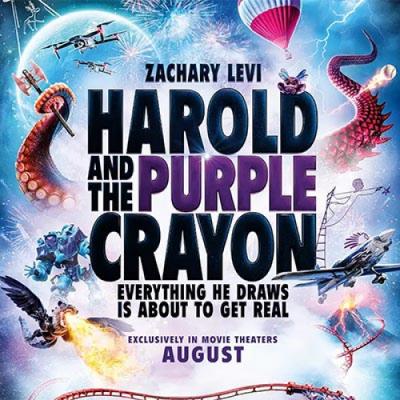
"Harold and the Purple Crayon" Soundtrack Lyrics
Movie • 2024
Track Listing
Batz
Apollo 440
FITZ
Ludwig van Beethoven
Leo Delibes
(Traditional)
(Traditional)
Claude Debussy
Franz Liszt
Danger Twins
Jordy Searcy and Boots Ottestad
"Harold and the Purple Crayon (Original Motion Picture Soundtrack)" Soundtrack Description
Overview
What happens when a minimalist picture-book becomes a live-action fantasy? The music has to bridge the gap. Harold and the Purple Crayon (2024) leans on Batu Sener’s playful, melody-forward orchestral score and a handful of recognizable needle drops—children’s tunes and classical warhorses—to sell a world where drawings “pop” into reality.
The soundtrack’s identity is twofold: Sener’s original score (released by Madison Gate Records on Aug 2, 2024) provides the film’s heart and comic timing, while a compact set of licensed tracks—Apollo 440’s “Stop the Rock,” FITZ’s “Spaceman,” the operatic “Flower Duet,” and simple piano staples like “Chopsticks” and “Für Elise”—deliver quick, readable musical jokes and bursts of energy. An original credit song, “Colors,” performed by Jordy Searcy and Boots Ottestad, closes the film on a clean thematic statement about imagination.
Questions & Answers
- Who composed the score?
- Batu Sener composed the original score; the album was released by Madison Gate Records on August 2, 2024.
- Is there an original song?
- Yes. “Colors” by Jordy Searcy & Boots Ottestad plays over the end credits and appears on the official album.
- Are the famous classical cues actually in the film?
- Yes. Short excerpts of “Für Elise,” “Arabesque No. 1,” “Hungarian Rhapsody No. 2,” and Delibes’ “Flower Duet” are used as recognizable quotes.
- Does the score use a recurring theme for Harold?
- Yes. A bright, stepwise motif (see tracks like “The Crayon Overture” and “Harold’s Theme” on the album) recurs across cues.
- What label released the soundtrack?
- Madison Gate Records (digital release; 23 tracks, ~61 minutes).
- Is the music from the 2001 TV series reused?
- No. The film features a new score by Batu Sener; the TV theme (Van Dyke Parks/Grant Geissman) is not credited in the movie.
Notes & Trivia
- “Colors” functions as a compact mission statement for the film’s imagination theme and was issued with a lyric video alongside release.
- Score production involved John Powell as a score consultant; Sener previously contributed additional music to Powell projects.
- The sound editorial emphasized “real” textures: the chalk’s scratch and the “pop” when drawings become tangible were mixed to read clearly over music.
- Several public-domain children’s tunes are used specifically because kids instantly recognize them from early piano lessons.
- The score album includes piano-only bonus cues (“Harold’s Theme,” “Crayon Tune”) not foregrounded in the film.
Genres & Themes
Orchestral adventure & whimsy: buoyant woodwinds, pizzicato strings, and bright brass announce discovery beats and comic pratfalls while keeping pacing light.
Classical mini-quotes as gags: fragments of Beethoven, Debussy, Liszt, and Delibes signal “music anyone can place in two seconds,” which the film uses for quick character or situational irony.
Kid-core cues: “Mary Had a Little Lamb” and “Chopsticks” appear as diegetic/near-diegetic nods to childhood and beginner piano, mirroring Harold’s simple lines becoming complex outcomes.
Tracks & Scenes
Below are confirmed placements and best-sourced moments. Exact timestamps can vary by edition/home-media cueing.
“Colors” — Jordy Searcy & Boots Ottestad
Scene: Plays over the end credits; non-diegetic. Summative lyrics about belief/imagination align with Harold’s arc.
Why it matters: Functions as the film’s thesis button; the only original song created for this production.
“Stop the Rock” — Apollo 440
Scene: Featured needle-drop during an upbeat, kinetic sequence (non-diegetic). The track’s propulsive breakbeats match the film’s chase/chaos energy.
Why it matters: A late-90s big-beat hit that instantly injects momentum and broad familiarity.
“Spaceman” — FITZ
Scene: Used over a light montage/transition beat (non-diegetic). Cosmic imagery in lyrics mirrors Harold’s “draw anything” headspace.
Why it matters: Contemporary pop sheen contrasts with the orchestral score, signaling a modern real-world vibe.
“Take It” — Batz
Scene: Cut-in needle-drop underscoring a brisk, mischievous beat (non-diegetic).
Why it matters: Indie-garage snap that sells movement and attitude in seconds.
“Never Gonna Stop” — Danger Twins
Scene: Brief motivational montage cue (non-diegetic).
Why it matters: A sync-friendly anthem used widely in family trailers and promos; here it tags a can-do beat.
“Bagatelle No. 25 in A Minor (Für Elise)” — Ludwig van Beethoven
Scene: Short, on-screen/near-diegetic piano gag—instantly recognizable, the joke is that even simple lines can “create a lot,” like the crayon itself.
Why it matters: Taps into shared music-class memory for humor.
“Arabesque No. 1” — Claude Debussy
Scene: A delicate, impressionist moment underscores a calmer visual beat (non-diegetic).
Why it matters: Suggests wonder without words.
“Hungarian Rhapsody No. 2” — Franz Liszt
Scene: Comic stinger or show-off flourish (non-diegetic).
Why it matters: Cartoon-coded virtuosity used knowingly for slapstick-adjacent timing.
“The Flower Duet” (Delibes)
Scene: A genteel or “fancy” setting needle-drop juxtaposed with chaos (non-diegetic).
Why it matters: High/low contrast gag that family films love—pretty music vs. barely contained mayhem.
“Mary Had a Little Lamb” / “Chopsticks” — Traditional
Scene: Quick piano-bench cues (diegetic/near-diegetic) linked to kid-logic or beginner’s luck jokes.
Why it matters: Signals childlike simplicity turning outsized.
Score highlights worth noticing on album: “The Crayon Overture,” “Take to the Skies,” “Duel of the Crayons,” and “The Crayon Suite” are standout set-pieces on the Madison Gate Records release.
Music–Story Links
Harold’s motif arrives whenever he shifts from confusion to invention; the theme’s upward motion suggests ideas clicking into place. Big-beat or pop cues step in for kinetic, real-world set-pieces, signaling that he’s outside the quiet book—where things get noisy and fast. Classical quotes act like speech bubbles: one bar of “Für Elise” or the “Flower Duet” tells you “we’re being fancy now” without dialogue.
How It Was Made
Composer Batu Sener recorded a full orchestral score with buoyant woodwinds and nimble strings, produced and mixed for clarity with bright percussion to articulate on-screen timing. The album lists Tracie Turnbull and Mark Graham as orchestrators, with mastering by Anders Peterson (GS Mastering & Post). The production also engaged score consultant John Powell, consistent with Sener’s prior collaborations in the Powell orbit.
On the sound side, supervising editors Andrew DeCristofaro and Darren “Sunny” Warkentin emphasized organic reality—chalk scrapes and a signature “pop” when drawings become objects—so music and effects interlock cleanly without cartoonish overstatement.
Reception & Quotes
Critical response to the film was mixed-to-negative, while the score album drew notices for craft and tunefulness. Representative snapshots:
“Swaps in formula for magic.” Variety
“Might be worse than you imagined.” Vulture
“Garish and charmless.” The Guardian
“Family-friendly with imagination front-and-center.” Common Sense Media
The score album released day-and-date with the U.S. theatrical opening (Aug 2, 2024).
Additional Info
- The official album runs ~61 minutes across 23 tracks; two solo-piano bonuses close the set.
- Digital availability: Apple Music, Spotify, Amazon; issued by Madison Gate Records (Columbia Pictures imprint).
- The end-credits single “Colors” is the only original non-score vocal track tied to the film.
- Needle-drops are compact—no sprawling pop soundtrack; the score does the heavy lifting.
- Short classical/public-domain cues help with budget-friendly recognition while staying family-accessible.
Technical Info
- Title: Harold and the Purple Crayon (Original Motion Picture Soundtrack)
- Year: 2024
- Type: Score + select licensed songs
- Composer: Batu Sener
- Score Orchestrators: Tracie Turnbull, Mark Graham
- Mastering: Anders Peterson (GS Mastering & Post)
- Label: Madison Gate Records (digital, Aug 2, 2024)
- Notable placements: “Colors” (end credits); “Stop the Rock,” “Spaceman,” “Take It,” “Flower Duet,” “Für Elise,” “Arabesque No. 1,” “Hungarian Rhapsody No. 2,” “Mary Had a Little Lamb,” “Chopsticks.”
- Running time (album): ~61 minutes (23 tracks)
- Film runtime: ~90 minutes (U.S. theatrical cut)
Canonical Entities & Relations
| Subject | Relation | Object |
|---|---|---|
| Harold and the Purple Crayon (2024 film) | music by | Batu Sener |
| Madison Gate Records | released | Harold and the Purple Crayon (Original Motion Picture Soundtrack) |
| “Colors” | performed by | Jordy Searcy & Boots Ottestad |
| “Stop the Rock” | performed by | Apollo 440 |
| “Spaceman” | performed by | FITZ |
| “Take It” | performed by | Batz |
| “Flower Duet” | composed by | Léo Delibes |
| “Für Elise” | composed by | Ludwig van Beethoven |
Sources: Wikipedia (film page), TheWrap, IMDb (Soundtracks), Film Music Reporter, Madison Gate Records, Post Magazine, Apple Music, Spotify, Metacritic, Variety, Vulture, The Guardian, Common Sense Media.
November, 10th 2025
A-Z Lyrics Universe
Cynthia Erivo Popular
Ariana Grande Horsepower
Post Malone Ain't No Love in Oklahoma
Luke Combs Good Riddance (Time of Your Life)
Green Day Bye Bye Bye
*NSYNC You're the One That I Wan
John Travolta & Olivia Newton-John I Always Wanted a Brother
Braelyn Rankins, Theo Somolu, Kelvin Harrison Jr. and Aaron Pierre The Power of Love
Frankie Goes to Hollywood Beyond
Auli’i Cravalho feat. Rachel House MORE ›