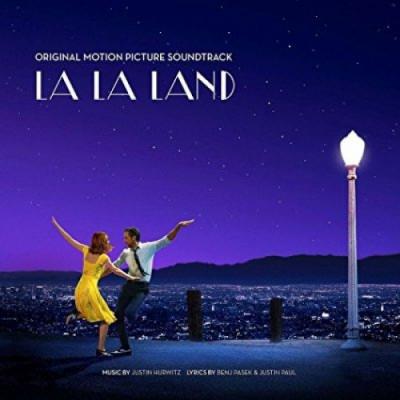
"La La Land" Soundtrack Lyrics
Movie • 2016
Track Listing
Emma Stone
Emma Stone, Callie Hernandez, Sonoya Mizuno, Jessica Rothe
Ryan Gosling, Emma Stone
Ryan Gosling
John Legend
Emma Stone
"La La Land: Original Motion Picture Soundtrack" – Album Guide to Tracks and Key Scenes
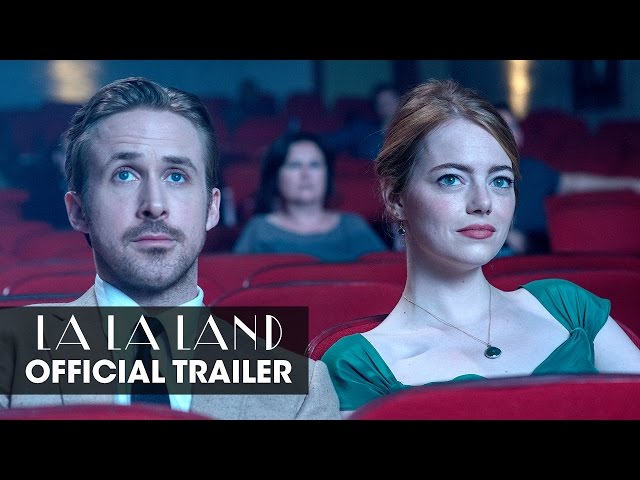
TL;DR
La La Land: Original Motion Picture Soundtrack is the song-and-score album for Damien Chazelle's 2016 musical about actress Mia Dolan and jazz pianist Sebastian Wilder. Justin Hurwitz composed the music, while Benj Pasek and Justin Paul wrote the lyrics for the principal songs; John Legend, Hurwitz, and Marius de Vries wrote "Start a Fire." The La La Land: Original Motion Picture Soundtrack album joins cast vocals, jazz motifs, orchestral cues, and pop production into a 45-minute account of the film's romance. Its lyrics track ambition closely: each promise of success carries a private cost.
Review
Why does a romance sound most hopeful when its ending is already moving out of reach? La La Land opens with "Another Day of Sun," where stalled Los Angeles traffic turns into a six-minute musical production. The film then narrows its focus to Mia, an aspiring actress played by Emma Stone, and Sebastian, a pianist played by Ryan Gosling. Their courtship moves through pool parties, jazz clubs, Griffith Park, the Hermosa Beach pier, and the Griffith Observatory. Hurwitz gives those locations a shared musical memory, so the final glance between Mia and Sebastian recalls melodies heard two hours earlier.
The album's strongest choice is its restraint. Gosling sings "City of Stars" with an exposed, conversational voice rather than a polished Broadway belt. Stone shapes "Audition (The Fools Who Dream)" around pauses, changes of tempo, and breath. Those performances fit characters who are talented but still testing their nerve. The standard album also alternates songs with concise instrumental cues, including "Mia & Sebastian's Theme," "Planetarium," and "Epilogue." That sequence lets the listener hear the relationship change without dialogue or images.
The soundtrack changes genre as the characters change. Brassy ensemble writing gives "Another Day of Sun" public optimism, while the quieter jazz piano material gives Sebastian a private language. The light tap rhythm of "A Lovely Night" turns denial into flirtation. "Start a Fire" replaces acoustic jazz intimacy with electric bass, synthesizers, a firm pop beat, and arena staging; its commercial polish matches Sebastian's growing career and Mia's concern that he has abandoned his original plan. The orchestral "Epilogue" combines these earlier styles because the film is revisiting an entire relationship rather than one isolated feeling.
How It Was Made
Damien Chazelle and Justin Hurwitz began developing the musical years before its 2016 release. The pair met at Harvard and pursued the idea of placing an MGM-style musical inside contemporary Los Angeles. Hurwitz reportedly prepared a vast number of piano demonstrations while Chazelle tested melodies against the screenplay. Their method placed musical themes inside the story before the cameras rolled, which explains why the principal melodies return with altered arrangements.
Benj Pasek and Justin Paul supplied lyrics for the central songs. Hurwitz wrote the melodies first, then the lyricists shaped words around character goals, rhythmic demands, and Chazelle's story. "City of Stars" needed enough simplicity to work as Sebastian's solitary pier song and as a later duet with Mia. "Audition" needed a flexible structure because Mia begins with a spoken memory, builds toward a declaration, and ends without a conventional show-stopping finish.
Music producer Marius de Vries and music supervisor Steven Gizicki helped connect composition, recording, playback, and filming. John Legend worked with Hurwitz and de Vries on "Start a Fire," which had to sound credible as a contemporary hit for Keith's band. The production deliberately made the song attractive. Its conflict comes through context: Sebastian receives applause while Mia watches him play music that differs sharply from the club he once described.
Ryan Gosling trained at the piano so Chazelle could photograph his hands and face in the same uninterrupted shots. Emma Stone recorded the casting-room performance of "Audition" live on set, giving her control over pauses and tempo. The freeway production for "Another Day of Sun" required a closed interchange ramp, dozens of performers, moving vehicles, extensive rehearsal, and concealed edits designed to resemble one continuous shot.
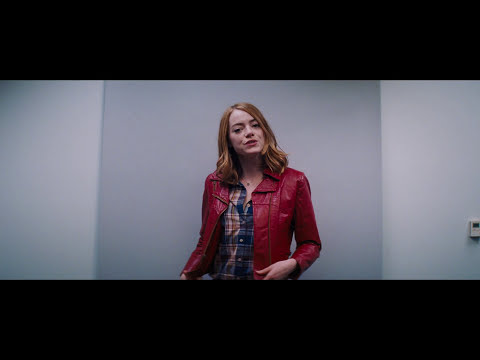
Tracks & Scenes
The time marks below are approximate and can vary by release, distributor logo, streaming edit, or playback format. Diegetic music is heard or performed inside the characters' world; non-diegetic music is supplied primarily for the audience.
"Another Day of Sun" (La La Land Cast)
- Where it plays:
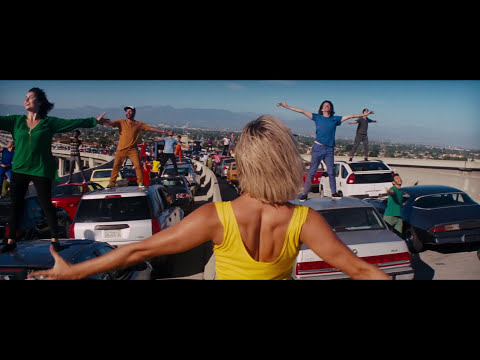
- The song begins during the opening minutes, approximately 00:01-00:06, on the Judge Harry Pregerson Interchange. A woman steps from her car during a traffic jam, and nearby drivers join her across car roofs, traffic barriers, and the roadway. The performance behaves like a classic non-diegetic musical number, although the dancers interact physically with the cars and environment. The last pose ends abruptly, horns return, and the camera finds Mia and Sebastian trapped in ordinary traffic.
- Why it matters:
- The lyrics introduce artists who reach Los Angeles after personal setbacks. The bright arrangement creates collective confidence, but individual verses mention failed relationships, financial strain, and repeated rejection. The cut back to angry drivers establishes the film's recurring gap between imagined success and daily inconvenience.
"Someone in the Crowd" (Emma Stone, Callie Hernandez, Sonoya Mizuno, and Jessica Rothe)
- Where it plays:
- The number arrives around 00:12-00:19 after Mia's roommates persuade her to attend a Hollywood Hills party. The scene begins inside their apartment, where clothes, makeup, doors, and hallway movements land on musical beats. It expands into a non-diegetic party sequence with synchronized dancers beside a pool. Mia eventually separates from the crowd and searches the rooms alone before the pool jump completes the number.
- Why it matters:
- The song treats networking as a lottery ticket: one encounter might change a career. Mia participates in the choreography but looks isolated once she enters the party. That visual split explains why professional opportunity and social belonging never become the same thing for her.
"Take On Me" (performed in the film by the party cover band)
- Where it plays:
- The 1980s pop song appears at a pool party around 00:26-00:28. The band performs it diegetically while guests dance and talk. Mia recognizes Sebastian behind the keyboard after their unpleasant restaurant encounter. She requests "I Ran" partly to embarrass him, and Sebastian cannot refuse without disrupting his paid job.
- Why it matters:
- The familiar party music strips Sebastian of the artistic seriousness he displayed at the restaurant piano. Mia gains comic control of the encounter, while Sebastian's expression reveals the distance between his jazz ambitions and his current work. The recording is a source cue and is absent from the standard soundtrack album.
"I Ran (So Far Away)" (performed in the film by the party cover band)
- Where it plays:
- Mia requests the song during the same pool-party sequence, approximately 00:28-00:29. Sebastian plays the keytar while maintaining eye contact with her, and the lyrics create a joke about his inability to escape the engagement. Their argument continues after the performance when both characters walk toward their parked cars.
- Why it matters:
- The scene converts their earlier hostility into competitive flirtation. Mia learns that Sebastian's professional life includes compromise, while Sebastian realizes that she can puncture his self-importance. Like the other party covers, the song does not appear on the 15-selection standard OST.
"Tainted Love" (performed in the film by the party cover band)
- Where it plays:
- The cover is heard diegetically during the pool-party material, close to the "Take On Me" and "I Ran" sequence. Guests treat the performance as background entertainment while Mia and Sebastian concentrate on their private contest. Its exact placement can shift slightly depending on the cut and credit timing used by a platform.
- Why it matters:
- The recognizable lyric supplies an ironic preview of a romance that will combine affection with frustration. The song also places Sebastian in a commercial nostalgia act, which contrasts with his later arguments for live jazz as a changing, present-tense form.
"A Lovely Night" (Ryan Gosling and Emma Stone)
- Where it plays:
- The hilltop duet begins around 00:31 and runs for about four minutes near Cathy's Corner in Griffith Park. Mia and Sebastian have left the party and found their cars after sunset. They complain that the setting offers romantic potential but insist that neither feels attracted to the other. Their conversation becomes a tap routine involving a bench, a lamppost, synchronized turns, and deliberately competitive footwork.
- Why it matters:
- The music contradicts the dialogue without requiring either character to confess. Their bodies cooperate while their lyrics resist the obvious attraction. Chazelle keeps both performers visible in extended shots, so the audience watches trust develop through shared timing.
"Mia & Sebastian's Theme" (Justin Hurwitz)
- Where it plays:
- The piano theme first becomes prominent when Mia hears Sebastian performing at the restaurant, roughly 00:21-00:24. Conversation and room noise recede as the camera moves toward him. The melody returns in instrumental transitions, romantic scenes, and the final jazz-club sequence. Some appearances are diegetic because Sebastian plays the piano; later orchestral versions function as non-diegetic score.
- Why it matters:
- The theme belongs to their shared history rather than one character alone. Its first form is sparse and unresolved. The "Epilogue" later expands the same melody into a full orchestral fantasy, allowing one brief piano phrase to reopen years of memory.
"Herman's Habit" (Justin Hurwitz)
- Where it plays:
- The jazz performance is heard at the Lighthouse Café after Sebastian introduces Mia to the music he values, around 00:39-00:42. Musicians trade phrases in a crowded club while Sebastian explains that jazz depends on conflict, listening, and improvisation. The performance is diegetic because the band appears inside the club and the characters respond to it.
- Why it matters:
- The scene gives Sebastian's ambition a physical setting and working musicians rather than an abstract speech. His explanation also describes the film's romance: two independent people respond to each other without surrendering their separate aims.
"City of Stars" (Ryan Gosling)
- Where it plays:
- Sebastian sings the solo version on the Hermosa Beach pier at approximately 00:46-00:48. He walks beneath the lamps, whistles the melody, and sings with minimal accompaniment. The presentation begins as a private, quasi-diegetic performance and expands gently for the audience. No crowd gathers, and no applause follows.
- Why it matters:
- The uncertain vocal asks whether Los Angeles contains love, recognition, or another disappointment. Gosling's limited vibrato suits a character thinking aloud. The short performance also leaves musical space for the later duet, where Mia adds harmony and changes the song's social meaning.
"Planetarium" (Justin Hurwitz)
- Where it plays:
- The cue accompanies Mia and Sebastian's visit to the Griffith Observatory, approximately 00:53-00:58. After watching Rebel Without a Cause at the Rialto Theatre, they enter the observatory and move beneath the projected stars. Gravity disappears within the musical fantasy, and the couple dances through the planetarium before sharing their first kiss.
- Why it matters:
- The orchestra enlarges attraction into a temporary universe with its own physical rules. The sequence borrows the visual scale of a Hollywood dream ballet, but the recurring piano theme keeps the fantasy connected to Sebastian's earlier restaurant performance.
"Summer Montage / Madeline" (Justin Hurwitz)
- Where it plays:
- The cue accompanies the early period of Mia and Sebastian's relationship, roughly around 01:00-01:03. Their dates, walks, music, and shared routines pass in a compressed montage. The jazz arrangement functions primarily as non-diegetic score, although its style remains connected to the clubs and piano performances inside the story.
- Why it matters:
- The rapid pace removes the uncertainty heard in the first "City of Stars." Romance now appears easy because the montage omits practical conflicts. The film later slows down when touring, work, and missed obligations begin to occupy their time.
"Start a Fire" (John Legend)
- Where it plays:
- Keith's band performs the song at a large concert around 01:12-01:16. Sebastian plays keyboards beneath stage lights as dancers, electronic textures, and a strong backbeat surround the band. The performance is fully diegetic. Mia watches from the audience, but her guarded reaction differs from the crowd's enthusiasm.
- Why it matters:
- The song gives Sebastian money, touring work, and public attention. Its polished production also reveals the scale of his compromise. The scene avoids treating the music as incompetent; the conflict concerns Sebastian's stated goal of opening a traditional jazz club and Mia's fear that he has stopped pursuing it.
"City of Stars" (Ryan Gosling and Emma Stone duet)
- Where it plays:
- The duet appears in Sebastian's apartment during their relationship, approximately 01:18-01:21. Sebastian plays piano while Mia joins him, and domestic actions occur around the performance. Their voices overlap without the large orchestra used elsewhere. The song is diegetic at the piano and receives light score support.
- Why it matters:
- The pier version asked whether Sebastian would find a meaningful connection. The duet supplies an answer because Mia now completes his phrases. Its modest arrangement also makes the later separation feel personal rather than melodramatic.
"Engagement Party" (Justin Hurwitz)
- Where it plays:
- The instrumental cue appears as Mia and Sebastian's relationship enters a strained period. Sebastian's tour schedule and Mia's one-woman play have altered their routines. The cue works as non-diegetic score and develops familiar melodic material with less romantic certainty.
- Why it matters:
- The music recalls the earlier courtship without recreating its energy. That difference tells the listener that familiarity remains even as the couple's daily lives move apart.
"Audition (The Fools Who Dream)" (Emma Stone)
- Where it plays:
- Mia performs the song during a callback near the end of the film, approximately 01:47-01:51. Casting staff ask her to tell a story rather than read prepared dialogue. She describes an aunt who jumped into the Seine, and the room falls away into darkness as a spotlight isolates her. Stone's live vocal changes pace as memory becomes an argument for people who accept embarrassment and failure.
- Why it matters:
- The audition converts Mia's accumulated rejection into usable experience. She no longer waits for a conventional role to validate her. The song also states the film's position on artistic risk shortly before the story reveals that her risk produced a successful career.
"Epilogue" (Justin Hurwitz)
- Where it plays:
- The extended cue begins when Mia enters Sebastian's jazz club with her husband, roughly 01:57-02:05. Sebastian sees her, sits at the piano, and plays their theme. The film then imagines an alternate life in which their first encounter, courtship, professional breakthroughs, marriage, and family follow a different path. The sequence is predominantly non-diegetic, although Sebastian's opening piano performance belongs to the club.
- Why it matters:
- The orchestra revisits "Another Day of Sun," "Someone in the Crowd," "A Lovely Night," "City of Stars," and the central piano theme. Each quotation changes the outcome of an earlier scene. When the fantasy ends, Mia and Sebastian exchange a small smile, accepting that their relationship helped create the lives they now lead.
"City of Stars" in the official trailers
- Where it plays:
- Lionsgate used "City of Stars" in promotional trailers and teaser material before the film's December 2016 theatrical expansion. The trailer edits place the melody beneath dialogue, dancing, piano shots, and images of Mia and Sebastian across Los Angeles. This use is non-diegetic promotional music rather than an additional film scene.
- Why it matters:
- The melody gave the campaign a recognizable musical identity without explaining the ending. Its modest vocal tone also distinguished the advertising from trailers built around louder ensemble numbers.
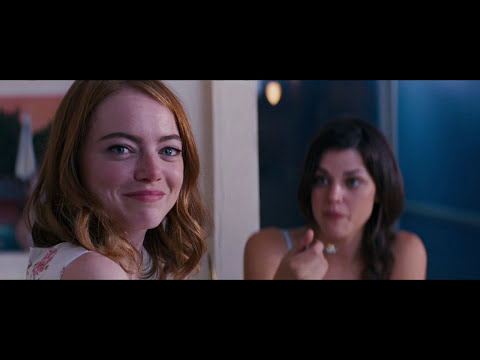
Notes & Trivia
- "City of Stars" appears first as Sebastian's solitary question and later as a duet, so the same lyrics change after Mia joins him.
- The restaurant owner fires Sebastian after he abandons the approved holiday set and plays the theme that first attracts Mia.
- Mia misses part of Sebastian's concert emotionally even while she stands in the audience; the crowd hears success, while she hears distance.
- The observatory dance begins after the projector fails during Rebel Without a Cause, so a broken film screening creates a new musical fantasy.
- The "Epilogue" corrects several painful scenes through editing and music, but it does not erase the careers Mia and Sebastian achieved separately.
- The party covers make Sebastian look unfashionable and employed at the same time, which complicates his later speeches about artistic purity.
- Mia's final audition begins without sheet music or a prepared text. Her ability to create under pressure completes the arc started by her interrupted café audition.
Reception & Quotes
The album reached number two on the US Billboard 200 in January 2017. It later reached number one on the UK Official Albums Chart, becoming the first soundtrack to lead that chart since the 2013 cast recording of Les Misérables. The Academy awarded Justin Hurwitz Best Original Score at the 89th Academy Awards. "City of Stars" won Best Original Song for Hurwitz, Benj Pasek, and Justin Paul, while "Audition (The Fools Who Dream)" received a nomination in the same category.
Critical response divided over the film's deliberate nostalgia, but reviewers consistently treated the music as central to the argument. Richard Lawson praised the early songs and staging in Vanity Fair, while Richard Brody's New Yorker review found the musical sequences overly calculated. That disagreement is useful: the soundtrack depends on rehearsal and formal control, yet its most affecting vocals preserve breath, hesitation, and imperfect surfaces.
Is there a way to do a big, full-fledged MGM-style musical in a completely modern setting?Damien Chazelle, Time
The first third of La La Land promises a film of almost otherworldly style and clever heart.Richard Lawson, Vanity Fair
Interscope released the standard soundtrack digitally and physically on December 9, 2016. The principal edition contains 15 selections and runs approximately 45 minutes and 53 seconds. La La Land: The Complete Musical Experience later expanded the listening program with dialogue and additional material. A separate original-score edition offers a broader selection of Hurwitz's instrumental writing. Catalog availability and physical configurations can differ by country and retailer.
Interesting Facts
- Hurwitz and Chazelle developed versions of La La Land for years before financing followed the success of Whiplash.
- The freeway number was filmed on an interchange ramp during a weekend closure rather than on a studio road.
- The apparent single take in "Another Day of Sun" contains concealed transitions that preserve the illusion of uninterrupted movement.
- Gosling's piano training allowed cinematographer Linus Sandgren to frame his face, hands, and instrument together.
- "Start a Fire" was designed as a plausible hit, because an obviously poor song would make Sebastian's decision too simple.
- The standard album omits several source songs heard at parties, restaurants, and clubs.
- The soundtrack combines original cast songs and selected score cues rather than presenting every piece heard in the film.
- The UK chart success placed a newly written film musical beside long-running soundtrack sellers associated with established stage properties.
- The "Epilogue" works like a compressed second film: it changes blocking, production design, relationships, and music while preserving the original characters.
Technical Info (Quick Facts)
- Title: La La Land: Original Motion Picture Soundtrack
- Year: 2016
- Type: Feature-film soundtrack album with original songs and selected score cues
- Associated work: La La Land, directed by Damien Chazelle
- Principal composer: Justin Hurwitz
- Principal lyricists: Benj Pasek and Justin Paul
- "Start a Fire" writers: John Legend, Justin Hurwitz, and Marius de Vries
- Music supervision: Steven Gizicki
- Album producers: Justin Hurwitz, Marius de Vries, and Steven Gizicki
- Label: Interscope Records
- Standard album release: December 9, 2016
- Standard running time: Approximately 45 minutes and 53 seconds
- Standard program: 15 selections on major streaming listings; some retailer metadata counts configurations differently
- Selected notable placements: "Another Day of Sun," "A Lovely Night," "City of Stars," "Start a Fire," "Audition," and "Epilogue"
- Non-album source music: Party performances include covers of "Take On Me," "I Ran," and "Tainted Love"
- US chart peak: Number two on the Billboard 200
- UK chart peak: Number one on the Official Albums Chart
- Academy Awards: Best Original Score and Best Original Song for "City of Stars"
- Expanded editions: The Complete Musical Experience and a separate original-score release
- Information checked: August 4, 2026
Key Contributors
| Subject | Relation | Object |
|---|---|---|
| Damien Chazelle | directed and wrote | La La Land |
| Justin Hurwitz | composed and orchestrated | the songs and score for La La Land |
| Benj Pasek | wrote lyrics for | the principal original songs |
| Justin Paul | wrote lyrics for | the principal original songs |
| Marius de Vries | produced music and co-wrote | "Start a Fire" |
| Steven Gizicki | supervised and produced music for | La La Land |
| John Legend | co-wrote and performed | "Start a Fire" |
| Emma Stone | performed | "Someone in the Crowd," "A Lovely Night," "City of Stars," and "Audition" |
| Ryan Gosling | performed | "A Lovely Night" and "City of Stars" |
| Interscope Records | released | La La Land: Original Motion Picture Soundtrack |
| Lionsgate | distributed and promoted | La La Land in the United States |
| Judge Harry Pregerson Interchange | provided the filming location for | "Another Day of Sun" |
| Griffith Observatory | provided the setting for | the "Planetarium" sequence |
| The Lighthouse Café | provided the setting for | Sebastian's jazz-club lesson to Mia |
Sources: Academy of Motion Picture Arts and Sciences; Billboard; Official Charts Company; Interscope Records; Lionsgate Movies; Spotify; GQ; Time; Vanity Fair; The New Yorker; Variety; The Guardian; La La Land soundtrack and production materials.
August, 04th 2026
A-Z Lyrics Universe
Cynthia Erivo Popular
Ariana Grande Horsepower
Post Malone Ain't No Love in Oklahoma
Luke Combs Good Riddance (Time of Your Life)
Green Day Bye Bye Bye
*NSYNC You're the One That I Wan
John Travolta & Olivia Newton-John I Always Wanted a Brother
Braelyn Rankins, Theo Somolu, Kelvin Harrison Jr. and Aaron Pierre The Power of Love
Frankie Goes to Hollywood Beyond
Auli’i Cravalho feat. Rachel House MORE ›