City of Stars (Duet) Lyrics
Soundtrack Album: La La Land
City of stars, Are you shining just for me?
City of stars, There's so much that i can't see. Who knows,
I felt it from the first embrace
I shared with you...
That now Our dreams,
They've finally come true.
City of stars, Just one thing everybody wants. There in the bars, and through the smokescreen of the crowded restaurants,
It's love,
Yes, all we're looking for is love
From someone else...
- A rush,
- A glance,
- A touch,
- A dance,
To look in somebody's eyes,
To light up the skies,
To open the world and send me whirly,
A voice that says,
I'll be here, and you'll be alright.
I don't care if I know
Just where I will go
'Cause all that I need, this crazy feeling, Ra-ta-tat of my heart
I think I wanted to stay.
City of stars, Are you shining just for me?
City of stars,
You never shined so brightly.
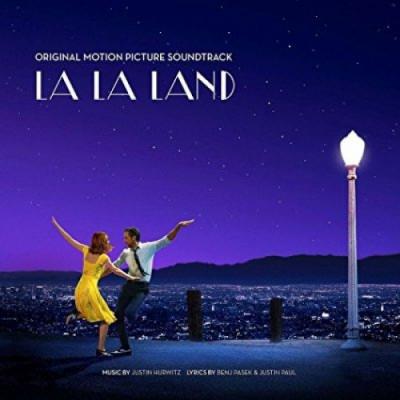
La La Land
Soundtrack Lyrics for Movie, 2016
Track Listing
Emma Stone
Emma Stone, Callie Hernandez, Sonoya Mizuno, Jessica Rothe
Ryan Gosling, Emma Stone
Ryan Gosling
John Legend
Emma Stone
Song Overview
Ryan Gosling and Emma Stone's "City of Stars" lyrics connect romantic love with the artistic ambitions of Sebastian and Mia in the 2016 film La La Land. Justin Hurwitz's piano-led duet reprises Sebastian's earlier pier solo, but Mia now helps complete the song as their uncertain courtship becomes a shared vision of love, acting, music, and Los Angeles.

Review and Highlights
"City of Stars" turns an unfinished solo into a duet that records the changing relationship between Sebastian and Mia. Sebastian repeats the questions heard during the earlier pier performance, but Mia supplies new lines about love, recognition, and companionship. Their shared refrain makes the completed composition part of the film's storytelling rather than a repeated soundtrack theme.
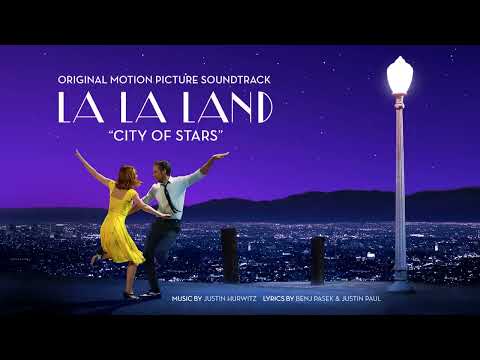
The duet begins with Sebastian's guarded questions and expands when Mia describes what people seek in bars and crowded restaurants. Her verse connects romantic longing with the experience of actors and musicians who need an audience to notice them. The song therefore treats love as personal affection, artistic recognition, and practical encouragement during repeated failure.
Justin Hurwitz keeps the arrangement centered on piano rather than a large orchestral climax. Ryan Gosling sings with a narrow, conversational range, while Emma Stone gives the middle section longer phrases and clearer projection. The contrast follows the scene's action: Sebastian begins with doubt, Mia develops the argument, and both characters claim the final refrain.
Key Takeaways
- The duet reprises Sebastian's earlier pier solo and answers its unresolved question about whether his dream can become real.
- Mia's new verse connects romantic love with an artist's need for support, attention, and recognition.
- The title image joins Los Angeles lights, film stars, destiny, and the couple's professional ambitions.
- The promise of a reassuring voice foreshadows Sebastian's absence from Mia's one-woman show.
- The heartbeat phrase converts romantic excitement into percussion inside a piano ballad.
- The qualified line "Think I want it to stay" anticipates a relationship that cannot survive both careers.
La La Land (2016) - diegetic musical performance - Sebastian plays the song on a piano inside his apartment, and Mia joins him within the story. Both characters hear and create the performance, which makes the scene diegetic. The sequence develops into a montage of their relationship and professional work, so the duet links domestic happiness with the career pressures that later divide them.
Top 7 Facts About City of Stars
"City of Stars" passed through several narrative forms before becoming the film's central duet. Its history includes Sebastian's earlier solo, Mia's added response, a separate seven-inch release, major awards, and an official soundtrack credit that distinguishes the two singers from composer Justin Hurwitz and producer Marius de Vries.
- The film presents the melody first as Sebastian's solo on a pier, then returns to it as a completed apartment duet with Mia.
- The later version answers the earlier lyric about a dream that Sebastian may never make true by declaring that their dreams have finally come true.
- The duet appeared as the second track on the 2016 seven-inch single Audition (The Fools Who Dream) / City of Stars.
- Official soundtrack credits identify Ryan Gosling and Emma Stone as the vocal artists, Justin Hurwitz as composer and producer, and Marius de Vries as producer.
- The Academy credited the music to Justin Hurwitz and the words to Benj Pasek and Justin Paul when the song won Best Original Song in 2017.
- The song reached number 54 on the United Kingdom Official Singles Chart during its 2017 chart run.
- The Recording Academy nominated Hurwitz, Pasek, and Paul for Best Song Written for Visual Media at the 60th Grammy Awards.
Creation History
Justin Hurwitz composed the melody for Damien Chazelle's original film musical, while Benj Pasek and Justin Paul wrote the words. The screenplay first gives the theme to Sebastian during a solitary pier performance, where his improvised-sounding questions express attraction and uncertainty. The apartment reprise adds Mia's verse and completes the composition as their relationship becomes secure. Interscope released the soundtrack recording on December 9, 2016, and the two-song vinyl single paired it with Emma Stone's "Audition (The Fools Who Dream)."
Lyricist Analysis
Benj Pasek and Justin Paul use flexible speech rhythm rather than a strict poetic meter. Short invocations such as "City of stars" alternate with complete conversational questions, while Mia's central passage grows into a long sentence. That expansion moves the scene from Sebastian's private uncertainty toward a shared statement about love and artistic recognition.
Metric and Scansion Analysis
The opening uses loose iambic movement, but Hurwitz's melody controls the stresses more strongly than a fixed poetic foot. "City of stars" places weight on "city" and "stars," followed by a question whose natural stress falls on "shining" and "me." Several lines enter with pickup syllables, creating anacrusis that makes Sebastian sound as though he is discovering each thought at the piano.
Mia's verse contains longer conversational units. The phrase about bars and crowded restaurants extends beyond the compact title invocation, while the chorus breaks language into brief physical images. This movement between short and extended phrases gives Mia's argument more urgency than Sebastian's opening questions.
Rhyme Scheme and Quality
The lyric follows a flexible scheme rather than a fixed ABAB pattern. "Me" and "see" form a perfect rhyme, while "wants" and "restaurants" create a stage-friendly rhyme across unequal line lengths. "Glance" and "dance" provide another clean pair before "eyes" and "skies" repeat the structure.
The writers use rhyme to make the chorus memorable without making Sebastian's opening sound rehearsed. His first verse contains pauses, questions, and incomplete certainty. Mia's section becomes more patterned because she is giving shape to feelings that Sebastian introduced but could not resolve alone.
Phonetic Texture
Sibilants appear in "stars," "shining," "see," "smokescreen," and "skies." These consonants support a close vocal delivery and echo the quiet movement of the piano. Plosives in "touch," "dance," "light," and "rat-tat-tat" interrupt that softness with brief rhythmic attacks.
The repeated open vowel in "stars," "are," "bars," and "heart" links the city image to the physical heartbeat near the chorus ending. The sound pattern allows both singers to sustain important words without using dense verbal ornament.
Prosodic Match
Natural word stress generally aligns with the main musical beats, but several entrances arrive after a pickup or across a held note. Sebastian's questions remain rhythmically hesitant, while Mia's list of gestures uses short phrases that can receive separate accents. The longest chorus sentence requires controlled breath because the melody carries the thought through eyes, skies, the opening world, and a reassuring voice.
Structural Function
The song changes function when Mia enters. Sebastian's reprise begins as a return to his earlier solo, but Mia's verse reframes his private hope as a universal search for love. The chorus then combines both voices, and the outro replaces the opening uncertainty with a shared statement that the city has never appeared brighter.
Song Meaning and Annotations
"City of Stars" describes two artists who believe their relationship has aligned romantic destiny with professional purpose. Sebastian and Mia support each other's ambitions during a period of rejection and financial instability, but several lines anticipate the later conflict between intimacy and success. The duet captures a temporary moment when both futures appear compatible.
Plot
Sebastian returns to the melody he sang alone after an early date with Mia. His first version expressed hope that Los Angeles might finally offer love or professional success, but it ended with uncertainty about another impossible dream. In the apartment scene, he repeats those opening questions and sings that an embrace has made their dreams appear real.
Mia adds a new verse about people searching for love in bars and crowded restaurants. Her response enlarges Sebastian's personal question into a statement about actors, musicians, and strangers who want somebody to recognize them. Both characters then list the gestures that can begin a relationship before declaring that their shared feeling is enough to face an unknown future.
The final refrain sounds settled within the scene, but the film later separates romantic fulfillment from professional success. Sebastian joins Keith's touring band, Mia stages a one-woman show, and their schedules create resentment. Both eventually achieve their central career goals, yet they do so outside the relationship celebrated by the duet.
Song Meaning
The title has several connected meanings. Los Angeles is the physical city whose lights surround the characters, while Hollywood stars represent the careers they pursue. Stars also suggest destiny, allowing Sebastian to ask whether love and success have finally aligned specifically for him.
The duet also examines how artists seek love through their work. Mia wants casting directors and audiences to see her as an individual rather than another rejected actor. Sebastian wants listeners to value the jazz tradition he hopes to protect through his own club. Their romantic support temporarily gives each character the recognition that the professional world withholds.
The song's central tension comes from the difference between emotional direction and practical direction. The couple says that the unknown destination does not matter because their feeling is enough. The later plot demonstrates that destinations do matter when Sebastian's touring schedule and Mia's theatrical work pull them into separate lives.
Annotations
"City of stars / Are you shining just for me?"
The opening directly reprises Sebastian's earlier pier solo. During that first performance, he seemed to invent the words while considering his attraction to Mia and his uncertain future in Los Angeles. The apartment reprise preserves the question, but Mia's presence now gives him a possible answer.
"There's so much that I can't see"
Sebastian cannot predict whether his relationship or jazz-club plan will survive. The line also establishes dramatic irony because the audience later sees the professional sacrifices, missed performance, argument, separation, and alternate life that remain invisible during this scene.
"I felt it from the first embrace I shared with you"
The identity of "you" remains deliberately flexible. Sebastian may be addressing Mia after their relationship becomes physical, but the title invocation also lets him address Los Angeles as a city that appeared to embrace his ambition when he arrived.
"That now, our dreams / They've finally come true"
The plural pronoun changes the meaning of Sebastian's earlier solo. His first version ended by wondering whether he faced another dream that he could not make real. Mia now joins him in claiming that their romantic partnership has given both professional dreams a credible future.
The statement also combines two kinds of fulfillment. Sebastian and Mia have found a partner who understands their work, and each has found an audience of one who treats the other's ambition seriously. Their support makes love and artistic recognition appear inseparable.
"Just one thing everybody wants"
Mia moves the lyric beyond the couple. The people in bars, restaurants, auditions, clubs, and theatres share a need for acceptance. Her statement includes romantic partners, but it also describes performers who create work because they want another person to see and understand it.
"Through the smokescreen of the crowded restaurants"
The smokescreen describes the crowded Los Angeles venues where people meet, work, perform, and hide disappointment. Public glamour can conceal rejection, low-paid employment, financial pressure, and uncertain careers. The image places Mia's romantic claim inside the film's less glamorous view of Hollywood labor.
"A rush, a glance / A touch, a dance"
The four short nouns compress attraction into physical actions. Their sequence resembles Mia and Sebastian's relationship, which develops through charged looks, accidental proximity, choreographed movement, and shared performance before either character states a commitment directly.
"A look in somebody's eyes / To light up the skies"
Eye contact carries unusual weight throughout the film because Mia and Sebastian often communicate through looks rather than direct statements. Damien Chazelle described Ryan Gosling and Emma Stone as a potential classic screen couple, while producer Marc Platt credited their visible chemistry. The lyric turns that casting quality into part of the story.
The line also describes an artist's desire for recognition. A casting director, audience member, musician, or romantic partner can change a person's world by looking closely rather than treating the performer as anonymous.
"To open the world and send it reeling"
The phrase describes the disorientation of new love, but it also matches the film's visual grammar. Camera movement, dance, saturated lighting, and musical transitions allow ordinary Los Angeles locations to change when Mia and Sebastian connect.
"A voice that says, 'I'll be here' / And 'you'll be alright'"
The promise defines the practical role each character plays in the other's ambition. Sebastian encourages Mia to write a one-woman show, while Mia challenges his decision to abandon his jazz-club goal for a commercially successful band.
The line later becomes an accusation through absence. Sebastian misses Mia's one-woman performance because of a band photo shoot. She experiences the small audience and professional disappointment without the person whose support had made the risk possible.
"I don't care if I know / Just where I will go"
The couple temporarily treats love as a sufficient direction. Both characters know the careers they want, but neither knows the route, cost, or location of success. Their faith in each other helps them continue during a period when external evidence offers little reason for confidence.
The later story exposes the limitation of this claim. Sebastian's route includes touring with Keith's band, while Mia's opportunity eventually takes her to Paris. Their destinations create schedules and obligations that romantic commitment cannot simply erase.
"'Cause all that I need is this crazy feeling"
The feeling represents their attraction and the impulsive decisions that love can produce. Sebastian accepts stable work with Keith's band partly because he believes he must contribute more money to the relationship, even though the music moves him away from his original club plan.
Mia responds to Sebastian's earlier support by developing her one-woman show. Their relationship motivates action, but those actions also place each character on a professional path that reduces the time available for the relationship.
"A rat-tat-tat on my heart"
The phrase is onomatopoeia because its syllables imitate a rapid heartbeat. Its hard consonants also function like a brief percussion pattern inside the quiet piano arrangement. Both singers share the phrase, so the physical excitement belongs to Mia and Sebastian rather than one narrator.
The playful wording gives the sensation a musical form. Their hearts appear to join the accompaniment, turning romantic excitement into rhythm as the duet approaches its final statement.
"Think I want it to stay"
The missing subject and the qualifier "think" preserve uncertainty inside a declaration of desire. Sebastian wants the relationship and its shared feeling to last, but he does not claim that permanence is guaranteed.
The line anticipates the film's final alternate-life sequence. Sebastian imagines a version of events in which the couple remains together while achieving both careers, yet the actual story gives them professional fulfillment through separate lives. The fantasy reveals what he wanted without rewriting the choice they made.
"You never shined so brightly"
The last line changes the opening question into apparent certainty. Los Angeles looks brighter because Sebastian and Mia now connect romantic hope with professional possibility. The brightness belongs to one stage of their lives, and the film later shows that a true feeling can remain temporary.
Romantic Love and Audience Recognition
Mia's verse links a lover's attention with an audience's attention. Both forms of recognition require somebody to look, listen, and respond. Sebastian and Mia understand each other's ambitions before the professional world rewards either person, which makes their relationship a private rehearsal for public recognition.
Los Angeles as Lover and Judge
Sebastian addresses the city with the language of romantic selection. Los Angeles can shine for him, hide possibilities, embrace him, or refuse his dream. This personification makes the city both a desired partner and an unpredictable judge of artistic value.
Support and Sacrifice
The reassuring voice represents the support that keeps both characters working after failure. That support becomes unstable when Sebastian changes his career plan, misses Mia's show, and spends long periods touring. The song therefore foreshadows a central conflict: love can motivate sacrifice, but one person's sacrifice may create distance rather than security.
The Alternate Ending
The final club sequence imagines the life Sebastian and Mia might have shared. In that fantasy, both careers succeed without requiring their separation. The scene does not prove that one character made the wrong decision, but it confirms that the desire expressed in "Think I want it to stay" remained part of Sebastian's private history.
Technical Information
Official soundtrack metadata credits Ryan Gosling and Emma Stone as the performers of the duet. Justin Hurwitz composed and produced the recording, while Marius de Vries also received a producer credit. Benj Pasek and Justin Paul wrote the words, and Interscope issued the soundtrack recording in December 2016.
- Song: City of Stars.
- Artist: Ryan Gosling and Emma Stone.
- Composer: Justin Hurwitz.
- Lyricists: Benj Pasek and Justin Paul.
- Producer: Justin Hurwitz and Marius de Vries.
- Release Date: December 9, 2016.
- Genre: Soundtrack, show tune, pop, and acoustic jazz ballad.
- Instruments: Piano, vocals, and light orchestral accompaniment.
- Label: Interscope Records.
- Mood: Hopeful, intimate, uncertain, and romantic.
- Length: 2 minutes and 29 seconds.
- Track #: 2 on the seven-inch single.
- Language: English.
- Album: Audition (The Fools Who Dream) / City of Stars - 7" Single.
- Soundtrack: La La Land: Original Motion Picture Soundtrack.
- Music style: Conversational film-musical duet with acoustic piano and jazz harmony.
- Poetic meter: Flexible speech rhythm with loose iambic movement.
Awards and Chart Positions
"City of Stars" won Best Original Song at the 89th Academy Awards on February 26, 2017. The Academy credited Justin Hurwitz for the music and Benj Pasek and Justin Paul for the words. The song also received a Golden Globe and a Grammy nomination before reaching number 54 on the United Kingdom Official Singles Chart.
| Award or Chart | Category or Peak | Result | Year |
|---|---|---|---|
| Academy Awards | Best Original Song | Winner | 2017 |
| Golden Globe Awards | Best Original Song - Motion Picture | Winner | 2017 |
| Grammy Awards | Best Song Written for Visual Media | Nominee | 2018 |
| United Kingdom Official Singles Chart | Peak position | 54 | 2017 |
Key Contributors
| Entity | Type | Contribution |
|---|---|---|
| Justin Hurwitz | Person | Justin Hurwitz composed the melody and co-produced the soundtrack recording. |
| Benj Pasek | Person | Benj Pasek co-wrote the English words. |
| Justin Paul | Person | Justin Paul co-wrote the English words. |
| Ryan Gosling | Person | Ryan Gosling performed Sebastian's vocal part and piano role. |
| Emma Stone | Person | Emma Stone performed Mia's vocal part and expanded the duet's perspective. |
| Marius de Vries | Person | Marius de Vries co-produced the soundtrack recording. |
| Damien Chazelle | Person | Damien Chazelle wrote and directed the film containing both versions of the song. |
| Interscope Records | Organization | Interscope Records released the original soundtrack recording. |
| La La Land | Work | The film uses the song to connect romance, artistic ambition, and later separation. |
| Sebastian's Apartment | Venue | The apartment contains the diegetic piano performance of the duet. |
How to Sing City of Stars
Singers should treat "City of Stars" as a private exchange rather than a projected theatre anthem. The recording depends on quiet entrances, natural English stress, controlled breath, and balanced duet phrasing. Sebastian's opening needs restraint, while Mia's longer chorus phrases require enough support to remain clear without breaking the scene's domestic scale.
- Learn the reprise: Compare Sebastian's opening with the earlier pier version so the repeated lines retain their original uncertainty.
- Mark the pickups: Identify every phrase that enters after the piano beat rather than directly on it.
- Use conversational volume: Keep the first verse close to spoken intensity and avoid broad musical-theatre projection.
- Separate Mia's images: Give "rush," "glance," "touch," and "dance" distinct attacks without inserting long pauses.
- Plan the long breath: Take a quiet breath before the passage about somebody's eyes, the skies, and the opening world.
- Match the vowels: Coordinate the sustained sounds in "stars," "eyes," "skies," and "brightly."
- Keep the heartbeat rhythmic: Sing "rat-tat-tat" with light consonants so it sounds like percussion rather than a comic effect.
- Preserve the qualifier: Do not overstate "Think I want it to stay," because its uncertainty anticipates the film's ending.
- Balance the final refrain: Blend both voices so the outro sounds shared rather than dominated by one singer.
Sources
- Official soundtrack upload - duet recording and confirmed video source
- Universal Music Group recording page - release date, performers, composer, and producer credits
- Interscope Records - official film video and soundtrack promotion
- Academy of Motion Picture Arts and Sciences - Best Original Song result and writing credits
- Academy Awards Acceptance Speech Database - winning song, film, composer, and lyricists
- Recording Academy - Grammy nominations and soundtrack awards
- Recording Academy nominations announcement - songwriting and performer credits
- Official Charts Company - United Kingdom chart peak
- Lyrics annotation page - reprise, character, foreshadowing, and alternate-ending interpretations
A-Z Lyrics Universe
Cynthia Erivo Popular
Ariana Grande Horsepower
Post Malone Ain't No Love in Oklahoma
Luke Combs Good Riddance (Time of Your Life)
Green Day Bye Bye Bye
*NSYNC You're the One That I Wan
John Travolta & Olivia Newton-John I Always Wanted a Brother
Braelyn Rankins, Theo Somolu, Kelvin Harrison Jr. and Aaron Pierre The Power of Love
Frankie Goes to Hollywood Beyond
Auli’i Cravalho feat. Rachel House MORE ›