Lose Yourself Lyrics – Eminem
Soundtrack Album: 8 Mile
[intro]
Look, if you had one shot, one opportunity
To seize everything you ever wanted
One moment
Would you capture it or just let it slip?
Yoo
[Verse]
His palms are sweaty, knees weak, arms are heavy
There's vomit on his sweater already, mom's spaghetti
He's nervous, but on the surface he looks calm and ready
To drop bombs, but he keeps on forgettin
What he wrote down, the whole crowd goes so loud
He opens his mouth, but the words won't come out
He's chokin now, everybody's jokin now
The clock's run out, time's up over, blouww!
Snap back to reality, Oh there goes gravity
Oh, there goes Rabbit, he choked
He's so mad, but he won't give up that
Is he? No
He won't have it , he knows his whole back city's ropes
It don't matter, he's dope
He knows that, but he's broke
He's so stacked that he knows
When he goes back to his mobile home, that's when it's
Back to the lab again yo
This whole rhapsody
He better go capture this moment and hope it don't pass him
[Hook]
You better lose yourself in the music, the moment
You own it, you better never let it go
You only get one shot, do not miss your chance to blow
This opportunity comes once in a lifetime yo
You better
[Verse]
The soul's escaping, through this hole that it's gaping
This world is mine for the taking
Make me king, as we move toward a, new world order
A normal life is borin, but superstardom's close to post mortar
It only grows harder, only grows hotter
He blows us all over these hoes is all on him
Coast to coast shows, he's know as the globetrotter
Lonely roads, God only knows
He's grown farther from home, he's no father
He goes home and barely knows his own daughter
But hold your nose cuz here goes the cold water
His hoes don't want him no mo, he's cold product
They moved on to the next schmoe who flows
He nose dove and sold nada
So the soap opera is told and unfolds
I suppose it's old partner, but the beat goes on
Da da dum da dum da da
[Chorus]
You better lose yourself in the music
The moment, you own it, you better never let it go (Go)
You only get one shot, do not miss your chance to blow
This opportunity comes once in a lifetime, yo
You better lose yourself in the music
The moment, you own it, you better never let it go (Go)
You only get one shot, do not miss your chance to blow
This opportunity comes once in a lifetime, yo
You better
[Hook]
No more games, I'ma change what you call rage
Tear this mothaf**kin roof off like 2 dogs caged
I was playin in the beginnin, the mood all changed
I been chewed up and spit out and booed off stage
But I kept rhymin and stepwritin the next cypher
Best believe somebody's payin the pied piper
All the pain inside amplified by the fact
That I can't get by with my 9 to 5
And I can't provide the right type of life for my family
Cuz man, these goddam food stamps don't buy diapers
And it's no movie, there's no Mekhi Phifer, this is my life
And these times are so hard and it's getting even harder
Tryin to feed and water my seed, plus
See dishonor caught up bein a father and a prima donna
Baby mama drama's screamin on and
Too much for me to wanna
Stay in one spot, another jam or not
Has gotten me to the point, I'm like a snail
I've got to formulate a plot fore I end up in jail or shot
Success is my only mothaf**kin option, failure's not
Mom, I love you, but this trail has got to go
I cannot grow old in Salem's lot
So here I go is my shot.
Feet fail me not cuz maybe the only opportunity that I got
[Chorus]
You better lose yourself in the music
The moment, you own it, you better never let it go (Go)
You only get one shot, do not miss your chance to blow
This opportunity comes once in a lifetime, yo
You better lose yourself in the music
The moment, you own it, you better never let it go (Go)
You only get one shot, do not miss your chance to blow
This opportunity comes once in a lifetime, yo
You better
[Outro]
You can do anything you set your mind to, man

8 Mile
Soundtrack Lyrics for Movie, 2002
Track Listing
Eminem
Eminem
Eminem
Obie Trice/ Eminem/ 50 Cent
50 Cent
50 Cent
D-12/50 Cent
Nas
Jay Z/Freeway
Young Zee
Gangstarr (gang Starr)
Xzibit
Macy Gray
Boomkat
Rakim
Eminem
Obie Trice
Obie Trice
50 Cent, Shady Rec. Eminem, Dr. Dre
Joe Beast
Brooklyn
Shauma
Eminem (B rabbit and Future)
Lil'ken
Rabbit(Eminem)vs. Lickety Split
Rabbit(Eminem)vs. Lotto
Rabbit(Eminem) vs. Papa Doc
Eminem
Song Overview
The Lose Yourself lyrics by Eminem are a rap narrative about performance anxiety, poverty, ambition, and the pressure to exploit a rare opportunity. The song anchors the 2002 8 Mile soundtrack with a tense guitar figure, programmed drums, keyboards, and an urgent vocal built around Jimmy "B-Rabbit" Smith Jr. Eminem packs the verses with multisyllabic rhyme chains, internal rhyme, syncopated stresses, and repeated body imagery. The record reached number one on the Billboard Hot 100, won the Academy Award for Best Original Song, and later won two Grammy Awards.

Review and Highlights
Eminem builds the song around one concrete problem: Rabbit must perform when fear has already disrupted his body, memory, and speech. The first verse turns a failed battle into physical detail, while the chorus converts that failure into an instruction. The guitar loop and hard drum accents keep the five-minute recording moving without relaxing its narrative pressure.
Key Takeaways
- The opening verse uses third-person narration to place the listener beside Jimmy Smith Jr. before the song gradually moves toward Eminem's own biography.
- The chorus reduces the story to one decision: act during the available moment or lose the opportunity.
- Internal rhymes often continue across several bars, so the rhyme system carries the story instead of stopping at line endings.
- The third verse becomes more autobiographical through references to a daughter, food stamps, family pressure, and Mekhi Phifer.
- The instrumental relies on guitar, keyboards, and programmed percussion rather than a dense stack of changing musical parts.
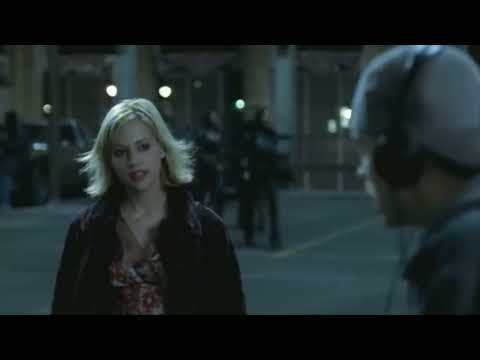
8 Mile (2002) - soundtrack recording - The complete vocal recording is non-diegetic because Rabbit and the other characters do not hear it as music. WhatSong places it at the end of the film and through the credits, while SoundtrackRadar gives an approximate start at 1:41. A subtitle timing source places the recognizable entrance near 1:45:29. The cue follows Rabbit's decision to leave the Shelter and return to work, so the chorus extends his final choice beyond the battle itself. IMDb and FilmMusic.com print the credit as written by M. Mathers, J. Bass, and L. Resto, produced and performed by Eminem, courtesy of Aftermath Entertainment/Interscope Records.
Top 8 Facts About Lose Yourself
Several details behind the record explain why its writing sounds unusually close to the film's action. Eminem reused an older musical idea, wrote during production, and recorded under the same time pressure described in the chorus. The following eight facts concern its production, film credits, alternate versions, video, and later reinterpretation rather than its chart awards.
- The instrumental began before the finished film song. In Eminem's 2015 self-annotations reported by Complex, he recalled finding an older session with Jeff Bass built around guitar chords and returning to that unused idea during 8 Mile.
- Eminem said this was the song he made specifically for the movie. He explained that director Curtis Hanson wanted music created inside the film's environment, which encouraged writing during production.
- The released verse performances were captured unusually quickly. Eminem recalled recording during a lunch break and keeping the take for each verse after later attempts failed to improve the original delivery.
- The film credit names Aftermath Entertainment/Interscope Records. IMDb and FilmMusic.com list the recording as performed by Eminem and supplied courtesy of that label partnership.
- An instrumental version appears earlier in 8 Mile. WhatSong places "Lose Yourself (Instrumental)" around 1:02 while Rabbit writes and Lily draws on her bed.
- Phillip G. Atwell, Eminem, and Paul Rosenberg directed the music video. IMDb credits all three directors to the 2002 promotional film.
- An earlier demo reached the public years later. Apple Music lists "Lose Yourself (Original Demo Version)" on the expanded 8 Mile soundtrack catalog, while the alternate demo first circulated officially with Shady XV in 2014.
- Kasey Chambers radically rearranged the song in 2022. Her official channel documents an eight-minute live country-rock interpretation recorded at Newcastle's Civic Theatre on June 15, 2022.
Song Biography
The commercial life of the song began alongside 8 Mile in October 2002 and continued through soundtrack reissues, major live performances, and streaming milestones. Amazon Music dates its 2002 soundtrack single master to October 28, while Apple Music dates the soundtrack release to October 29. Later catalog editions kept the original recording in circulation for another two decades.
Shazam credits Eminem on vocals, Jeff Bass and Luis Resto on keyboards, Eminem as producer, Jeff Bass as co-producer, Mike Strange as recording engineer, Steve King as mixing and recording engineer, and Brian Gardner as mastering engineer. Shazam also lists Marshall Mathers, Jeff Bass, and Luis Resto as the songwriters.
The Ringer traced the production to Eminem's Detroit recording circle and 54 Sound, where studio owner Joel Martin recalled the work around the song. The finished record was closely tied to a portable studio used during filming, which allowed Eminem to move between acting and recording.
The song remained active well after its original campaign. Grammy.com documented Eminem's surprise performance at the Academy Awards on February 9, 2020, seventeen years after the song won its Oscar. NME reported that the recording passed one billion Spotify streams in February 2021, a milestone Eminem acknowledged publicly.
Lyricist Analysis
Marshall Mathers writes these verses as accent-driven rap rather than strict iambic, trochaic, or anapestic poetry. The dominant unit is the musical bar, and syllable counts expand or contract around stressed rhyme targets. That flexibility lets the first verse sound physically unstable while the chorus restores a simpler stress pattern that listeners can anticipate after each narrative section.
Metric and Scansion Analysis
The verses use conversational speech-rhythm over regular 4/4 accompaniment. Natural stresses such as "palms," "sweaty," "knees," "weak," "arms," and "heavy" land as rhythmic anchors, but unstressed syllables are squeezed between them. The result resembles accentual verse because the number and placement of strong stresses matter more than a fixed number of syllables.
Anacrusis appears whenever short pickup words enter before a stronger beat, including phrases such as "Look" and "Yo." These pickups imitate spoken hesitation before the verse settles into denser rhythmic cells. Catalectic effects occur when a phrase ends abruptly on a hard stress, especially around battle language such as "blaow," where the cut-off line reproduces the finality of a battle clock.
Rhyme Scheme and Quality
A conventional ABAB map cannot describe most of the verses because Eminem creates rhyme families inside and across bars. The opening clusters "sweaty," "heavy," "already," and "ready," then shifts into chains around "loud," "out," and "now." Perfect rhyme appears beside slant rhyme, which lets normal speech continue without forcing each sentence into identical endings.
The second verse uses repeated long vowels and consonant frames across "farther," "daughter," "water," and "product." These are not uniform dictionary rhymes, but their placement on matching rhythmic points makes them function as one extended sound family. The technique makes a sixteen-bar narrative feel connected even when the syntax changes every line.
Phonetic Texture and Sound Devices
Plosives such as p, b, t, d, k, and g give the verses a percussive attack. Phrases containing "drop bombs," "clock's run out," and "back to the lab" repeatedly strike consonants against the drum pattern. Sibilants appear around words such as "success," "shot," and "seize," which create a thinner hiss before harder consonants close the phrase.
Assonance carries many of the longer passages. Eminem repeatedly preserves a vowel family while changing consonants, which allows the rhyme to remain audible without producing identical word endings. Consonance then locks nearby phrases together through recurring r, t, k, and d sounds.
Prosodic Match
Eminem places important nouns and verbs on accented musical positions while moving articles, pronouns, and auxiliary words through weaker subdivisions. Syncopation appears when a rhyme lands before or after the expected beat, then the next phrase corrects the listener's rhythmic balance. Long verse sentences also reduce breathing space, which matches the character's panic and later determination.
Structural Function
The chorus interrupts the verses with shorter syntax and repeated melodic-rhythmic shapes. Each return replaces Rabbit's changing circumstances with the same command to act. That structural repetition gives the listener a fixed reference point while the verses move through choking onstage, imagining fame, confronting poverty, and choosing another attempt.
Song Meaning and Annotations
The story begins with Jimmy Smith Jr. failing under pressure and gradually merges his situation with Eminem's own history of financial stress, parenthood, and professional ambition. The central message concerns action under limited time: fear, humiliation, and uncertainty remain present, but the narrator decides that waiting carries a greater cost than risking another public failure.
Plot
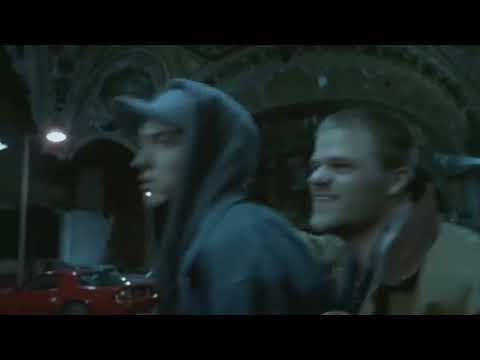
The first verse follows Rabbit before and during a failed rap battle. His body shows panic, his memorized material disappears, the crowd reacts, and time expires. He returns to ordinary life after the humiliation, but the closing bars send him back toward writing instead of surrender.
The second verse expands the possible future. Success brings touring and public attention, but the narrator imagines losing family contact and becoming disposable when popularity fades. The verse therefore treats success as another unstable condition rather than a permanent rescue.
The third verse collapses the distance between Rabbit and Marshall Mathers. References to providing for a daughter, food stamps, a nine-to-five job, and Mekhi Phifer announce that the narrator is drawing directly on Eminem's own life. The final bars return to the opening opportunity, but the speaker now acts instead of freezing.
Song Meaning
The phrase "lose yourself" describes concentrated performance rather than disappearance. Rabbit succeeds only when self-consciousness stops interrupting his ability to rap. The chorus therefore treats preparation and presence as related actions: the opportunity arrives once, but the performer must already possess enough craft to use it.
The song also refuses a simple success fantasy. Verse two imagines fame becoming isolation, distance from family, and eventual commercial decline. Verse three answers that fear with economic necessity because the narrator cannot tolerate the life represented by food stamps, unstable work, and the trailer.
Annotations
His palms are sweaty, knees weak, arms are heavy
Eminem explained in his published self-annotation that the pronoun matters: the first verse describes Jimmy Smith Jr. in third person. The body sequence converts stage fright into observable symptoms before the audience hears a single failed bar.
Snap back to reality, ope, there goes gravity
The rhyme links psychological collapse with physical falling. Rabbit loses the battle, then returns to the unchanged conditions of work, money problems, and the mobile home, so "gravity" becomes the force pulling him away from the imagined escape.
Better go capture this moment and hope it don't pass him
The final line of verse one reverses the preceding failure. Rabbit cannot change the lost battle, but he can return to writing, which makes another performance possible. The verb "capture" also anticipates the chorus's repeated demand to possess the moment.
You only get one shot, do not miss your chance to blow
The chorus converts the film's battle structure into a broader instruction. "Shot" carries the idea of a rare opportunity, while "blow" works as both sudden success and explosive release. The fixed chorus gives that instruction the same wording after every changing verse.
His soul's escaping through this hole that is gaping
The mouth becomes both an exit and an instrument. The image can describe exhaustion, but it also fits a rapper pushing private material outward through performance. The next lines immediately turn that vulnerability toward ambition and public control.
God only knows he's grown farther from home, he's no father
The line extends the second verse's cost-of-success argument. Touring creates literal distance, while "farther," "father," and the following "daughter" are placed into one sustained rhyme pattern that connects career movement with family separation.
And there's no movie, there's no Mekhi Phifer, this is my life
This line openly breaks the film frame. Mekhi Phifer plays Future in 8 Mile, so naming the actor tells the listener that the verse has crossed into Marshall Mathers's biography. The rhyme still belongs to Rabbit's story, but the financial and family stakes now belong to the rapper.
Success is my only motherfuckin' option, failure's not
The sentence removes the conditional language that dominated the opening. Rabbit originally asks whether the opportunity will be captured; the third-verse narrator declares a decision. The line also reverses the familiar "failure is not an option" construction into a statement centered on success.
To go, I cannot grow old in Salem's Lot
The title refers to Stephen King's 1975 novel Salem's Lot, where a town is consumed by vampires. Inside the verse, the reference turns the trailer and surrounding environment into a place that can drain the narrator's future if he remains there.
So here I go, it's my shot, feet, fail me not
The final body image answers the opening's weak knees and heavy arms. "Feet" now carry the speaker forward, and the phrase returns to "shot" immediately before the chorus repeats its central warning. The verse therefore ends with movement instead of paralysis.
Rhythm and Emotional Arc
The first verse begins with clipped physical observations, then accelerates as the crowd becomes louder and Rabbit loses control. Verse two extends phrases across longer rhyme chains because the narrator is imagining an entire career cycle. Verse three compresses family, employment, violence, and ambition into increasingly urgent sentences before the final commitment.
Production and Instrumentation
Shazam credits Jeff Bass and Luis Resto on keyboards, while Universal's official YouTube metadata credits Eminem with production, mixing work, and drum programming and Jeff Bass with additional production. The repeating guitar figure keeps harmonic movement limited, which leaves space for dense consonants and internal rhymes.
Idioms and Symbols
The song combines familiar idioms with film-specific images. "Back to these ropes" merges the pressure of having one's back against a wall with boxing's "on the ropes." "One shot" becomes the central opportunity symbol, while the mobile home represents a life the narrator believes he must escape.
Cultural Touchpoints
The lyrics refer directly to Mekhi Phifer, the Pied Piper story, Stephen King's Salem's Lot, and the language of boxing. These references occupy different cultural registers, but each supports a concrete problem: professional control, payment, environmental danger, or survival under pressure.
Technical Information
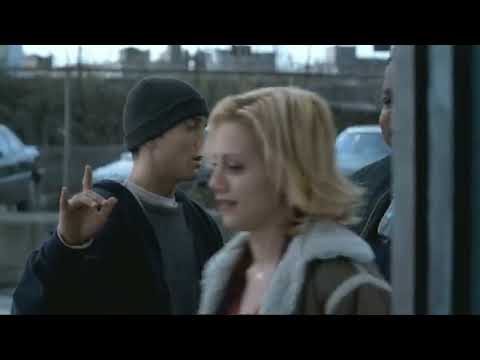
The recording combines verified catalog data with credits published by Shazam, Apple Music, Musicnotes, and Universal's official distribution metadata. Some services describe different masters, which explains the 5:20 album duration and 5:26 single or compilation duration found online. The fields below use data that can be tied to a named catalog or credit source.
- Song: Lose Yourself.
- Artist: Eminem.
- Composer: Marshall Mathers, Jeff Bass, Luis Resto.
- Producer: Eminem; Jeff Bass is credited by Shazam as co-producer.
- Release Date: October 28, 2002 for the single listing; Apple Music dates the 8 Mile soundtrack master October 29, 2002.
- Genre: Hip-Hop/Rap; Musicnotes also classifies published arrangements as Rap, Hardcore Rap, Movie/TV, and Soundtrack.
- Instruments: Vocals, keyboards, guitar-based loop, and programmed drums. Shazam credits Jeff Bass and Luis Resto on keyboards, while Universal metadata credits Eminem with drum programming.
- Label: Shady Records and Interscope Records; the film credit identifies Aftermath Entertainment/Interscope Records for the recording.
- Length: 5:26 on the Shazam and Tunebat compilation master; soundtrack editions also circulate at approximately 5:20.
- Track #: 1 on 8 Mile: Music from and Inspired by the Motion Picture.
- Language: English.
- Album: 8 Mile: Music from and Inspired by the Motion Picture.
- Music style: Narrative hip-hop with rap-rock guitar, soundtrack scoring elements, and a repeated chorus.
- Poetic meter: Accentual speech-rhythm in 4/4 rather than a strict classical foot.
Awards and Chart Positions
The song converted its film role into measurable commercial and awards success during 2002-2004. Billboard records it as Eminem's first Hot 100 number one, where it remained for 12 weeks. The Academy awarded it Best Original Song in 2003, and the Recording Academy followed with two Grammy wins at the 46th ceremony in 2004.
| Institution or Chart | Year | Result |
|---|---|---|
| Billboard Hot 100 | 2002-2003 | No. 1 for 12 weeks; Eminem's first Hot 100 No. 1. |
| Academy Awards | 2003 | Won Music - Original Song for 8 Mile; music credited to Eminem, Jeff Bass, and Luis Resto, with lyric by Eminem. |
| Grammy Awards | 2004 | Won Best Male Rap Solo Performance and Best Rap Song. |
| Grammy Awards | 2004 | Also received nominations including Record of the Year, Song of the Year, and Best Song Written for Visual Media. |
| RIAA certification | Reported in 2025 | Forbes reported the recording at 13x Platinum in the United States; the RIAA had previously documented its Diamond milestone at 10x Platinum. |
Key Contributors
| Type | Name | Contribution |
|---|---|---|
| Person | Eminem | Eminem wrote the lyric, performed the vocal, and produced the recording. |
| Person | Jeff Bass | Jeff Bass co-wrote the composition, contributed keyboards, and received a co-production credit from Shazam. |
| Person | Luis Resto | Luis Resto co-wrote the composition and played keyboards on the credited recording. |
| Person | Steve King | Steve King handled recording and mixing duties according to Shazam's production credits. |
| Person | Mike Strange | Mike Strange received a recording-engineer credit on Shazam and Universal metadata. |
| Organization | Aftermath Entertainment/Interscope Records | The 8 Mile film credit identifies the recording as supplied courtesy of Aftermath Entertainment/Interscope Records. |
| Work | 8 Mile | The 2002 film uses the complete vocal recording near its final scene and into the end credits. |
| Venue | 8 Mile production music trailer | Eminem recorded verse vocals during a lunch break in the on-set recording trailer described in his later account. |
How to Sing Lose Yourself
Performance accuracy depends more on rhythmic diction and breath control than sustained singing. Musicnotes publishes the song in D minor and 4/4, while SingingCoach.ai lists a D3-E4 speech-register range and a 171 BPM performance grid. Tunebat also measures 171 BPM, although its automated harmonic analysis labels the recording D major rather than D minor.
Musicnotes uses a slower metronome marking of approximately 66 BPM for its published arrangement, so singers should follow the pulse of the specific backing track rather than assume every transcription represents tempo identically. SingingCoach.ai identifies rushing the first verse as a common problem because the familiar words tempt performers to move ahead of the beat.
- Learn the pulse before the words. Clap quarter-note beats with the backing track until each bar remains stable through the guitar loop.
- Mark stressed syllables. Put weight on the main nouns, verbs, and rhyme targets instead of striking every syllable equally.
- Practice the first verse below performance speed. The opening contains dense internal rhyme, so accuracy should precede speed.
- Plan breaths by sentence. Take breaths before long syntactic runs rather than interrupting a multisyllabic rhyme chain midway through its pattern.
- Keep consonants short. Plosives should attack the beat without adding extra vowel sounds after words ending in t, d, k, or p.
- Separate verse and chorus delivery. Use tighter speech rhythm in the verses and a broader, more projected pattern in the repeated hook.
- Record one full verse at a time. Check whether stressed words land consistently against the snare and whether breath noise causes late entries.
- Use the microphone for clarity rather than volume. Keep a stable distance because fast consonants become harder to understand when the input clips.
For practice materials, Musicnotes publishes piano, voice, lead-sheet, and transposed arrangements, including the original published D minor edition. SingingCoach.ai provides a rhythm and breath-oriented rap guide, while an instrumental backing track can be used to test whether the performer can maintain the rhyme pocket without following Eminem's recorded vocal.
Sources
- Billboard - Hot 100 number-one history and 12-week run
- Academy of Motion Picture Arts and Sciences - 2003 Best Original Song result and official writing credits
- Grammy Awards - Best Male Rap Solo Performance win
- Grammy Awards - Best Rap Song and additional nominations
- Grammy.com - writing during 8 Mile production and career history
- Grammy.com - 2020 Academy Awards performance
- Apple Music - original 8 Mile soundtrack catalog listing
- Shazam - performer, songwriter, production, engineering, instrument, and duration credits
- Tunebat - 171 BPM recording analysis
- Musicnotes - D minor published key, 4/4 meter, voice and piano arrangement
- SingingCoach.ai - D3-E4 speech-register range, 171 BPM guide, breath and timing issues
- IMDb - 8 Mile soundtrack credit
- FilmMusic.com - printed film credit and courtesy line
- WhatSong - end-credit placement and earlier instrumental cue
- SoundtrackRadar - approximate 1:41 film placement
- The Ringer - 54 Sound history, Jeff Bass guitar origin, and 20th-anniversary reporting
- Complex - Eminem's 2015 self-annotations about the demo and on-set recording
- NME - one-billion Spotify stream milestone in 2021
- Forbes - 13x Platinum status and later Billboard activity
- RIAA - documented Diamond certification milestone
- Kasey Chambers - official 2022 live cover documentation
- Eminem official artist channel - official Lose Yourself video used for article figures
A-Z Lyrics Universe
Cynthia Erivo Popular
Ariana Grande Horsepower
Post Malone Ain't No Love in Oklahoma
Luke Combs Good Riddance (Time of Your Life)
Green Day Bye Bye Bye
*NSYNC You're the One That I Wan
John Travolta & Olivia Newton-John I Always Wanted a Brother
Braelyn Rankins, Theo Somolu, Kelvin Harrison Jr. and Aaron Pierre The Power of Love
Frankie Goes to Hollywood Beyond
Auli’i Cravalho feat. Rachel House MORE ›